Turn photos of notes and handouts into a practice test
Upload a photo of your notes and QuerySpark writes practice tests from what is actually in it, so you can rehearse the real exam on exactly what your course covers. PNG, JPG, WEBP, TIFF and more.
- No credit card
- Free plan after the trial
- Cancel anytime
Drop a PDF, slides or notes
or paste a YouTube link
Quick answer
How do you turn a photo of your notes into practice tests?
Upload a photo of your notes, a review sheet, a handout or a textbook page and choose practice test. QuerySpark reads the text with OCR, including neat handwriting, and writes a mixed test from it: multiple choice, true or false, short answer and essay questions, with a score at the end and an explanation for every answer. It takes about a minute. New accounts get a 3-day Pro trial with no credit card; the free plan then includes 20 questions a month, with 5 MB files.
- From notes, handouts, review sheets and textbook pages
- A score at the end, every answer explained
- Export to PDF, Word, QTI or Moodle XML
- HEIC photos need converting to JPG
How it works
How to turn a photo of your notes into practice tests
- 01
Photograph the material the test should cover
A review sheet, the summary pages of a chapter, or your notes for the unit. One page per photo, flat and in good light.
- 02
Upload and choose practice test
Set the level to match your class. The test is written only from what is on the pages you uploaded.
- 03
Check numbers before you trust a question
OCR can misread a digit or a unit in a formula. If a question's numbers look wrong, compare them with the source passage shown under the answer.
- 04
Take it, then review the misses
Answer everything, see your score, then read the explanation for each miss. Those questions return in your review queue before the real test.
Example
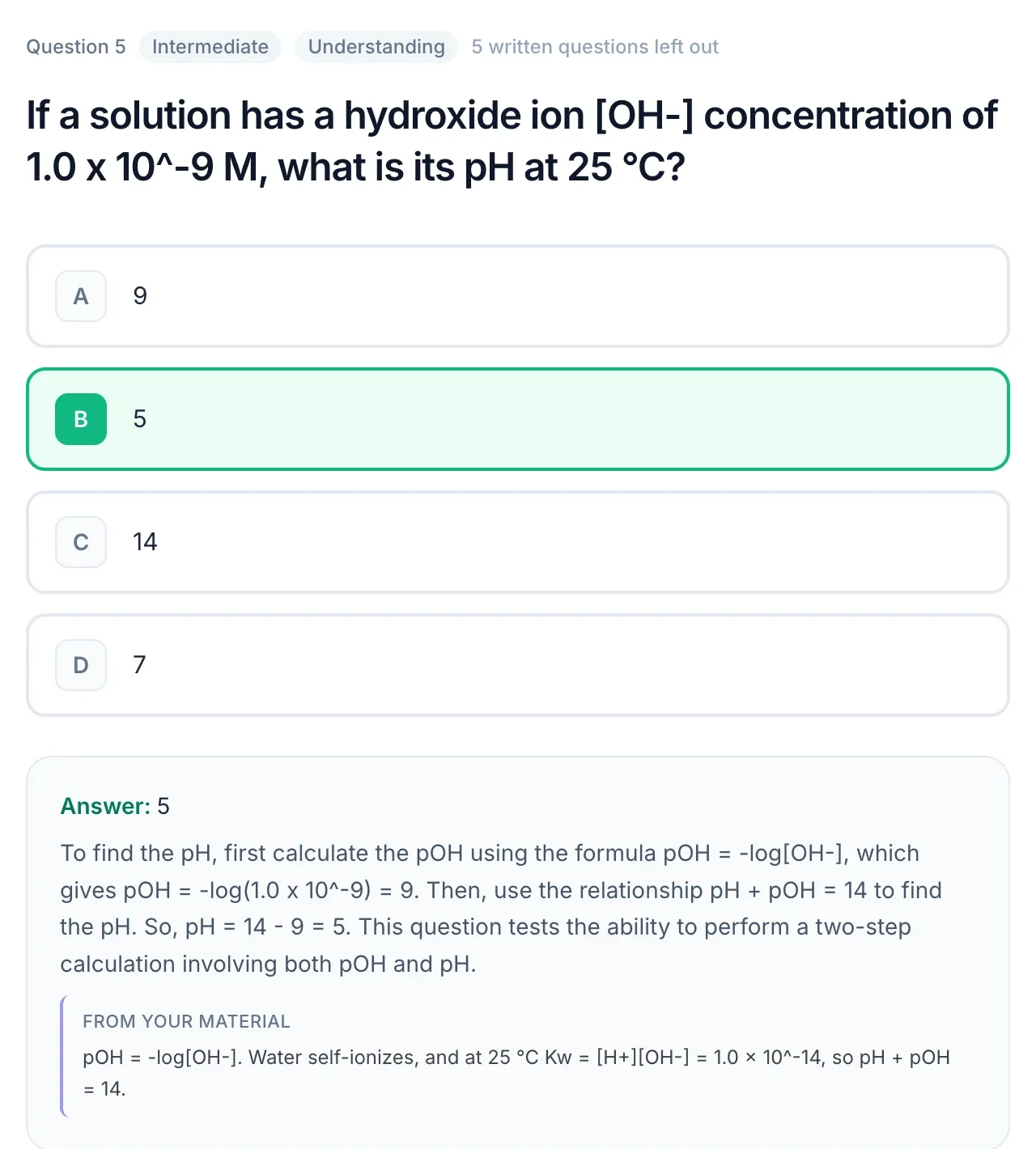
Practice test from Handwritten notes
A sample of what you get from a photo of your notes on chemistry. Yours is written from your own file.
Question 1 · Multiple choice
What is the pH of a solution with [H+] = 1 × 10⁻³ mol/L?
- 3
- -3
- 11
- 7
pH = -log[H+] = -log(10⁻³) = 3.
Question 2 · Multiple choice
Which describes a Brønsted–Lowry base?
- Proton donor
- Proton acceptor
- Electron-pair acceptor
- Hydroxide donor only
Brønsted–Lowry acids donate H+; bases accept it.
Question 3 · Short answer
Why does diluting a strong acid tenfold raise its pH by one unit?
Model answer: [H+] falls by a factor of ten, and pH is a base-10 logarithm, so pH rises by exactly 1.
What your practice tests include
- A timed, exam-style test mixing question types
- A score at the end, with every question you missed explained
- Questions pitched at the level you choose, from high school to professional
- The source passage behind every answer, so you can check it yourself
How you study them
Take it under exam conditions, then review your misses. Questions you got wrong go into your review queue so they come back before the real exam.
Best for: mock exams, measuring readiness, teachers building assessments.
How we read photos of handwritten notes
Photos go through Google Document AI OCR, which reads print and most neat handwriting. Snap a page of your notebook or a textbook page and study it a minute later.
Get the best results
- One page per photo, filling the frame.
- Include diagrams' labels; they make good questions.
Making a practice test from a review sheet
When a teacher hands out a review sheet, it is usually the clearest list you will get of what the test covers. Photograph it and generate a practice test, and the questions stay inside those topics instead of wandering across the whole subject.
If the review sheet is only a list of topic names, there is not enough on it to write questions from. In that case, photograph your notes or the textbook pages for those topics instead and use the sheet as your checklist.
Practice tests from textbook photos
Photograph the explanatory pages, worked examples and key-term boxes, not the end-of-chapter exercises. A test generated from exercise questions tends to ask about the exercises themselves, while one from the explanations tests the ideas.
Chapter summaries are especially efficient: one or two photos cover the whole chapter at the level of detail most tests use.
Teachers: turning paper handouts into a digital test
Photograph a handout or reading you already use and QuerySpark writes a new practice test from its content, which you can assign to a class with a join code or export as QTI for Canvas, Blackboard or D2L, or Moodle XML.
Be clear about what this is: it writes new questions from the material. It does not copy the questions from an existing paper test onto a screen. If you want your exact questions online, retype them or use your LMS's own question import.
Handwritten notes that are hard to read
Neat handwriting is read well; very messy handwriting can lose words, and a test built on missing words will have gaps. A quick check: look at the source passages under a few answers. If they read cleanly, the page was read well. If they are full of odd words, retake the photo closer up or type the key lines.
Things that trip people up with photos of handwritten notes
Shadows and steep angles cost accuracy. Shoot flat, in good light.
iPhone HEIC photos are not supported. Set the camera to Most Compatible, or screenshot the photo.
Very messy handwriting may lose words; type up the key definitions if that happens.
Questions about photo to practice test
Yes. Upload the picture, choose practice test, and you get a scored, mixed-format test from the text in it. The picture needs readable text; drawings on their own give little to test.
A full page of notes typically gives 10 to 20 per run; a sparse page gives fewer. For a full mock exam, scan several pages into one PDF first.
For the explanations and definitions, yes. Handwritten or complex equations can lose their layout in OCR, so check any question that depends on a formula against the original.
Yes. Export it as PDF or Word to print, or as plain text, Markdown or CSV.
Yes. Choose high school, undergraduate, graduate or professional. Higher levels ask more application and comparison questions.
Free to start with the 3-day Pro trial with no credit card. After the trial the free plan includes 1 study session and 20 questions a month. Student is $9 a month, or $7 a month billed yearly.
Yes, most neat handwriting. Print is read near perfectly; rushed handwriting may lose the odd word.
Yes. Upload each page and generate a set from them together.
Yes. Create a class, share the join code, and assign the set. You see each student's progress on every assignment.
Yes, to start. New accounts get a 3-day Pro trial with no credit card. After the trial the free plan includes 1 study session, 20 questions and 10 PDF pages a month, and you keep everything you made. You can also try the question generator on pasted text without an account, 3 times a day.
Still stuck? Email us.
Make practice tests from your photos of handwritten notes
Start with a 3-day Pro trial. No credit card, and you keep everything you make.