Notes to study guide: turn scattered notes into an organised guide
Upload your notes and QuerySpark writes study guides from what is actually in it, so you can see the whole topic on one page on exactly what your course covers. Pasted text, or .txt and .md files.
- No credit card
- Free plan after the trial
- Cancel anytime
Drop a PDF, slides or notes
or paste a YouTube link
Quick answer
How do you turn your notes into study guides?
Paste your notes (or upload .txt and .md files) and choose a study guide. QuerySpark sorts what you wrote into topics, pulls out the key terms and examples, and writes a quick review sheet, a comprehensive guide or an exam prep guide with practice questions, in about a minute. Download it as PDF or Markdown. A free account starts with a 3-day Pro trial and no card; after it, the free plan includes 1 study guide a month.
- Organises notes by topic, not by the order you wrote them
- Key terms, examples and practice questions
- Quick review, comprehensive or exam prep
- Download as PDF or Markdown
How it works
How to turn your notes into study guides
- 01
Collect the notes for one unit
Copy the notes from every lecture in the unit into one place, in any order. The guide reorganises them by topic.
- 02
Paste or upload
Paste the text, or upload .txt and .md files. Handwritten pages go through the photo of notes converter instead.
- 03
Choose a format
Comprehensive if your notes are rough and you need them explained back to you, exam prep for the final week, quick review for the night before.
- 04
Patch the gaps it shows you
Topics with thin coverage in the guide are topics with thin notes. Paste in the reading for those topics and generate again.
Example
Study guide from ECON 101 notes
A sample of what you get from your notes on economics. Yours is written from your own file.
ECON 101 notes: Price elasticity of demand
The formula
- PED = %ΔQd / %ΔP
- Sign is negative; compare magnitudes
Revenue rule
- Elastic: cut price to raise revenue
- Inelastic: raise price to raise revenue
Determinants
- Substitutes
- Necessity vs luxury
- Time horizon
Check yourself
Why is demand for petrol more elastic in the long run than the short run?
What your study guides include
- A structured outline of the main topics in your material
- Key terms, learning objectives and common misconceptions
- Worked examples where your material has them
- Practice questions at the end of each section
How you study them
Read the guide to get the shape of the topic, then jump into practice from any section. The guide and the questions come from the same analysis, so they cover the same ground.
Best for: starting a new unit, condensing a long reading, the night before an exam.
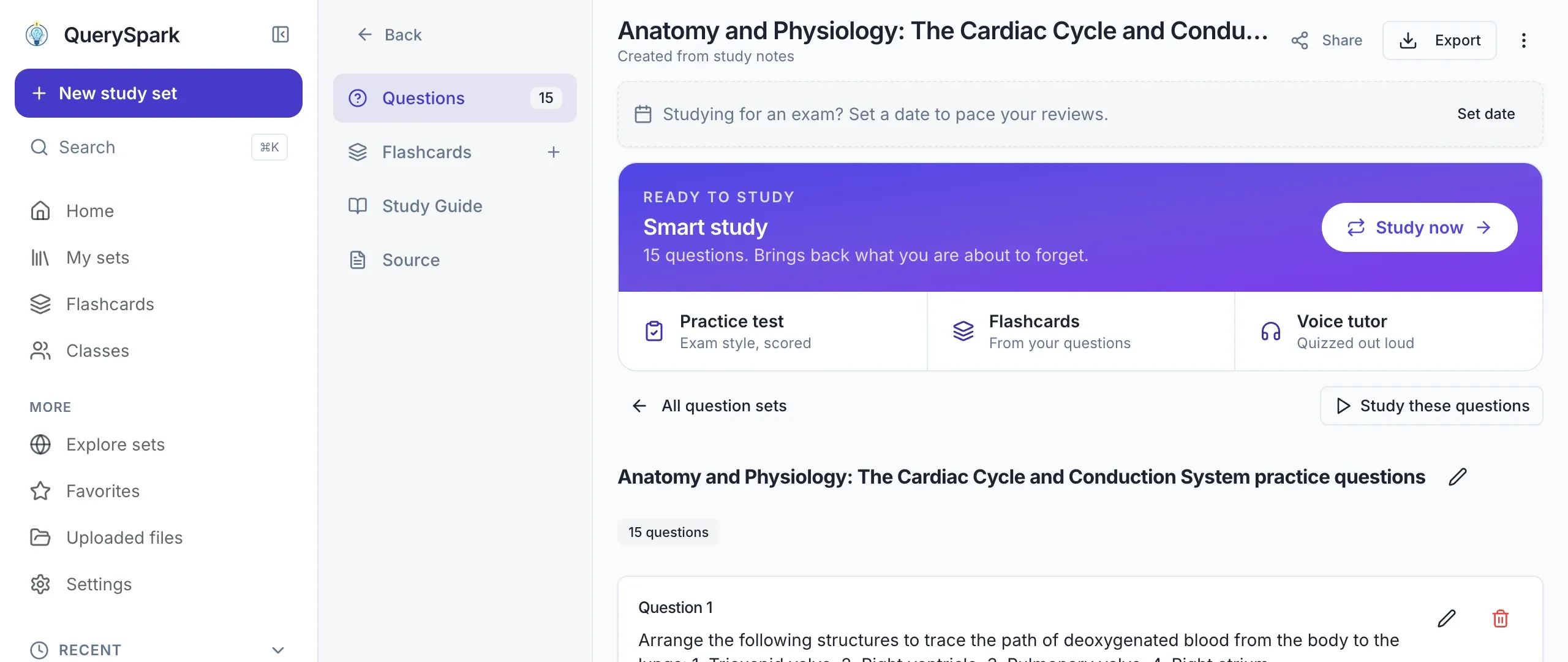
How we read notes
Paste notes straight in, any length from a paragraph to a full unit. Short notes produce a small, focused set; longer notes are split into topics first so coverage stays even.
Get the best results
- Write in full sentences where you can.
- Include the definitions and the examples your teacher used.
- Add your exam date so reviews are paced to it.
How to make a study guide from your notes
The manual method has three passes. First, regroup: notes are written in lecture order, but a study guide is organised by topic, so related points from different weeks end up together. Second, condense: each topic gets its key terms, the one or two ideas that matter most and an example. Third, test: write questions at the end of each section so you can check yourself.
QuerySpark does all three passes as a first draft. It is worth reading the result against your notes once, because the regrouping often reveals connections between lectures you had not noticed, and gaps where your notes stop short.
Can AI make a study guide for me?
Yes, but it can only organise what you give it. A guide made from notes is as complete as the notes. If you missed a lecture or stopped writing halfway through, the guide will be thin in exactly those places, and an honest tool will not cover that up with invented material.
The fix is a second source for the weak spots: the lecture slides, the textbook chapter or a recording of the lecture. Paste the missing material in with your notes, or make a separate guide from that source.
Combining notes from several lectures into one guide
Paste the notes from three to five related lectures together. Long notes are split into topics before anything is written, so coverage stays even and the last lecture does not get squeezed.
Do not put a whole semester into one guide. It will be too general to study from. One guide per unit, then a quick review sheet per unit in the last days, works better for a final.
Study guide, flashcards or a quiz: which to make from notes?
They do different jobs, and from the same notes you can make all three.
- Study guide first, when you need the shape of a unit: what the topics are and how they connect.
- Flashcards next, for the terms, formulas and dates you have to know cold, reviewed a little every day.
- A quiz or practice test last, to check you can use what you know, ideally a few days before the exam so there is time to fix what it shows you.
Things that trip people up with notes
Very short notes (a few lines) produce only a handful of questions. That is intentional: we do not invent facts that are not in your text.
Abbreviations only you understand can confuse the model. Spell out key terms once.
Questions about notes to study guide
Paste your notes into QuerySpark, choose study guide and pick a format. The guide is organised by topic with key terms and practice questions, ready in about a minute.
QuerySpark is free to start with a 3-day Pro trial and no card. After it, the free plan includes 1 study guide a month, and guides you made stay in your account.
Yes. Paste the notes from one lecture or a whole unit. For lectures where your notes are thin, add the slides to the same set.
Yes. Photograph the pages or export them from Goodnotes or Notability as images or PDF and upload them. Neat handwriting is read with OCR first.
No. It organises and explains what your notes contain. If a topic is missing from your notes, add a source that covers it.
Yes. Download it as PDF to print, or as Markdown to paste into Notion, Obsidian or another notes app.
About 80 characters is the minimum, but a page or more of notes gives a proper set. We size the set to your material instead of padding it.
Yes. Copy and paste works from any notes app; formatting is ignored, the text is kept.
Choose a quick review sheet, a comprehensive guide or an exam-prep guide. Length follows your material: a ten-page chapter gets a page or two, not padding.
Yes, to start. New accounts get a 3-day Pro trial with no credit card. After the trial the free plan includes 1 study session, 20 questions and 10 PDF pages a month, and you keep everything you made. You can also try the question generator on pasted text without an account, 3 times a day.
Still stuck? Email us.
Make study guides from your notes
Start with a 3-day Pro trial. No credit card, and you keep everything you make.