Overview
Active recall is the most effective study technique according to cognitive science. Learn what it is, why it works, and how to implement it with practical examples.
If you could only use one study technique for the rest of your academic career, it should be active recall. Decades of cognitive science research consistently show that testing yourself is the single most effective way to learn and retain information.
Yet most students still default to passive methods: re-reading notes, highlighting textbooks, watching lecture recordings. These feel productive but produce minimal long-term retention.
What Is Active Recall?
Active recall is the practice of actively stimulating your memory during learning. Instead of passively reviewing information, you close your notes and try to retrieve what you've learned from memory.
Simple examples:
- Closing your textbook and writing down everything you remember about a topic
- Using flashcards to test yourself
- Answering practice questions without looking at your notes
- Teaching the material to someone else from memory
The Research Behind Active Recall
The Testing Effect (Roediger & Karpicke, 2006)
In a landmark study, students who used retrieval practice remembered 80% of material after one week, compared to 36% for those who simply re-read the material. That's more than double the retention.
Retrieval Practice Produces More Learning (Karpicke & Blunt, 2011)
Published in Science, this study found that retrieval practice produced 50% more long-term retention than elaborate concept mapping, a technique many educators consider highly effective.
The Pretesting Effect (Richland et al., 2009)
Even attempting to answer questions about material you haven't studied yet improves learning. Failed retrieval attempts prime the brain to encode the correct answer more deeply when you encounter it.
Why Active Recall Works: The Cognitive Science
Active recall works because of how memory consolidation functions in the brain:
- Strengthens retrieval pathways: Every time you successfully recall information, the neural pathway to that memory becomes stronger and faster.
- Identifies knowledge gaps: When you can't recall something, you immediately know what to study next. Passive review masks these gaps.
- Creates desirable difficulties: The effort of retrieval (even when it feels hard) signals to your brain that this information is important and worth retaining.
- Enhances transfer: Information learned through active recall is more easily applied to new situations, not just recognized in familiar contexts.
How to Practice Active Recall (5 Methods)
1. The Blank Page Method
After studying a chapter, take a blank piece of paper and write down everything you can remember. Then compare against your notes. This is the simplest and most powerful form of active recall.
2. Flashcard Testing
Create question-answer flashcards and test yourself regularly. For maximum efficiency, combine with spaced repetition to review cards at optimal intervals.
Pro tip: Use QuerySpark to automatically generate flashcards from your study materials, each card is mapped to Bloom's Taxonomy cognitive levels.
3. Practice Questions
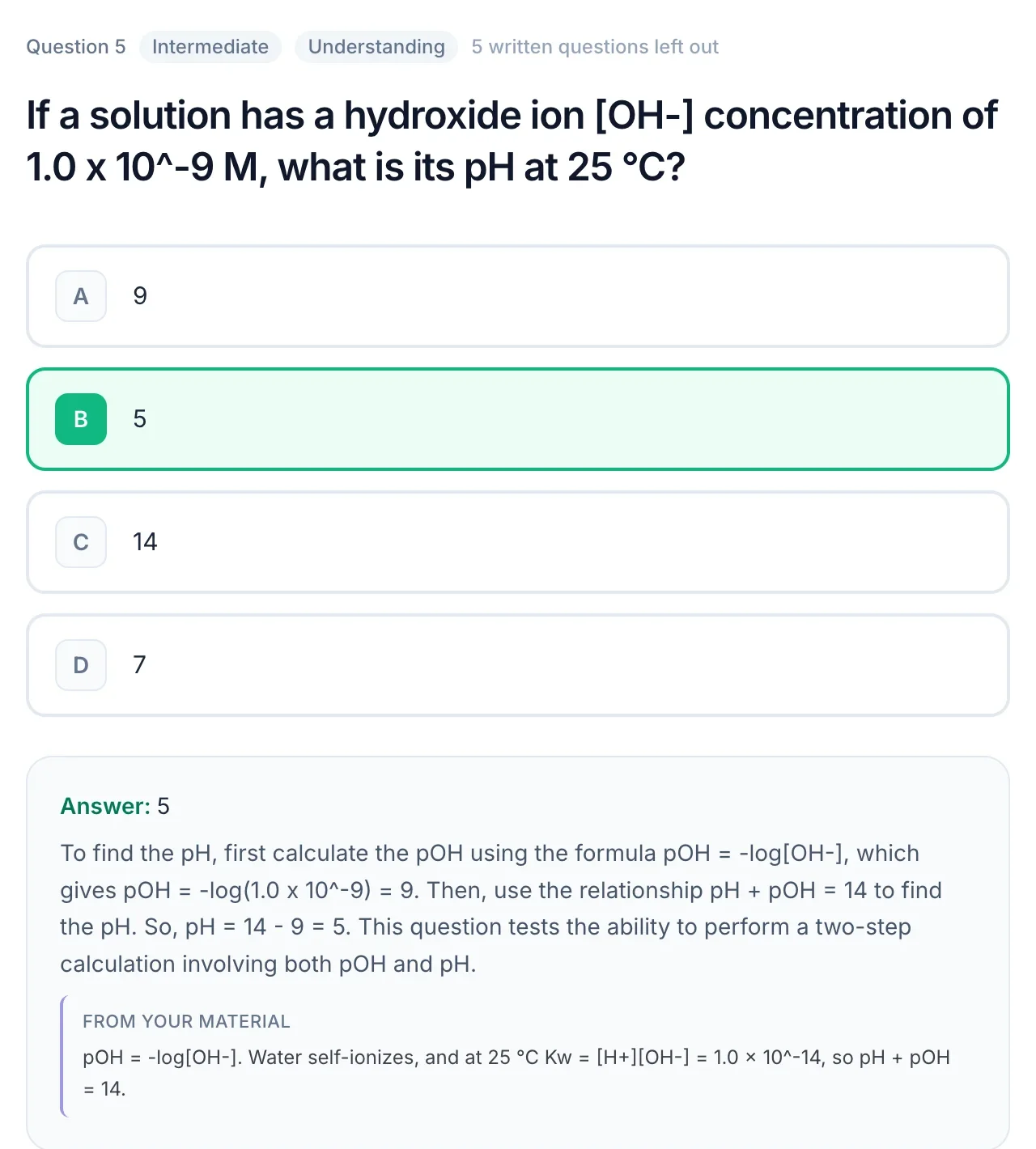
Answer practice questions without looking at your notes first. This is especially effective for exam preparation because it simulates test conditions. QuerySpark can generate practice questions from any PDF, URL, or text content in seconds.
4. The Feynman Technique
Try to explain a concept in simple language as if teaching it to a child. Where you stumble, you've found a knowledge gap. Go back and study that specific area, then try explaining again.
5. Cornell Note-Taking
Divide your note page into sections: notes on the right, questions on the left, summary at the bottom. Use the questions column to test yourself during review sessions.
Active Recall vs. Other Study Methods
| Method | Retention After 1 Week | Effort Level | Evidence Quality |
|---|---|---|---|
| Active Recall | 80% | High | Strong (100+ studies) |
| Re-reading | 36% | Low | Strong (ineffective) |
| Highlighting | 35% | Low | Strong (ineffective) |
| Concept Mapping | 45% | Medium | Moderate |
| Summarization | 50% | Medium | Moderate |
Combining Active Recall with Spaced Repetition
Active recall tells you how to study. Spaced repetition tells you when to study. Together, they form the most powerful evidence-based study system available.
The SM-2 algorithm (used by QuerySpark) automatically schedules your review sessions based on how well you recalled each item. Items you struggle with appear more frequently; items you know well are spaced further apart.
Start Using Active Recall Today
You don't need any special tools to start, just close your notes and try to recall what you've studied. But if you want to supercharge the process, try QuerySpark free to automatically generate practice questions and flashcards from your study materials, with built-in spaced repetition scheduling.