Overview
Science says your go-to study method is one of the least effective. Here are 5 evidence-based alternatives that actually work.
Be honest: when you "study," what do you actually do? If you're like 84% of students (Karpicke et al., 2009), your primary strategy is rereading your notes or textbook.
Here's the uncomfortable truth: decades of cognitive science research show that rereading is one of the least effective study strategies you can use.
What the Research Says
The Illusion of Competence
When you reread material, it feels increasingly familiar. Your brain interprets this familiarity as learning. But recognition is not the same as recall, and exams test recall.
Kornell & Bjork (2008) found that students who reread material were significantly overconfident in their knowledge. They rated themselves as well-prepared, then performed poorly on tests.
Diminishing Returns
Callender & McDaniel (2009) showed that rereading a textbook chapter produced no significant improvement over reading it once, especially for higher-order comprehension questions.
Dunlosky's Meta-Analysis (2013)
In a comprehensive review published in Psychological Science in the Public Interest, Dunlosky and colleagues rated 10 common study strategies. Their verdict on rereading: "Low utility."
Why Rereading Fails
- It's passive: your brain is receiving information, not actively processing it
- No retrieval practice: you never test whether you can actually recall the information without looking
- Creates false confidence: familiarity with text ≠ ability to answer questions about it
- Time-inefficient: the same time spent on active methods produces 2-3x better results
5 Evidence-Based Alternatives
1. Active Recall (Highest Impact)
Close your notes. Try to write down everything you remember about a topic. Then check what you missed. This single technique can double your retention compared to rereading.
👉 Read our complete guide to active recall
2. Practice Testing
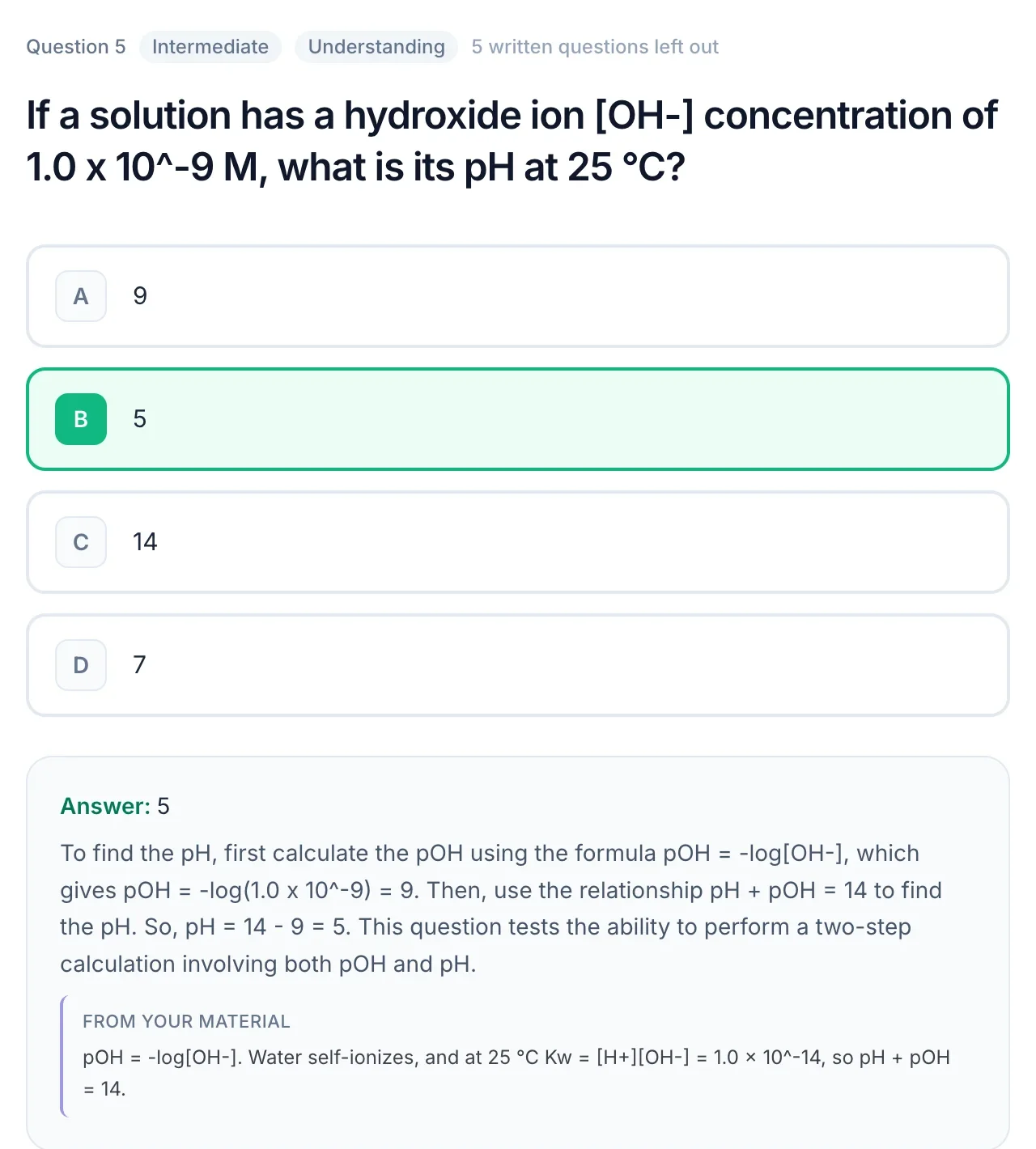
Test yourself with practice questions, even before you feel "ready." The pretesting effect shows that attempting questions before studying actually improves subsequent learning.
Shortcut: Use QuerySpark to auto-generate practice questions from your notes in seconds. Each question is mapped to Bloom's Taxonomy, so you practice at every cognitive level.
3. Spaced Repetition
Instead of reviewing everything in one long session, spread your reviews across multiple days. Use the SM-2 algorithm to schedule reviews at the optimal moment, just before you'd forget.
👉 Learn how spaced repetition works
4. Elaborative Interrogation
For every fact you study, ask "Why?" and "How?" Answering these questions forces deeper processing than simply reading the fact.
Example: Instead of reading "Mitochondria are the powerhouse of the cell," ask: "Why are mitochondria compared to a powerhouse? What specific process makes this analogy appropriate?"
5. Interleaving
Instead of studying one topic exhaustively before moving to the next (blocking), mix different topics within a single study session. Research shows interleaving improves your ability to discriminate between concepts and apply knowledge to novel problems.
The Evidence Comparison
| Strategy | Dunlosky Rating | Retention Improvement | Effort |
|---|---|---|---|
| Practice Testing | High utility | +50-100% | Medium |
| Spaced Practice | High utility | +50-150% | Low (with tools) |
| Elaborative Interrogation | Moderate utility | +20-40% | Medium |
| Interleaving | Moderate utility | +10-30% | Medium |
| Summarization | Low utility | +5-15% | High |
| Rereading | Low utility | ~0% | Low |
| Highlighting | Low utility | ~0% | Low |
Make the Switch Today
You don't need to overhaul your entire study system overnight. Start with one change: after your next study session, close your notes and write down everything you remember. That single act of retrieval will teach your brain more than rereading the material three more times.
Want to automate the process? Upload your notes to QuerySpark and get AI-generated practice questions in seconds, with built-in spaced repetition to schedule your reviews at the perfect time.