Overview
A comprehensive MCAT study guide using AI tools and evidence-based strategies. Covers study schedules, section strategies, and how to generate unlimited practice questions.
The MCAT is one of the most challenging standardized exams in existence. With 230 questions across four sections, testing everything from biochemistry to psychology to critical reasoning, preparation requires a strategic approach.
This guide combines evidence-based study techniques with AI-powered tools to help you study more efficiently and score higher.
MCAT Overview
| Section | Questions | Time | Score Range |
|---|---|---|---|
| Chem/Phys (CP) | 59 | 95 min | 118-132 |
| CARS | 53 | 90 min | 118-132 |
| Bio/Biochem (BB) | 59 | 95 min | 118-132 |
| Psych/Soc (PS) | 59 | 95 min | 118-132 |
Total: 230 questions | 6 hours 15 minutes | Score range: 472-528
The 3-Phase Study Plan
Phase 1: Content Review (Months 1-2)
Build your knowledge base across all four sections. Use textbooks (Kaplan, Princeton Review) for initial learning, then generate practice questions to test retention.
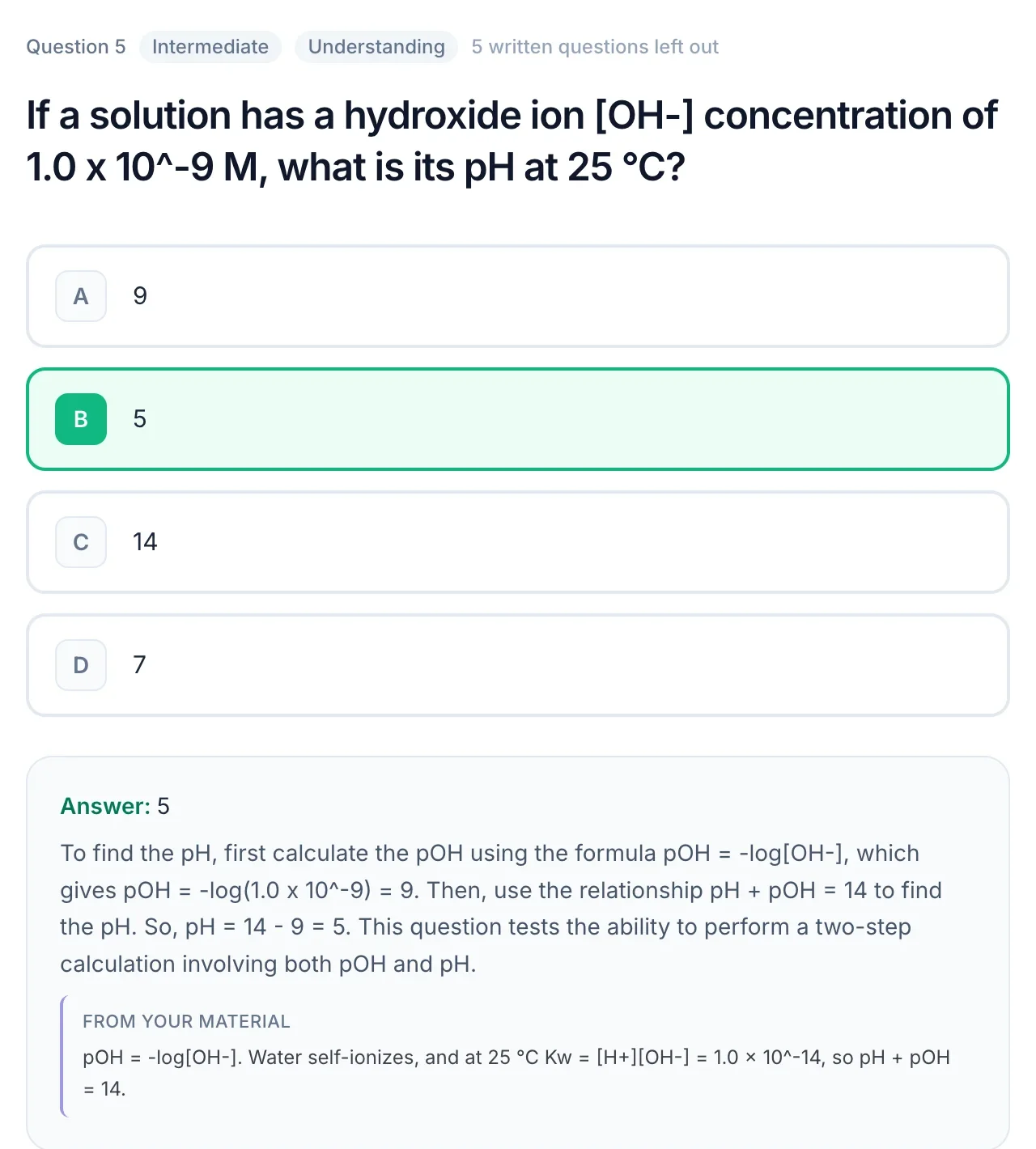
AI Strategy: After studying each chapter, upload your notes to QuerySpark to generate questions at every Bloom's Taxonomy level. The MCAT doesn't just test recall, it heavily emphasizes application and analysis.
Phase 2: Practice & Application (Months 2-3)
Shift from content review to active practice. Do practice passages, generate questions from your weak areas, and use spaced repetition for high-yield facts.
AI Strategy: Upload MCAT-style passages to QuerySpark and generate passage-based questions. Focus on Analyze and Evaluate level questions, these mirror actual MCAT difficulty.
Phase 3: Full-Length Practice (Month 4)
Take full-length practice exams under real conditions. Review every wrong answer thoroughly.
AI Strategy: After each practice exam, input your missed topics into QuerySpark to generate targeted practice questions for your specific weak areas.
Section-by-Section Strategy
Chemical and Physical Foundations (CP)
High-yield topics: amino acid chemistry, enzyme kinetics, electrochemistry, optics, fluids. Focus on understanding when and how to apply equations, not just memorizing them.
Critical Analysis and Reasoning (CARS)
The most unique MCAT section. No science knowledge needed, it tests reading comprehension and critical reasoning. Practice with dense humanities and social science passages daily.
Biological and Biochemical Foundations (BB)
The highest-yield section for study efficiency. Focus heavily on metabolism, molecular biology, organ systems, and experimental analysis. Use active recall for amino acid structures, metabolic pathways, and signaling cascades.
Psychological, Social, and Biological Foundations (PS)
Often the highest-scoring section. Learn the 300+ key terms from the AAMC outline. Combine with sociology theories and research methodology concepts.
Using AI to Generate Unlimited Practice Questions
Traditional MCAT prep courses give you a fixed bank of practice questions. Once you've seen them all, you can't generate new ones. AI changes this entirely:
- Upload your lecture notes, textbook chapters, or study guides to QuerySpark
- Generate questions at specific Bloom's Taxonomy levels (focus on Apply and Analyze for MCAT)
- Use spaced repetition to review high-yield facts efficiently
- Generate new questions from your weak areas after each practice exam
Study Schedule Template
| Time | Activity | Duration |
|---|---|---|
| Morning | Content review (new material) | 2-3 hours |
| Midday | Practice questions (AI-generated) | 1-2 hours |
| Afternoon | CARS practice passages | 1 hour |
| Evening | Spaced repetition review | 30-45 min |
High-Yield Study Tips
- Use spaced repetition for facts: amino acids, metabolic pathways, psych terms. Learn more about spaced repetition.
- Practice active recall daily: close your notes and write what you remember before reviewing. Read our active recall guide.
- Study at MCAT cognitive levels: the MCAT tests at Bloom's Apply/Analyze level. Use Bloom's Taxonomy to match your studying to test difficulty.
- Review AAMC practice material: official AAMC materials are the gold standard for question style and difficulty calibration.
- Take care of yourself: sleep, exercise, and breaks are not optional. Cognitive performance drops significantly with poor sleep.
Start Your MCAT Prep
Try QuerySpark free to generate unlimited, Bloom's-mapped practice questions from your MCAT study materials.