Overview
Most students only study at the lowest cognitive level. Learn how Bloom's Taxonomy can transform your study strategy and help you ace higher-order exam questions.
Here's a scenario every student has experienced: you memorize all the definitions, feel prepared for the exam, then encounter a question that asks you to analyze or evaluate something, and you freeze.
The problem? You studied at level 1 of Bloom's Taxonomy. The exam tested you at level 4.
What Is Bloom's Taxonomy?
Bloom's Taxonomy is a framework created by educational psychologist Benjamin Bloom in 1956 (revised in 2001) that classifies thinking into six hierarchical levels:
- Remember: Recall facts and basic concepts (define, list, memorize)
- Understand: Explain ideas or concepts (describe, discuss, explain)
- Apply: Use information in new situations (solve, demonstrate, use)
- Analyze: Draw connections among ideas (compare, contrast, examine)
- Evaluate: Justify a stance or decision (argue, defend, judge)
- Create: Produce new or original work (design, construct, develop)
Why This Matters for Studying
Most students only study at the Remember level, flashcards with definitions, re-reading highlighted text. But university exams typically test at the Apply, Analyze, and Evaluate levels.
If you only practice recall, you'll struggle with questions that ask you to:
- "Compare and contrast the effectiveness of two economic policies" (Analyze)
- "Evaluate whether the researcher's methodology was appropriate" (Evaluate)
- "Apply the principles of thermodynamics to this novel scenario" (Apply)
How to Study at Every Level
Level 1: Remember
This is your foundation. Use flashcards and repetition for key terms, dates, formulas, and definitions.
Study action: Create basic flashcards with term → definition pairs.
Level 2: Understand
Go beyond memorization. Can you explain the concept in your own words? Can you give an example?
Study action: After recalling a definition, write a one-sentence explanation in your own words. If you can't, you don't truly understand it.
Level 3: Apply
Practice using knowledge in new contexts. Solve problems you haven't seen before.
Study action: Work through practice problems. Don't just re-do examples from class, find new problems that require the same concepts.
Level 4: Analyze
Break complex information into parts. Compare different approaches. Identify patterns.
Study action: Create comparison tables. Ask yourself "How is X different from Y?" and "What would happen if Z changed?"
Level 5: Evaluate
Make judgments based on criteria. Defend a position with evidence.
Study action: Practice writing arguments. "Which theory better explains this phenomenon, and why?"
Level 6: Create
Synthesize knowledge into something new, a hypothesis, a solution, a design.
Study action: Design your own exam questions. Create analogies. Propose solutions to open-ended problems.
How QuerySpark Uses Bloom's Taxonomy
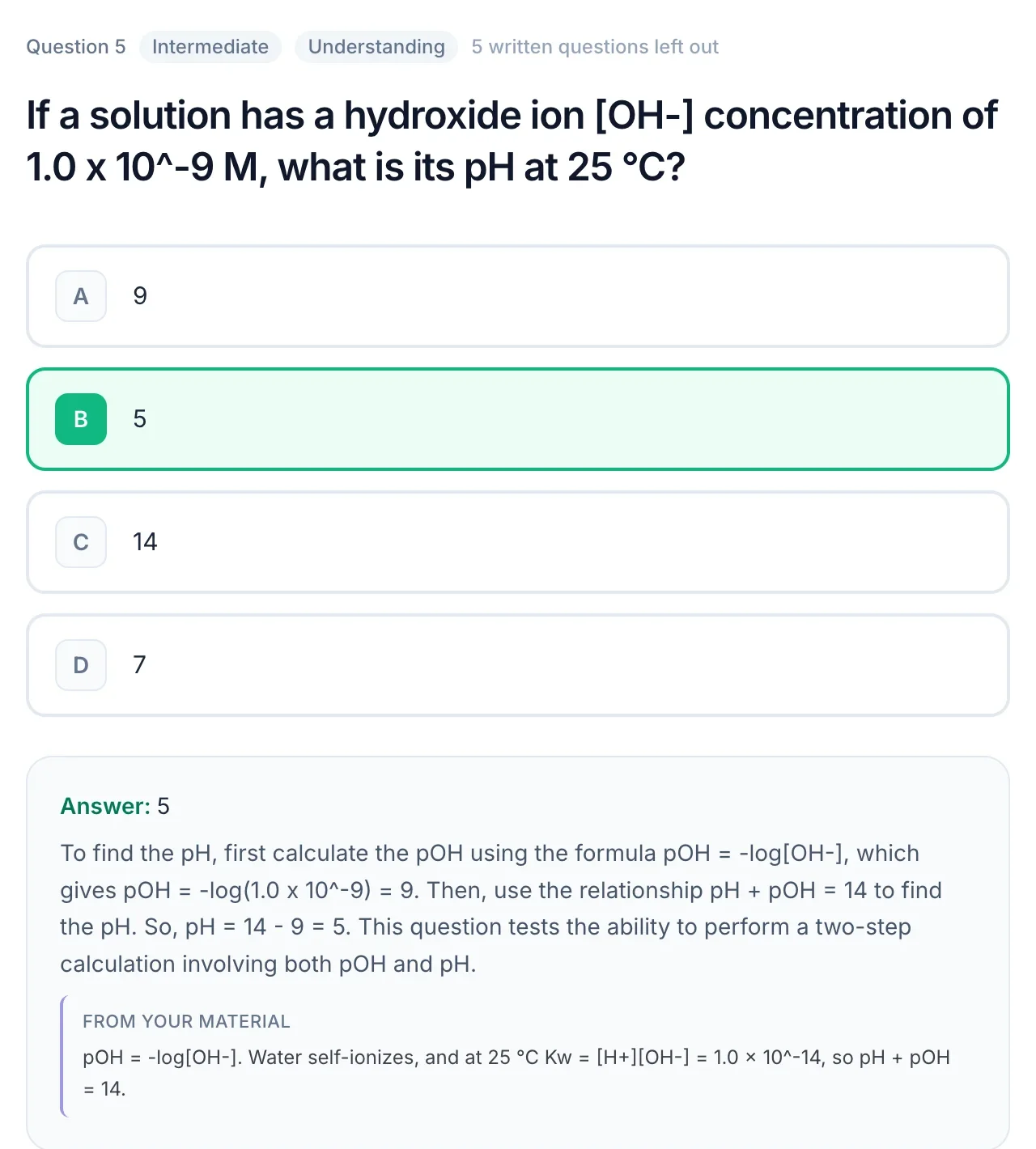
QuerySpark is the only AI study tool that maps every generated question to a Bloom's Taxonomy level. When you upload a PDF and generate questions, each question is tagged:
- 🟢 Remember. "Define the term osmosis"
- 🔵 Understand. "Explain why osmosis occurs in hypertonic solutions"
- 🟡 Apply. "Predict what would happen to a red blood cell in a salt water solution"
- 🟠 Analyze. "Compare osmosis and diffusion in terms of energy requirements"
- 🔴 Evaluate. "Evaluate whether osmosis or active transport is more critical for kidney function"
This means you can see exactly what cognitive level you're studying at and intentionally practice higher-order questions before your exam.
The Bloom's Study Strategy
- Week 1: Focus on Remember and Understand, build your knowledge base
- Week 2: Move to Apply, solve problems using your knowledge
- Week 3: Practice Analyze and Evaluate, compare, contrast, and make judgments
- Exam week: Mix all levels with emphasis on whatever your professor tends to test
Start Studying Smarter
Stop guessing what cognitive level your exam will test. Upload your study material to QuerySpark and get questions mapped to every level of Bloom's Taxonomy, so you're prepared for anything the exam throws at you.