Overview
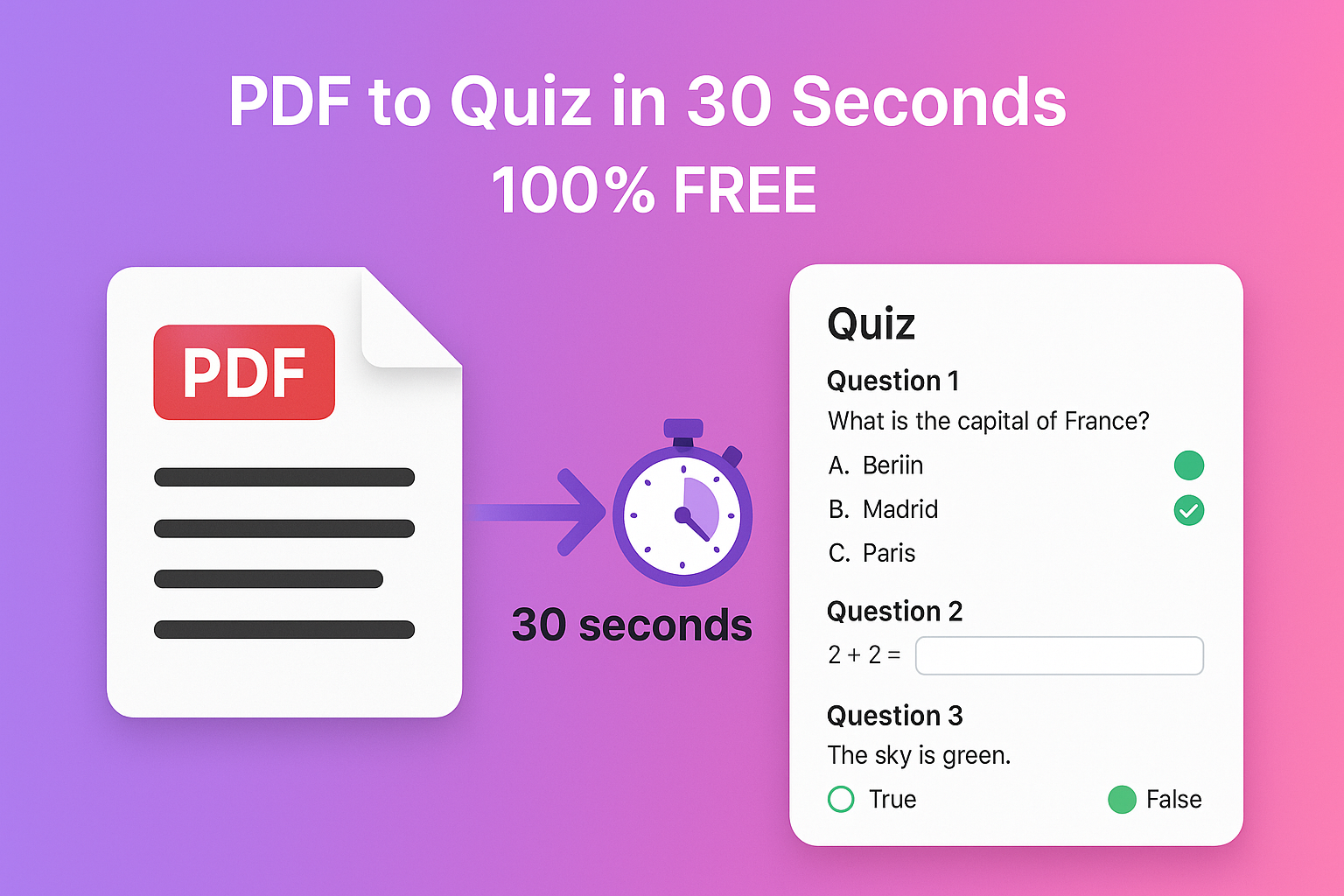
Learn 4 proven methods to generate practice questions from PDF documents. Compare manual, AI, and automated approaches with step-by-step tutorials. Free tools included.
Introduction: The PDF Practice Question Problem
You have a 47-page PDF lecture note, textbook chapter, or research paper. Your exam is in two weeks. You know you need practice questions to actually retain this information, but there's a problem:
Creating quality practice questions takes forever.
Last semester, I spent 6 hours manually writing questions for a single biochemistry chapter. By the time I finished, I was too exhausted to actually study. The questions I created were mediocre at best—mostly simple recall items like "What is the definition of X?"
There had to be a better way.
Over the past year, I've tested every method I could find for generating practice questions from PDFs. I've tried manual techniques, AI prompts, dedicated software, and everything in between. I've created questions from textbooks, research papers, lecture slides, and study guides.
The result? Four distinct methods, each with clear advantages and specific use cases.
In this guide, I'll walk you through all four methods with step-by-step instructions, real examples, time comparisons, and honest pros and cons. By the end, you'll know exactly which method to use for your specific situation.
Let's dive in.
Why Practice Questions Matter: The Science
Before we get into the methods, let's address why you should even bother creating practice questions.
The research is overwhelming: practice questions are one of the most effective study techniques.
The Testing Effect
Cognitive scientists have documented what they call "the testing effect"—the finding that practicing retrieval (answering questions) produces better long-term retention than simply re-reading material.
A 2011 study published in Science by Karpicke and Blunt found that students who practiced retrieval through questions scored 50% higher on final tests compared to students who used concept mapping or repeated studying.
Active Recall vs. Passive Review
When you create and answer practice questions, you engage in active recall—your brain has to work to retrieve information. This effort strengthens neural pathways and makes future retrieval easier.
Compare this to passive review methods:
- Highlighting: Recognition, not recall
- Re-reading: Superficial processing
- Summarizing: Better, but still passive
Practice questions force your brain to do the work that creates learning.
The Generation Effect
There's another benefit: the generation effect. When you generate your own questions (rather than just answering provided ones), you process the material more deeply. You have to:
- Identify what's important
- Formulate it as a question
- Determine what constitutes a good answer
- Create the question clearly
This deep processing enhances learning even before you answer the questions.
Bottom line: If you're serious about retaining information from PDFs, practice questions aren't optional—they're essential.
Now, let's look at how to create them efficiently.
Method 1: Manual Question Writing (The Traditional Approach)
Overview
This is the classic method: read your PDF, identify key concepts, and manually write questions in a document or notebook.
Step-by-Step Process
Step 1: Read and Highlight (15-20 minutes per 10 pages)
- Read through your PDF section by section
- Highlight or note key concepts, definitions, processes, and important facts
- Mark areas that seem test-worthy or conceptually important
Step 2: Categorize Your Highlights (5 minutes)
- Group highlights by type:
- Definitions (What is X?)
- Processes (How does X work?)
- Comparisons (How is X different from Y?)
- Applications (When would you use X?)
- Analysis (Why does X matter?)
Step 3: Write Questions (20-30 minutes per 10 pages)
- For each highlight, write 1-3 questions
- Use the question stems below as templates
- Write answers separately (test yourself later)
- Aim for a mix of difficulty levels
Step 4: Review and Refine (10 minutes)
- Read through your questions
- Remove duplicates or overly similar questions
- Ensure questions are clear and answerable
- Check that answers can be found in the PDF
Useful Question Stems
Definition Questions:
- What is [concept]?
- How is [term] defined?
- What does [term] mean in this context?
Explanation Questions:
- How does [process] work?
- What are the steps in [procedure]?
- Why does [phenomenon] occur?
Comparison Questions:
- What's the difference between [X] and [Y]?
- How are [X] and [Y] similar?
- Compare and contrast [X] and [Y].
Application Questions:
- When would you use [concept]?
- How could [principle] apply to [scenario]?
- What's an example of [concept] in real life?
Analysis Questions:
- Why is [concept] important?
- What are the limitations of [theory]?
- What assumptions underlie [argument]?
Example: Manual Question Creation
Let's say you're reading a PDF about photosynthesis. Here's how manual question writing would look:
PDF Text:
"Photosynthesis is the process by which plants convert light energy into chemical energy. It occurs in two stages: the light-dependent reactions and the Calvin cycle. The light-dependent reactions take place in the thylakoid membranes and produce ATP and NADPH."
Your Manual Questions:
- What is photosynthesis?
- What are the two main stages of photosynthesis?
- Where do the light-dependent reactions occur?
- What products do the light-dependent reactions produce?
- Why is photosynthesis important for life on Earth?
Pros of Manual Question Writing
✅ Complete control over question quality and difficulty
✅ Deep processing as you create questions (enhances learning)
✅ Custom focus on exactly what you need
✅ No tools required beyond your brain and a document
✅ Best for developing question-writing skills
✅ Free (just time investment)
Cons of Manual Question Writing
❌ Extremely time-consuming (2-3 hours per chapter)
❌ Mentally exhausting (too tired to study after creating questions)
❌ Quality varies with your energy level and expertise
❌ Easy to miss important concepts when doing it manually
❌ Repetitive and tedious for long documents
❌ Skill-dependent (beginners create poor questions)
Best For:
- Short documents (under 10 pages)
- When you want to develop question-writing skills
- Material you already understand well
- Situations where you need very specific question types
- When you have plenty of time before your deadline
Time Investment:
30-50 minutes per 10 pages (including reading)
Verdict: Manual question writing is thorough but impractical for most students with multiple subjects and limited time.
Method 2: The Cornell Note Method Adaptation
Overview
The Cornell Note Method, developed at Cornell University, involves dividing your page into sections: notes, cues, and summary. We can adapt this for question generation from PDFs.
Step-by-Step Process
Step 1: Set Up Your Template (2 minutes)
Create a document with two columns:
- Left column (30% width): Questions
- Right column (70% width): Notes/Answers
Step 2: Read and Take Notes (20 minutes per 10 pages)
- Read your PDF section by section
- In the right column, take notes on key points
- Use bullet points and keep it concise
- Focus on main ideas, not every detail
Step 3: Generate Questions from Notes (15 minutes per 10 pages)
- Go back to your notes
- For each note/bullet point, write a question in the left column
- The question should be answerable by the note in the right column
- Cover the right column to test yourself later
Step 4: Create Summary Questions (5 minutes)
- At the end of each section, write 2-3 synthesis questions
- These should connect ideas across the section
Example: Cornell Method for Question Generation
PDF Section About Cell Structure:
| Questions (Left Column) | Notes/Answers (Right Column) |
|---|---|
| What is the function of the cell membrane? | Cell membrane: controls what enters/exits cell, provides protection, selective permeability |
| What organelles are involved in protein synthesis? | Ribosomes (synthesis), Rough ER (modification), Golgi (packaging and distribution) |
| How is the mitochondria described? | "Powerhouse of cell" - generates ATP through cellular respiration |
| What distinguishes plant cells from animal cells? | Plant cells have: cell wall, chloroplasts, large central vacuole |
Pros of Cornell Method
✅ More structured than pure manual writing
✅ Note-taking and question generation combined (efficient)
✅ Forces concise formulation (better questions)
✅ Built-in study system (cover right column, answer left)
✅ Visual organization helps with retention
✅ Good for lectures and textbooks
Cons of Cornell Method
❌ Still time-intensive (35-40 minutes per 10 pages)
❌ Requires discipline to follow the structure
❌ Can miss deeper conceptual questions (tends toward factual recall)
❌ Manual formatting can be tedious
❌ Not ideal for non-linear PDFs (research papers, articles)
Best For:
- Textbooks with clear structure
- Lecture slides converted to PDF
- When you want to combine note-taking and question creation
- Students who like structured study systems
- Medium-length documents (10-30 pages)
Time Investment:
35-40 minutes per 10 pages
Verdict: Better than pure manual writing, but still quite time-consuming. Great if you're already using Cornell Notes.
Method 3: ChatGPT/AI Prompts (The DIY AI Approach)
Overview
Use ChatGPT, Claude, or other AI language models to generate questions from your PDF text. This requires copying text from your PDF and using strategic prompts.
Step-by-Step Process
Step 1: Extract Text from PDF (5-10 minutes)
- Use a PDF reader to copy text
- Or use PDF to text converter (many free options)
- Save text in a document for easy copying
- Note: This can be messy with tables, images, or complex formatting
Step 2: Craft Your AI Prompt (2 minutes)
Here's an effective prompt template:
I'm studying [SUBJECT/TOPIC]. Please generate 15 practice questions
from the following text. Include a mix of:
- 5 definition/recall questions
- 5 explanation/application questions
- 5 analysis/critical thinking questions

Make questions specific and answerable from the text. Format as
numbered list with answers provided separately.

Text:
[PASTE YOUR PDF TEXT HERE]
Step 3: Generate Questions (2 minutes)
- Paste your prompt with the PDF text into ChatGPT
- Wait for generation (usually 30-60 seconds)
- Review the questions
Step 4: Review and Edit (10-15 minutes)
- Check for accuracy (AI sometimes hallucinates)
- Remove duplicate or overly similar questions
- Adjust difficulty if needed
- Verify answers against the original PDF
- Add any missing important concepts
Step 5: Repeat for Remaining Sections
- Most AI tools have input limits (around 3000-4000 words)
- You'll need to process your PDF in chunks
- Combine all questions in one document
Advanced Prompt Examples
For Higher-Level Thinking:
Generate 10 questions that require deep understanding and application.
Avoid simple recall. Focus on "why" and "how" questions, comparisons,
and real-world applications.
For Specific Question Types:
Create 5 multiple-choice questions with 4 options each and 5
short-answer questions that require explanation. Include answer key.
For Exam Preparation:
Generate 20 exam-style questions similar to [EXAM TYPE] covering
the key concepts. Include a mix of easy (30%), medium (50%), and
difficult (20%) questions.
Example: Using ChatGPT for Question Generation
Input to ChatGPT:
"Generate 10 practice questions from this text about the American Revolution:
[Text about causes of American Revolution, key events, major figures...]"
Output from ChatGPT:
- What were the main causes of the American Revolution?
- How did the Stamp Act contribute to colonial unrest?
- Who were the key leaders of the American Revolution?
- Compare the perspectives of the Patriots and Loyalists.
- Why was the Battle of Saratoga significant? [...and 5 more questions]
Pros of ChatGPT Method
✅ Much faster than manual (15-20 minutes per 10 pages)
✅ Generates diverse question types automatically
✅ Free (ChatGPT free tier works fine)
✅ Can specify difficulty level and question types
✅ Good for generating ideas you can refine
✅ Available 24/7
Cons of ChatGPT Method
❌ Text extraction is messy (formatting issues, tables lost)
❌ Input length limits (must process in chunks)
❌ Accuracy issues (AI sometimes makes mistakes)
❌ Requires careful review (can't trust blindly)
❌ No PDF context (loses images, diagrams, formatting)
❌ Quality inconsistent across different prompts
❌ Tedious for long documents (lots of copying/pasting)
Best For:
- Text-heavy PDFs without complex formatting
- When you have time to review and edit
- Budget-conscious students
- Generating question ideas to refine manually
- Shorter documents (under 20 pages)
Time Investment:
15-25 minutes per 10 pages (including extraction, generation, and review)
Verdict: Significantly faster than manual methods, but the text extraction hassle and need for careful review limit its effectiveness for long or complex PDFs.
Method 4: Dedicated AI Question Generator (QuerySpark & Similar Tools)
Overview
Purpose-built tools like QuerySpark are specifically designed to generate questions from PDFs. They handle the entire process—reading the PDF, understanding context, and creating quality questions—automatically.
Step-by-Step Process (Using QuerySpark)
Step 1: Upload Your PDF (30 seconds)
- Drag and drop your PDF or click to upload
- Tool automatically processes the document
- Preserves formatting, images, and structure
- Works with any PDF type (textbook, research paper, slides, etc.)
Step 2: Choose Question Settings (1 minute)
- Select number of questions (10, 20, 50, etc.)
- Choose question types:
- Multiple choice
- Short answer
- True/false
- Application questions
- Analysis questions
- Set difficulty level (easy, medium, hard, or mix)
- Specify focus areas if needed
Step 3: Generate Questions (30-60 seconds)
- AI processes your PDF
- Identifies key concepts automatically
- Generates questions with optimal distribution
- Creates answer key
Step 4: Review and Customize (5 minutes)
- Browse generated questions
- Edit any questions you want to modify
- Delete questions that don't fit your needs
- Add custom questions if desired
- Regenerate specific questions if needed
Step 5: Export and Study (30 seconds)
- Download as PDF, Word doc, or Anki flashcards
- Print for physical study
- Or study directly in the platform
- Schedule review sessions
What Makes Dedicated Tools Different
Context Awareness: Unlike ChatGPT (which only sees text), dedicated tools understand:
- Document structure (chapters, sections, subsections)
- Relative importance of different sections
- Visual elements (diagrams, charts, images)
- Formatting cues (bold, italics, headers)
Quality Control: Purpose-built tools include:
- Question quality scoring
- Automatic removal of duplicate concepts
- Balance across question types
- Difficulty level calibration
- Bloom's taxonomy alignment
PDF-Specific Optimization: These tools are built specifically for PDFs:
- No text extraction needed
- Handles complex formatting
- Processes tables and lists correctly
- Maintains document context
- Works with scanned PDFs (OCR)
Example: QuerySpark Question Generation
Input: 25-page PDF textbook chapter on cellular respiration
Output (sample):
Recall Questions:
- What are the three main stages of cellular respiration?
- Where in the cell does glycolysis occur?
- What is the primary product of the Krebs cycle?
Explanation Questions: 4. How do electron carriers function in the electron transport chain? 5. Why does cellular respiration require oxygen? 6. Explain the role of ATP synthase in ATP production.
Application Questions: 7. If a poison blocked the Krebs cycle, how would this affect ATP production? 8. Why do muscle cells contain more mitochondria than skin cells? 9. How would a deficiency in NAD+ affect cellular respiration?
Analysis Questions: 10. Compare and contrast fermentation and aerobic respiration. 11. Why is cellular respiration considered more efficient than fermentation? 12. What evolutionary advantage does aerobic respiration provide?
Total time from upload to download: ~7 minutes for 25 pages
Pros of Dedicated Tools
✅ Extremely fast (2-5 minutes per 10 pages including review)
✅ High quality (trained specifically for question generation)
✅ Zero manual text extraction (direct PDF processing)
✅ Handles all PDF types (textbooks, papers, slides, notes)
✅ Diverse question types automatically
✅ Consistent quality across documents
✅ Preserves context (understands document structure)
✅ Customizable (difficulty, types, quantity)
✅ Answer keys included
✅ Multiple export formats
✅ Scalable (works as well for 5 pages as 500 pages)
Cons of Dedicated Tools
❌ May require subscription (though many offer free tiers)
❌ Learning curve (though minimal, ~5 minutes)
❌ Internet connection required
❌ Less control than pure manual creation
❌ Upload limits on free tiers
Best For:
- Any PDF length (optimal for 10+ pages)
- Students with multiple subjects
- Time-constrained situations (exam prep)
- Long documents (textbooks, comprehensive guides)
- Regular, ongoing use
- When quality AND speed both matter
Time Investment:
2-7 minutes per 10 pages (including upload, review, and export)
Verdict: By far the most efficient method for most use cases. The time savings are dramatic, and quality is consistently high. The small learning curve and potential subscription cost are minor compared to the time saved.
Side-by-Side Comparison: All 4 Methods
Let's compare all methods head-to-head for a typical scenario: Creating practice questions from a 30-page textbook chapter.
| Factor | Manual Writing | Cornell Method | ChatGPT | QuerySpark |
|---|---|---|---|---|
| Setup Time | 0 min | 5 min | 10 min | 2 min |
| Generation Time | 90-150 min | 105-120 min | 45-75 min | 6-10 min |
| Review/Edit Time | 15 min | 10 min | 30 min | 10 min |
| Total Time | 105-165 min | 120-135 min | 85-115 min | 18-22 min |
| Question Quality | Varies (skill-dependent) | Good (structured) | Good (with review) | Excellent (consistent) |
| Variety of Questions | Limited (fatigue) | Moderate | Good | Excellent |
| Difficulty Control | Full control | Good control | Some control | Full control |
| Learning Curve | None | Low | Low-Medium | Very Low |
| Cost | Free | Free | Free | Free tier available |
| Best Use Case | Short docs, skill building | Note-taking + questions | Text-heavy PDFs | All PDFs, any length |
| Scalability | Poor | Poor | Moderate | Excellent |
Winner for Speed: QuerySpark (6-8x faster)
Winner for Cost: Manual/Cornell (completely free)
Winner for Control: Manual Writing
Winner for Quality: QuerySpark (consistent, comprehensive)
Winner for Learning: Manual Writing (deepest processing)
Best Overall: QuerySpark (speed + quality balance)
Real-World Time Savings Analysis
Let's do the math on what these time differences mean over a semester:
Scenario: Average college student with 5 classes, each requiring questions from 1 textbook chapter per week.
Per Week:
- 5 chapters × 25 pages each = 125 pages total
- Manual method: ~12.5 hours
- Cornell method: ~10 hours
- ChatGPT method: ~7 hours
- QuerySpark: ~1.5 hours
Per Semester (14 weeks):
- Manual: 175 hours
- Cornell: 140 hours
- ChatGPT: 98 hours
- QuerySpark: 21 hours
Time Saved with QuerySpark vs. Manual: 154 hours per semester
That's 6.4 days of your life back every semester. Or 16.5 hours per week you can spend actually studying, sleeping, or having a social life.
How to Choose the Right Method for You
Still not sure which method to use? Answer these questions:
Question 1: How much time do you have?
- Plenty of time (2+ weeks until exam): Any method works; choose based on preference
- Moderate time (1-2 weeks): ChatGPT or QuerySpark
- Limited time (less than 1 week): QuerySpark only
- Cramming (1-2 days): QuerySpark, no question
Question 2: What's your budget?
- Zero budget: Manual or Cornell method
- Minimal budget ($0-10/month): ChatGPT free tier
- Value time over money: QuerySpark (paid tier if needed)
Question 3: What type of PDF?
- Simple text document: Any method works
- Complex formatting (tables, diagrams): QuerySpark or Manual
- Research paper with citations: QuerySpark or Manual
- Scanned PDF (image): QuerySpark with OCR
Question 4: How important is question quality?
- Preparing for major exam: QuerySpark or Manual (with lots of time)
- Regular studying: ChatGPT or QuerySpark
- Quick review: ChatGPT or Cornell
- Teaching yourself question-writing: Manual
Question 5: What's your skill level at creating questions?
- Beginner: QuerySpark (learn from examples)
- Intermediate: ChatGPT or QuerySpark
- Advanced: Manual or QuerySpark (for speed)
Decision Tree
Do you have 3+ hours per chapter?
├─ Yes → Manual or Cornell (if you enjoy the process)
└─ No → Continue

Is your PDF under 10 pages?
├─ Yes → ChatGPT or QuerySpark
└─ No → Continue

Do you need consistently high quality?
├─ Yes → QuerySpark
└─ No → ChatGPT is fine

Do you have multiple chapters/PDFs to process?
├─ Yes → QuerySpark (scalability matters)
└─ No → ChatGPT works

Are you on a tight budget?
├─ Yes → Try ChatGPT first, consider QuerySpark free tier
└─ No → QuerySpark for best experience
Pro Tips for Better Practice Questions (Any Method)
Regardless of which method you choose, these principles will improve your questions:
1. Mix Question Difficulty Levels
Bad approach: All easy recall questions Good approach:
- 30% easy (recall, definitions)
- 50% medium (application, explanation)
- 20% hard (analysis, synthesis)
This mirrors most exam structures and trains your brain at all levels.
2. Include Different Question Types
Don't just stick to "What is X?" questions. Use:
- Multiple choice (tests recognition and discrimination)
- Short answer (requires recall and explanation)
- True/false (good for misconceptions)
- Comparison questions (tests deeper understanding)
- Application scenarios (tests transfer)
3. Write Clear, Unambiguous Questions
Bad: "What about mitochondria?"
Good: "What is the primary function of mitochondria in cellular respiration?"
Each question should have one clear answer based on the material.
4. Create Questions at Different Bloom's Taxonomy Levels
Remember: What are the three types of rocks?
Understand: How do igneous rocks form?
Apply: What type of rock would form from lava cooling quickly?
Analyze: Why do sedimentary rocks often contain fossils while igneous rocks rarely do?
Evaluate: Which rock type is most useful for construction and why?
Create: Design an experiment to distinguish between the three rock types.
5. Space Your Review
Don't create questions and then immediately answer them all. Use spaced repetition:
- Day 1: Create questions
- Day 2: First review
- Day 4: Second review
- Day 7: Third review
- Day 14: Fourth review
This dramatically improves long-term retention.
6. Focus on "Why" and "How" Over "What"
Weak question: "What is photosynthesis?"
Strong question: "Why do plants require both light-dependent and light-independent reactions for photosynthesis?"
The second question requires deeper understanding.
7. Include Real-World Applications
Academic question: "What is the function of a catalyst?"
Application question: "Why do cars use catalytic converters, and what would happen without them?"
Application questions help you transfer knowledge to new situations.
Common Mistakes to Avoid
Mistake 1: Creating Too Many Easy Questions
If you can answer all your questions instantly, they're not challenging enough. You need questions that make you think.
Fix: Intentionally create 20-30% of questions that are difficult and require real thought.
Mistake 2: Not Reviewing AI-Generated Questions
ChatGPT and even QuerySpark can occasionally generate odd questions or make small errors.
Fix: Always spend 5-10 minutes reviewing generated questions. Edit or delete anything unclear.
Mistake 3: Waiting Until the Last Minute
Creating quality questions takes time, regardless of method.
Fix: Start creating questions at least 1 week before your exam.
Mistake 4: Ignoring Answer Keys
Questions without answers are much less effective for self-study.
Fix: Always include answers, even brief ones. With AI tools, answers are automatic.
Mistake 5: Not Tracking Which Questions You Get Wrong
If you keep missing the same questions, that's valuable information.
Fix: Mark questions you miss. These are your weak areas—focus review time here.
Mistake 6: Creating Questions from Unimportant Details
Not every sentence in a PDF deserves a question.
Fix: Focus on main concepts, key terms, and ideas emphasized in the text (headers, bold terms, repeated concepts).
Mistake 7: Using Questions as the Only Study Method
Questions are powerful but work best combined with other techniques.
Fix: Use questions alongside:
- Spaced repetition
- Concept mapping
- Teaching others
- Practice problems
Maximizing Your Practice Questions
Once you've created questions using any of these methods, here's how to use them effectively:
Create a Study Schedule
Week 1 (7 days before exam):
- Monday: Create questions from chapters 1-2
- Wednesday: Create questions from chapters 3-4
- Friday: Create questions from chapters 5-6
- Sunday: First review of all questions
Week 2 (Exam week):
- Monday: Second review of all questions (focus on missed ones)
- Wednesday: Third review of difficult questions only
- Thursday: Final rapid review
- Friday: Exam day
Use the Leitner System
This is a flashcard technique that works beautifully with practice questions:
- Box 1: Questions you don't know (review daily)
- Box 2: Questions you know sometimes (review every 2-3 days)
- Box 3: Questions you know well (review weekly)
When you answer correctly, the question moves to the next box. When you miss it, it goes back to Box 1.
Study with Others
Turn your questions into a study group activity:
- Quiz each other
- Discuss answers together
- Create team competitions
- Teach concepts when someone struggles
Track Your Progress
Keep a simple spreadsheet:
- Date of review
- Questions attempted
- Questions correct
- Topics to review more
- Time spent
This helps you see improvement and identify weak areas.
Frequently Asked Questions
How many practice questions should I create per chapter?
For a typical 20-30 page chapter:
- Minimum: 20-30 questions
- Good: 40-50 questions
- Comprehensive: 60-80 questions
More questions = better coverage, but quality > quantity.
Can I use these methods for non-academic PDFs?
Absolutely! These methods work for:
- Professional development books
- Industry reports
- Technical documentation
- Training materials
- Certification study guides
Should I create questions while reading or after?
While reading: Better for deep processing and comprehension
After reading: Faster, tests what you retained naturally
I recommend after reading for speed, while reading for difficult material.
How do I know if my questions are good quality?
Good questions are:
- Clear and unambiguous
- Answerable from the material
- At appropriate difficulty level
- Focused on important concepts
- Well-distributed across the content
What if I can't answer my own questions?
Perfect! That shows you where knowledge gaps exist. Re-read that section and try again.
Can I share my generated questions with classmates?
Check your academic integrity policy. Generally, sharing study questions is fine, but make sure everyone is creating their own answers.
How long do practice questions remain useful?
For exams: Until the test is over
For long-term learning: Indefinitely (perfect for cumulative finals or professional certifications)
Should I create questions from lecture slides or textbook chapters first?
Start with whichever is:
- More comprehensive (usually textbook)
- Closer to test format
- What professor emphasizes more
Often, combining both sources creates the best question set.
What's the best format for storing questions?
Digital:
- Anki (spaced repetition software)
- Quizlet (if you like their interface)
- Google Docs (simple, shareable)
- Notion (if you use it already)
Physical:
- Index cards (front = question, back = answer)
- Notebook with folded pages (cover answers)
Choose whatever you'll actually use consistently.
Conclusion: Which Method Should YOU Use?
After testing all four methods extensively, here's my honest recommendation:
For most students most of the time: Use QuerySpark or a similar dedicated tool.
The time savings are simply too significant to ignore. Converting hours of work into minutes while maintaining (or improving) quality is a massive advantage.
However, there are exceptions:
- Use Manual Method when: You're learning question-writing skills, have plenty of time, and enjoy the process
- Use Cornell Method when: You're already using this system for notes and want to integrate question creation
- Use ChatGPT when: You have no budget and moderate time, and your PDFs are text-heavy
- Use QuerySpark when: You value your time, have multiple PDFs to process, or are preparing for important exams
My personal workflow:
- QuerySpark for 90% of question generation (textbooks, papers, slides)
- Manual for the remaining 10%—adding specific questions on topics I find difficult or want to explore more deeply
This hybrid approach gives me the speed of AI with the personalization of manual creation.
Ready to Transform Your Study Process?
The difference between these methods isn't just time—it's the difference between stressed cramming and confident preparation.
Next steps:
- Choose your method based on the decision tree above
- Try it with your next chapter (start small to build the habit)
- Track your results (compare to your usual method)
- Adjust as needed (maybe combine methods)
And if you want to try the fastest method right now:
👉 Upload your first PDF to QuerySpark - Generate 10 practice questions free, no signup required.
See for yourself how transforming a PDF into practice questions in under 5 minutes can change your study game.
What's your current method for creating practice questions? Have you tried any of these approaches? Drop a comment below—I read and respond to all comments.
Related Resources
Continue Learning:
- I Read 47 Research Papers This Month. Here's What Actually Stuck - Why questions are essential for retention
- Study Smarter: The Complete Guide to Question-Based Learning - Deep dive into question-based study methods
- The 2AM Study Crisis: Why Highlighting Doesn't Work - Breaking bad study habits
Free Resources:
- Download: 50 Universal Question Starters - Templates for creating better questions
- Video Tutorial: Creating Questions in QuerySpark - Watch the full process
- Checklist: Question Quality Assessment - Evaluate your questions
Published: [DATE]
Updated: [DATE]
Reading Time: 18 minutes
Category: Study Tips & Learning
Tags: PDF to questions, study methods, practice questions, AI study tools, exam preparation
Share this guide:
Twitter | LinkedIn | Reddit | Email