Overview
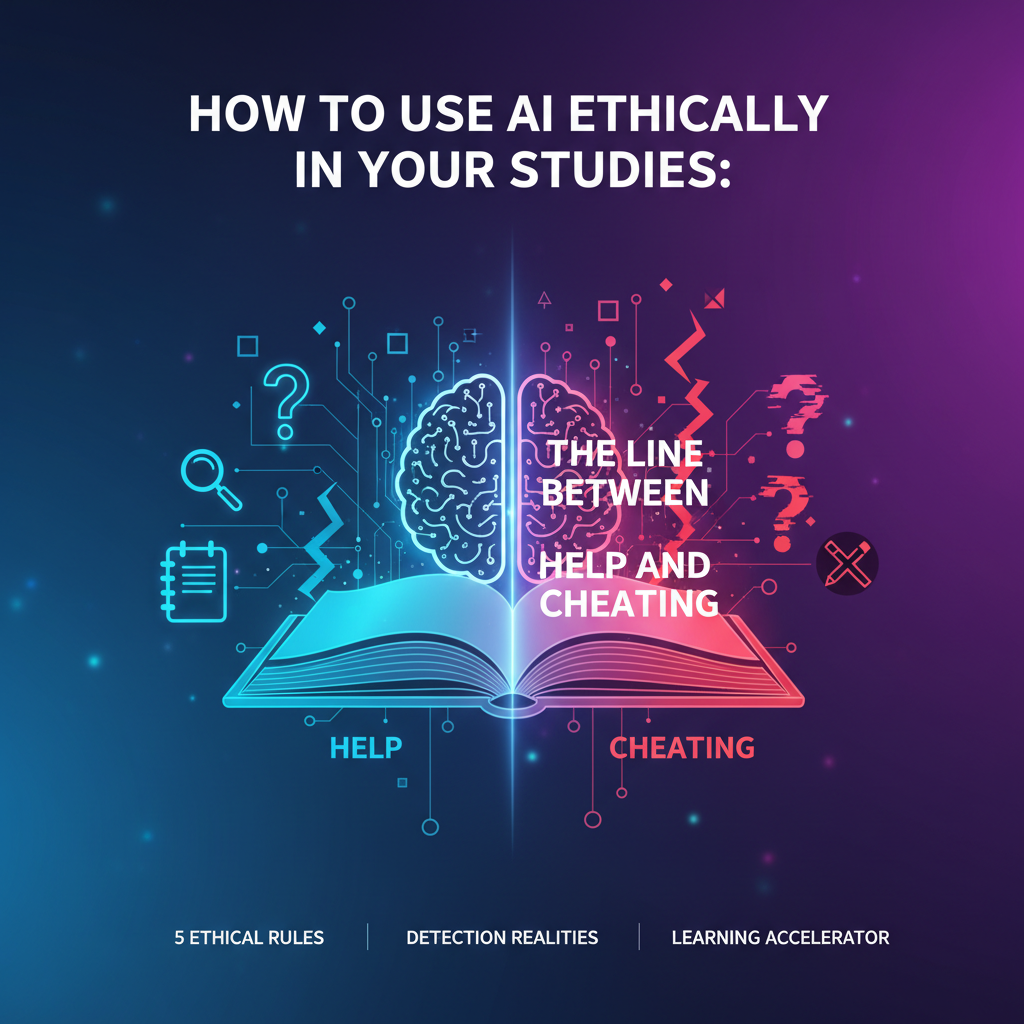
ecent data shows 90% of college students tried ChatGPT within two months of its launch, and one in four high school students now use it regularly for homework. But here's the problem: nobody seems to agree on where the line is between smart studying and straight-up cheating. Three out of four university tech officers say AI has become a significant risk to academic integrity, yet policies vary wildly—even within the same school. This guide breaks down the spectrum of AI use in academics, from legitimate learning support to outright dishonesty. You'll learn the five rules for staying ethical, what professors can actually detect, and how to use AI as a learning accelerator rather than a crutch. Because the real question isn't "Can I get away with it?" It's "What am I actually here to learn?
How to Use AI Ethically in Your Studies: The Line Between Help and Cheating
Look, we need to talk about the elephant in every college classroom right now: AI tools like ChatGPT.
If you're reading this, chances are you've either used AI for schoolwork, thought about it, or watched your classmates do it. You're not alone. Recent data shows that within just two months of ChatGPT's launch, about 90% of college students had already tried it for assignments. One in four high school students now use it regularly for homework.
But here's the thing that's keeping professors up at night and getting students hauled into honor courts: nobody seems to agree on where the line is between smart studying and straight-up cheating.
The Reality Check: Everyone's Confused
Let's be honest about what's happening on campuses right now.
Three out of four university tech officers say AI has become a moderate to significant risk to academic integrity. Students are getting caught submitting AI-written papers, then apologizing with emails that also look like they came from ChatGPT. Some colleges are scrambling to create policies. Others have thrown their hands up.
But here's what makes this different from old-school cheating: AI isn't just a shortcut. It's a tool that can genuinely help you learn, or completely replace your learning, depending on how you use it.
The problem? Most schools haven't figured out how to draw that line yet. Policies vary from classroom to classroom, even within the same university. One professor might encourage AI use for brainstorming, while another considers it grounds for expulsion.
So what's a student supposed to do?
Understanding the Spectrum: From Helper to Cheater
Think of AI use on a spectrum, not as a simple yes or no question.
The Green Zone: Legitimate Learning Support
These uses are almost universally accepted (but always check your specific course policy):
- Explaining difficult concepts: "Explain quantum entanglement like I'm in high school" is no different from watching a YouTube tutorial
- Generating practice questions: Using AI to create quiz questions from your notes for self-testing
- Brainstorming ideas: Getting initial thoughts or outlines before you develop your own original angle
- Checking grammar and spelling: Similar to Grammarly or spell-check
- Learning a new coding language: Getting syntax help or debugging assistance (though understand the code, don't just copy it)
- Translating sources: Converting research materials from other languages for comprehension
The Yellow Zone: Proceed With Caution
These uses might be okay in some classes but not others. Always ask first:
- Creating detailed outlines: Some professors say this is fine; others consider it doing the intellectual work for you
- Improving your writing: Having AI polish your draft can cross the line from editing to rewriting
- Analyzing data: Using AI to interpret results might be acceptable in one course and prohibited in another
- Summarizing readings: This might prevent you from engaging deeply with the material, even if it's not explicitly banned
The Red Zone: Academic Dishonesty
These uses will get you in trouble at virtually every institution:
- Having AI write your essays: Even if you edit them afterward
- Copying code without understanding it: If you can't explain how it works, you shouldn't submit it
- Generating answers for homework: When the point is to demonstrate your knowledge
- Using AI during exams: Unless explicitly permitted
- Not citing AI use: When your professor requires disclosure
The Gray Area That Nobody Wants to Talk About
Here's where it gets complicated: what if you write a paper yourself, then run it through AI to "make it sound better"?
A recent case illustrates this perfectly. One student wrote an essay largely on her own but then used AI to polish it. She got caught and flagged for cheating. The professor explained that even though she did most of the work, having AI refine the language still undermined the assignment's purpose, to develop her own writing skills.
This is the nuanced stuff that makes the AI ethics conversation so difficult. Intent matters. Disclosure matters. The learning objectives of the assignment matter.
Five Rules for Staying on the Right Side of the Line
1. When in Doubt, Ask
Seriously. Email your professor. Go to office hours. Ask "Can I use AI to help me understand this concept?" or "Is it okay if I use ChatGPT for brainstorming?" Most professors would rather clarify expectations upfront than deal with academic integrity violations later.
2. The 'Can I Explain It?' Test
If you use AI to help with any assignment, ask yourself: Could I sit down with my professor right now and explain every part of this work? If not, you've crossed a line.
3. Cite Your AI Usage
Even when it's allowed, transparency is key. Some schools now require students to include a statement like: "I used ChatGPT to generate initial ideas for this essay, which I then developed into my own argument." Check your school's citation guidelines for AI tools.
4. Remember the Long Game
That AI-generated essay might get you an A today, but what about when you need those skills in your career? Or when you're in an interview and can't explain something that's supposed to be on your resume? You're not just cheating the system, you're cheating yourself.
5. Use AI as Training Wheels, Not a Crutch
The best approach? Use AI to learn, not to replace learning. If you're using it to understand a concept so you can then write about it in your own words, that's legitimate. If you're using it because you don't want to do the thinking, that's where problems start.
What Professors Can Actually Detect
Let's be real: you're probably wondering if you can get away with it.
AI detection tools exist, but they're far from perfect. They often flag innocent work and miss obvious AI content. However, professors don't need fancy software to spot AI use. They know your writing style. They know the voice and depth of your previous work. When something suddenly sounds different, more polished, less personal, weirdly formal, they notice.
Plus, professors are getting savvier. They're designing assignments that are harder to AI-fy: personal reflections, in-class essays, oral presentations, creative projects that require real-world application.
The detection question misses the point anyway. The real question isn't "Can I get away with it?" It's "What am I actually here to learn?"
The Nuanced Take: AI Isn't Going Away
Here's the truth that everyone's dancing around: AI is going to be part of your professional life, whatever field you enter. Learning to use it effectively and ethically now is actually a valuable skill.
The key word is "learning." If AI does your thinking for you, you're not learning anything except how to outsource cognitive work. But if you use AI to accelerate your learning, understand complex topics faster, or practice skills more efficiently, that's legitimate.
Think of it like a calculator. You can use a calculator to check your work in a math class and that's fine. But if you never learn the underlying math because you always rely on the calculator, you're missing the point of the education.
Creating Your Own Ethical Framework
Since policies are inconsistent, you need your own internal compass. Ask yourself these questions every time you consider using AI:
- Does this assignment test my understanding or my ability to produce output?
- Am I using AI to learn or to avoid learning?
- Could I recreate this work without AI if asked?
- Would I be comfortable telling my professor exactly how I used AI?
- Does my school/course have a specific policy I need to follow?
If you can't confidently answer these questions, you're probably in murky waters.
The Bigger Picture
Universities are institutions designed to help you develop critical thinking, problem-solving, and communication skills. Every assignment, even the ones that feel pointless, is meant to build these capabilities.
When you offload that cognitive work to AI, you're getting a grade but missing the education. And here's the brutal reality: nobody cares about your GPA five years after graduation. They care about what you can do.
The students who are using AI as a learning accelerator, who ask better questions, understand concepts more deeply, and build skills more efficiently, are going to outperform both the AI-averse luddites and the AI-dependent cheaters.
The Bottom Line
AI isn't inherently good or bad for your education. It's a tool, and like any tool, it depends on how you use it.
Use it to understand difficult concepts? Great. Use it to generate practice problems? Excellent. Use it to brainstorm ideas that you then develop yourself? Perfect.
Use it to write your essays? Submit code you don't understand? Generate homework answers? That's not just cheating your professors. It's cheating your future self out of the skills you're paying to develop.
The line between help and cheating isn't always clear, and that's okay. When it's unclear, err on the side of transparency and ask your professors. Document how you use AI. Always prioritize actual learning over easy grades.
Because here's the thing nobody says out loud: AI is making education better for the students who want to learn and worse for the students who just want to get by. Which side of that line you fall on is entirely up to you.
Taking Action: Your Next Steps
If you've been using AI in ways you're not proud of, it's not too late to reset:
- Review your school's academic integrity policy (yes, actually read it)
- Email your professors to clarify AI policies for each class
- If you've already submitted questionable work, consider coming clean, most schools are more lenient with students who self-report
- Going forward, document your AI use: keep chat logs, note what you asked and how you used the responses
- Focus on using AI to accelerate your learning, not replace it
The AI era of education is here. The students who figure out how to navigate it ethically will come out ahead, not just in grades, but in actual skills and capabilities that matter in the real world.
The choice is yours. Choose wisely.