Overview
ChatGPT is excellent at reshaping material you supply and unreliable at supplying facts itself. Here is the line between the two, and the rule that keeps you out of trouble.
ChatGPT is genuinely useful for studying and genuinely bad at some of the things students most want to use it for. Knowing which is which saves you from confidently learning something wrong the week before an exam.
Here is an honest breakdown, based on what the tool is actually doing under the hood.
What ChatGPT is
ChatGPT is a large language model. It predicts likely continuations of text, trained on an enormous amount of writing. That single fact explains almost all of its behaviour, both the impressive parts and the failures.
It is very good at things that are fundamentally about language: rephrasing, explaining, summarising, translating, structuring, and producing plausible prose on demand. It is unreliable at things that require a fact to be true rather than merely likely, because "true" and "likely continuation" are not the same property.
Where it genuinely helps with studying
Explaining something at a different level
If a textbook explanation is not landing, asking for the same concept explained more simply, or through a different analogy, works well. This is a language task and the model is good at it. Ask it to explain the Krebs cycle as if you already understand a factory production line, and you will usually get something useful.
Turning your own notes into questions
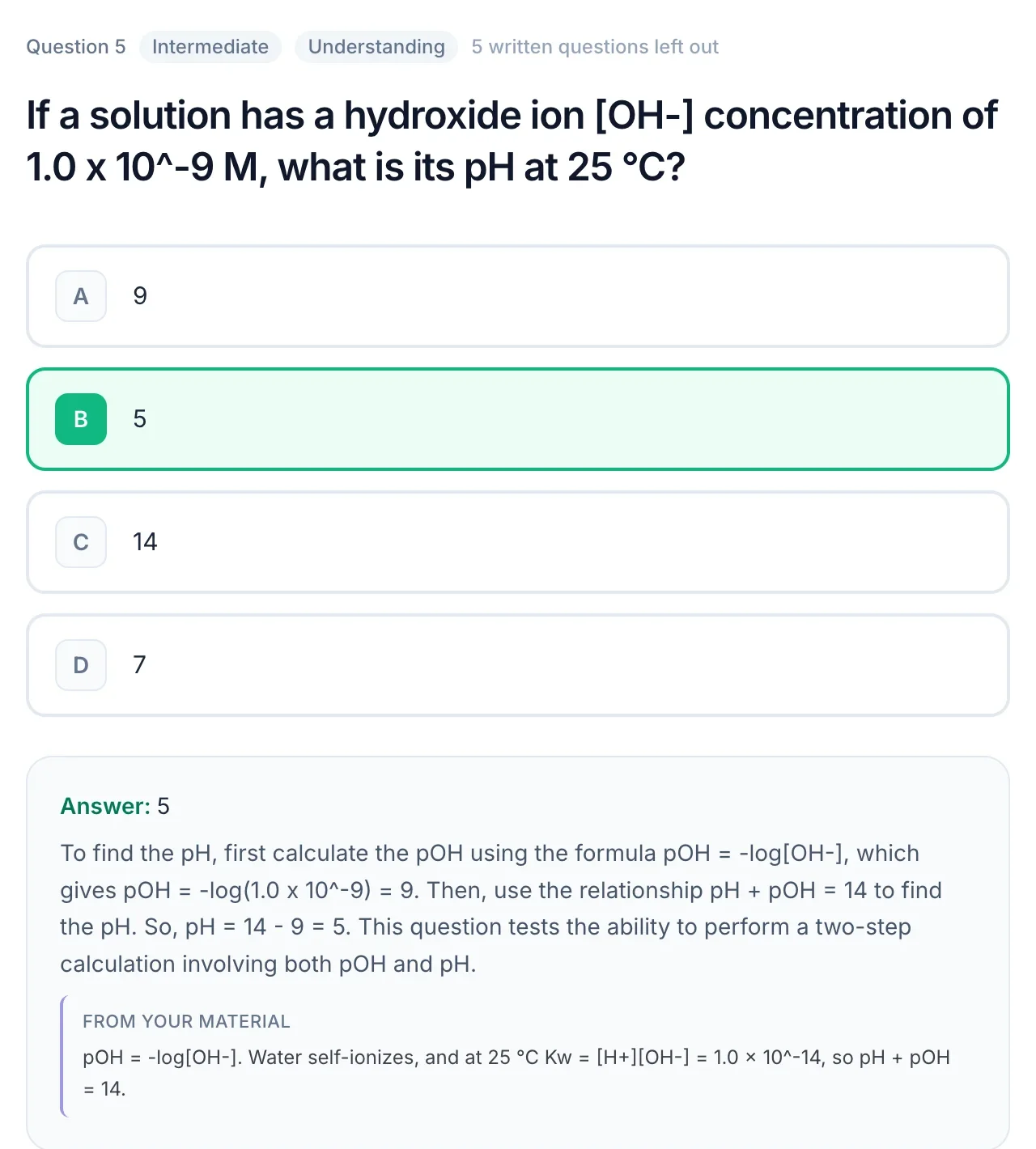
Paste a section of your notes and ask for ten questions that test application rather than recall. Because you supplied the source material, the failure mode of inventing facts is much reduced. The model is reorganising your text, not retrieving from memory.
Finding the hole in your reasoning
Write out your understanding of a concept, then ask it to identify what is wrong or missing. This works because critiquing an argument is a language task. It also forces you to write out your understanding, which is retrieval practice on its own.
Drafting and structure
Outlines, essay structure, thesis statements you then argue with. Useful as a starting point that you rewrite, and academically fine as long as the final work is yours and your institution allows it.
Where it will quietly let you down
Facts, dates, numbers, and citations
The model generates plausible text, and a fabricated citation is extremely plausible text. It will produce a real-sounding author, a real-sounding journal, and a page range that does not exist. This is the single most common way students get caught out. Never cite anything you have not opened yourself.
Anything after its training cutoff
It does not know about recent developments unless it is searching the web in that session. For fast-moving fields this matters a lot.
Multi-step quantitative work
It has become much better at arithmetic and derivations, but it still makes step errors and presents them with total confidence. Check the working, not just the answer. If the answer matters, do the calculation yourself.
Knowing what your course actually covers
It does not know your syllabus, your professor's emphasis, or which of the six things in a chapter will be on the exam. It will happily generate a thorough study plan for the wrong material.
The rule that keeps you safe
Use it for transformation, not for retrieval.
Transformation means you supply the content and it changes the shape: your notes into questions, a dense paragraph into a simpler explanation, your draft into a critique. The facts come from you, so it cannot invent them.
Retrieval means asking it to supply the facts: "what were the findings of X", "give me sources on Y", "what is the dosage of Z". This is where the failures live, and they are hard to spot precisely because the output reads so well.
On academic honesty
The line most institutions draw is between using a tool to understand material and using it to produce work that is submitted as yours. Generating practice questions from your own notes sits comfortably on the acceptable side. Submitting generated prose as your own writing does not.
The practical test: if explaining exactly how you used it would embarrass you, that is the answer. Check your institution's specific policy, because they vary more than people assume.
Where a dedicated tool fits
For general explanation and drafting, a chat interface is the right shape. For studying specifically, the friction is that a chat window has no memory of what you got wrong, no schedule, and no way to bring a question back three days later when you are about to forget it.
That is the gap purpose-built study tools fill: not better question generation necessarily, but keeping track of which questions you missed and when to show them again. If you are already generating questions in ChatGPT and pasting them somewhere to study, that is the part worth automating.