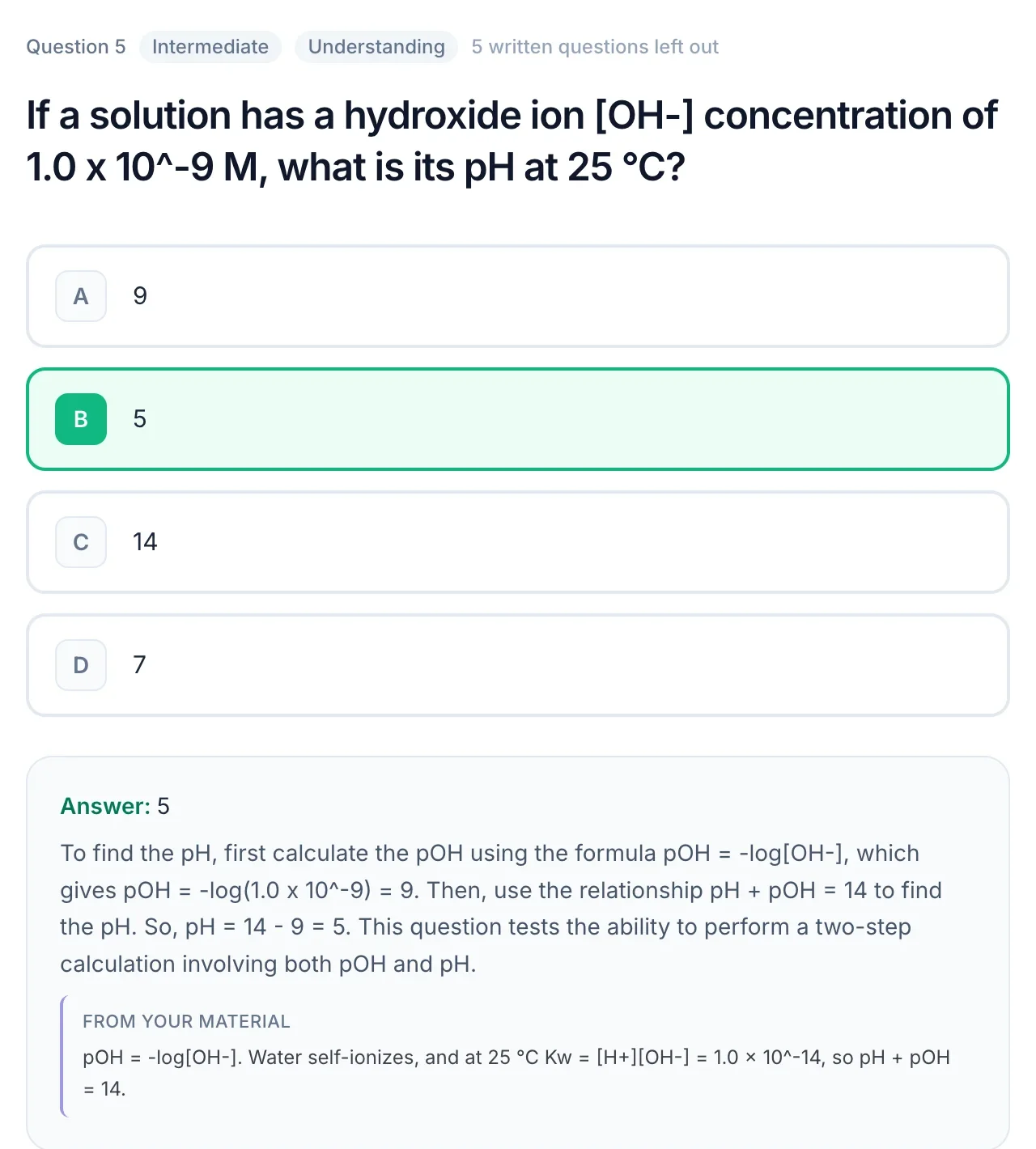
Turn any PDF into high-quality multiple choice questions in seconds. Upload textbooks, lecture notes, or research papers and let AI create exam-ready MCQs with realistic distractors and Bloom's Taxonomy tagging.
No signup required to try. Supports PDF up to 200 pages.
Purpose-built AI that understands academic content and creates assessment-quality multiple choice questions
Upload a PDF and get high-quality multiple choice questions in under 30 seconds. No manual writing needed.
Generate MCQs targeting remember, understand, apply, and analyze levels for deeper learning outcomes.
Set easy, medium, or hard difficulty. Control question complexity to match your study or assessment goals.
AI generates plausible wrong answers that test true understanding, not just recognition of obviously wrong options.
Upload multiple PDFs at once and generate MCQs across entire textbooks, course packs, or lecture series.
Export MCQs to Anki, Quizlet, CSV, QTI, or Moodle-compatible formats. Ready for any LMS or study tool.
From upload to exam-ready questions in under a minute
Drag and drop any PDF — textbooks, lecture slides, research papers. Up to 200 pages per file.
Our AI analyzes the content, identifies testable concepts, and creates MCQs with realistic distractors.
Edit questions, adjust difficulty, then export to Anki, Quizlet, CSV, QTI, or Moodle XML.
Students, teachers, and professionals across every discipline
Convert anatomy, pharmacology, and pathology PDFs into USMLE-style MCQs.
Turn case law summaries and legal textbooks into multiple choice questions.
Generate NCLEX-style MCQs from nursing textbooks and clinical guidelines.
Create assessment-ready MCQs from lesson plans and curriculum documents in seconds.
Convert accounting standards and tax code summaries into practice MCQs.
See the quality of AI-generated multiple choice questions from real PDF content
Q1: What is the primary function of mitochondria in eukaryotic cells?
Explanation: Mitochondria are the powerhouses of the cell, generating ATP through oxidative phosphorylation during cellular respiration.
Q2: Under the doctrine of judicial review established in Marbury v. Madison (1803), the Supreme Court has the power to:
Explanation: Marbury v. Madison established that the Supreme Court has the authority to review and invalidate laws that conflict with the Constitution.
Q3: Which class of antibiotics inhibits bacterial cell wall synthesis by binding to penicillin-binding proteins (PBPs)?
Explanation: Beta-lactam antibiotics (penicillins, cephalosporins, carbapenems) work by binding to PBPs and inhibiting peptidoglycan cross-linking in the bacterial cell wall.
Discover other ways QuerySpark helps you learn faster
Stop writing questions by hand. Upload a PDF and get exam-ready multiple choice questions in seconds.