Overview
QuerySpark turns a PDF or your lecture notes into practice questions with answers and explanations. Here is what it is good at, what it is not, and how it compares to Anki, Quizlet and Knowt.
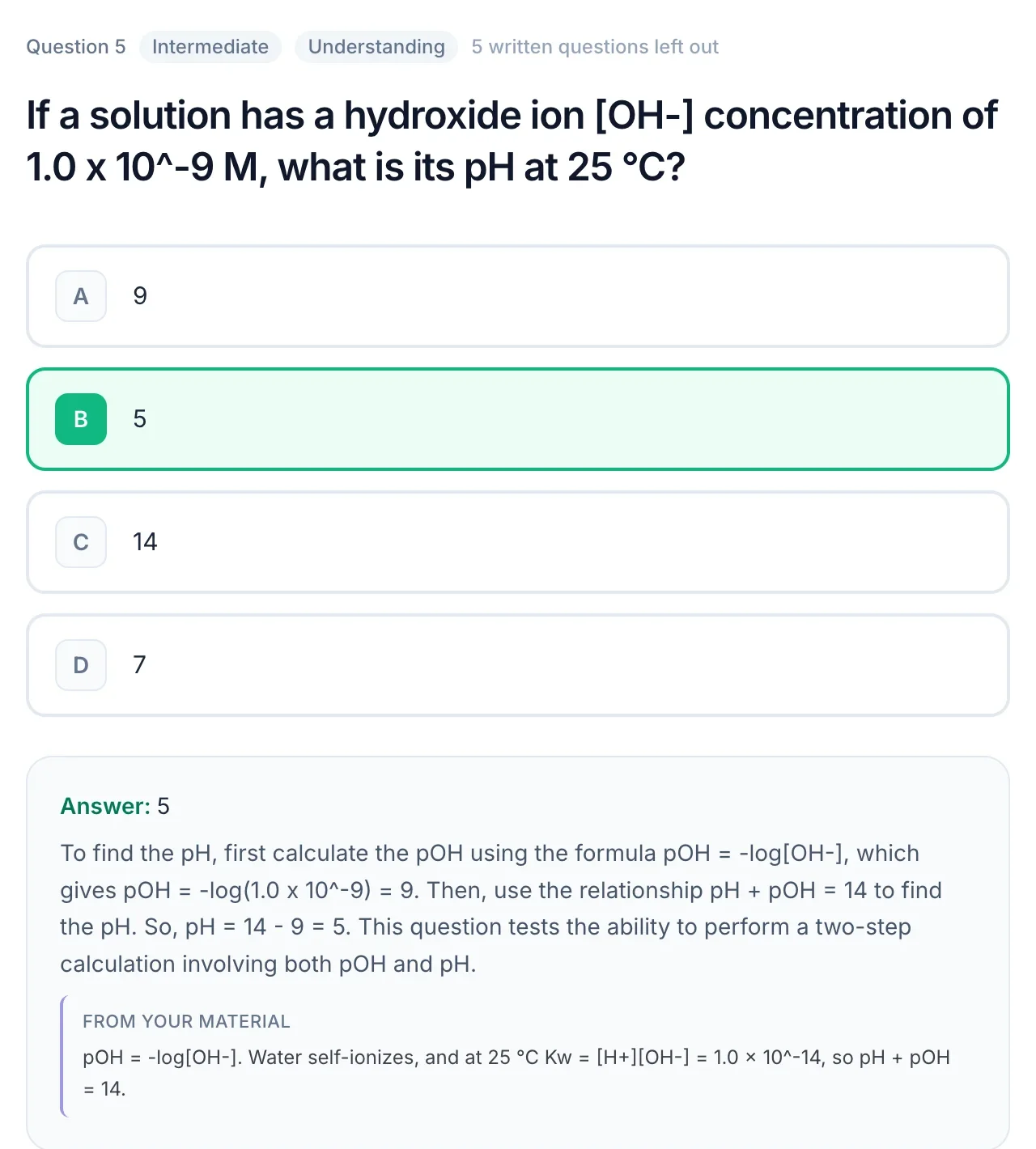
QuerySpark turns study material you already have into practice questions you can actually answer. You upload a PDF, paste your lecture notes, or drop in a URL, and it writes questions from that source, along with the answers and an explanation of why each answer is right.
That is the whole product. The rest of this page is about when it helps, when it does not, and how it compares to the tools you are probably already using.
The problem it solves
Most students know that testing yourself beats rereading. The research on that has been settled for years. The reason people reread anyway is that testing yourself requires questions, and nobody hands you questions for your specific lecture on renal physiology or your specific chapter on contract formation.
Writing your own questions works well. It is also slow, and it has a circularity problem: to write a good question about a topic you need to already understand the topic well enough to know what is worth asking. That is exactly the understanding you are trying to build.
So the questions never get written, and you fall back to rereading, which feels productive because the material gets more familiar every pass. Familiarity is not recall, and exams test recall.
How it works
You give it a source. A PDF, a Word document, PowerPoint slides, plain text, a web page, or a YouTube transcript. Scanned and photographed pages go through OCR, so pictures of lecture slides usually work.
It reads the document, identifies what the material is actually about, and generates questions tagged by Bloom's taxonomy level. That tagging matters more than it sounds. A question that asks you to define a term is testing something different from a question that asks you to predict what happens when you change a variable, and a study session made entirely of definitions will leave you unprepared for an exam full of application questions.
Each question comes with the answer and a short explanation. You can edit any question, delete the ones that miss, and add your own. The generated set is a first draft you own, not a fixed quiz.
From there you can study the questions directly, flip them as flashcards, take them as a timed quiz, or generate a structured study guide from the same source. Reviews are scheduled with spaced repetition, so questions you get wrong come back sooner than questions you answer confidently.
What it is good at
- Dense factual material. Anatomy, pharmacology, pathophysiology, statutes, accounting standards, and vocabulary all work well. There is a lot to recall and the source text is explicit about it.
- Material nobody has made a deck for. Your professor's slides, your own notes, a specific paper. This is the case where premade libraries fail you completely.
- Turning a reading backlog into something reviewable. If you have 200 pages you were supposed to have read, a generated question set at least tells you what you do not know yet.
What it is not good at
Being honest about this saves everyone time.
- Skills you learn by doing. Writing proofs, debugging code, and clinical reasoning at the bedside are built through practice, not retrieval. Generated questions can check whether you know which method applies. They cannot build the fluency to apply it.
- Material that is mostly diagrams or equations. Extraction gets the text. A page that carries its meaning in a pathway diagram loses most of that meaning on the way through.
- Bad source material. Questions are generated from what you upload. Sparse slides with three bullet points per page produce thin questions, because there is nothing else there. The output is bounded by the input.
How it compares
Anki is a better scheduler and it is free. Its algorithm is more mature and more configurable. The catch is that you write every card yourself, which is where most people give up. If you enjoy authoring cards, use Anki.
Quizlet and Knowt have enormous libraries of decks other students made. If your course is common enough that a good deck already exists, that is faster than generating anything. Knowt in particular gives away a lot for free. Their weakness is the same as their strength: the deck was made for someone else's course, and it will not match your professor's emphasis.
NotebookLM is excellent at answering questions about a document. It is built for interrogation rather than for scheduled retrieval practice, so it fits a different part of studying.
The honest summary is that QuerySpark is worth using when the questions do not exist yet and you do not want to write them. If a good deck already exists for your exam, go use it.
What it costs
New accounts get three days of full access with no credit card. After that the free tier keeps unlimited access to everything you already created, plus one new study session and 20 new questions per month. Paid plans start at $9 per month, which is currently the cheapest in this category.
The free tier is deliberately narrow. It is enough to keep studying what you have already made, and not enough to generate new material every week. If you want a genuinely generous free tier for AI flashcards, Knowt is the better answer and we would rather say so than pretend otherwise.
Getting started
Upload the single most important document for your next exam. Not your whole semester, just the one chapter or deck you are least confident about. Generate a set, delete the two or three questions that miss, and answer the rest without looking at your notes.
The questions you cannot answer are the useful output. That list is what to study, and you now have it in about a minute instead of after a week of rereading.