Overview
Your heart's racing during finals week, but here's surprising news: you're part of a positive mental health trend. Recent data from over 84,000 college students shows severe depression dropped from 23% to 18% since 2022, and anxiety fell from 37% to 32%. Students are getting better at managing stress through concrete, science-backed techniques. This comprehensive guide reveals 10 proven strategies that go beyond "just relax" advice: starting early with strategic study plans, using active recall instead of passive re-reading, scheduling breaks that actually restore mental energy, mastering your environment, practicing specific stress-reduction techniques, prioritizing sleep, fueling your brain properly, building support systems, reframing your exam mindset, and preparing strategically for test day. These aren't just study tips—they're life skills that will serve you throughout your career whenever you face high-stakes moments.
Exam Stress Is Real: 10 Science-Backed Ways to Stay Calm During Finals
Your heart's racing. Your hands are sweating. You've read the same paragraph four times and still can't remember what it said. Welcome to exam season.
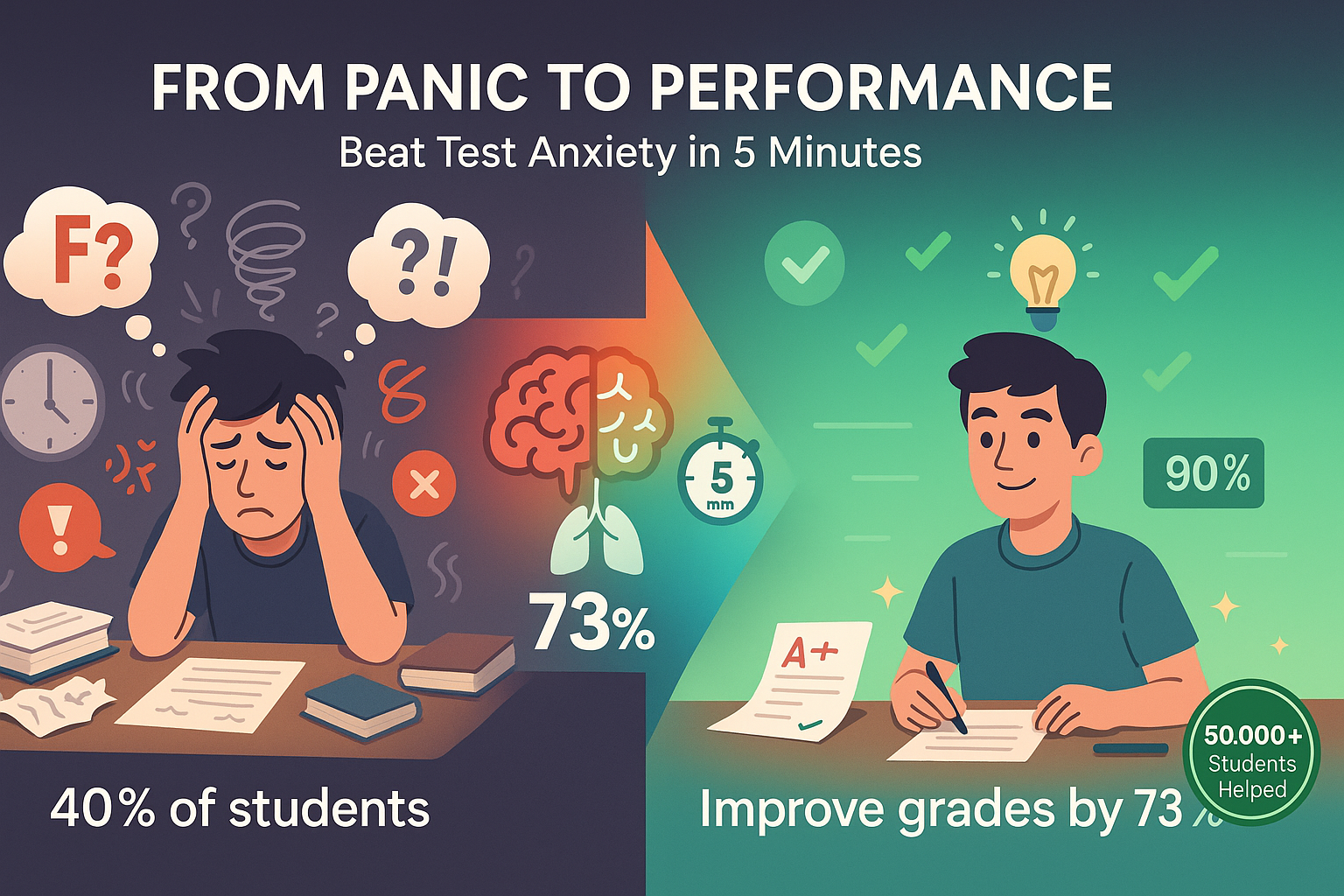
If you're feeling anxious about your upcoming tests, here's something that might surprise you: you're actually part of a positive trend. Recent data from over 84,000 college students shows that severe depression dropped from 23% in 2022 to 18% in 2025, and anxiety fell from 37% to 32%. Students are reporting better mental health outcomes for the third year in a row.
But let's be real, those statistics don't make your chemistry final any less terrifying.
The good news? Mental health improvements aren't happening by accident. Students are getting better at managing stress, and researchers have identified specific strategies that actually work. Not the fluffy "just relax" advice that nobody can actually use, but concrete, science-backed techniques that can help you stay calm and perform better during the most stressful weeks of the semester.
Why Finals Feel Different This Year
Something's shifted in how students approach exam season, and it's not just about studying harder.
Moderate to severe anxiety symptoms among college students have decreased significantly over the past three years. Suicidal thoughts dropped from 15% to 11%. Even loneliness, that crushing feeling of being isolated even when surrounded by people, fell from 58% to 52%.
What changed?
Experts point to several factors: distance from the pandemic, better institutional support, and crucially, students developing better coping mechanisms. About 37% of students now receive therapy or counseling, and among those showing depression or anxiety symptoms, 60% are getting clinical mental health treatment.
But mental health support isn't just about therapy. It's also about the daily practices you build during high-stress periods like finals. The strategies that help you manage exam anxiety now will serve you throughout your career when you face high-stakes presentations, important deadlines, or major life transitions.
The Science of Exam Stress: What's Actually Happening
Before we dive into solutions, let's understand what's going on in your brain and body during exam stress.
When you're anxious about a test, your body activates the same stress response humans developed to escape predators. Your amygdala signals danger. Your hypothalamus triggers the release of stress hormones like cortisol and adrenaline. Your heart rate increases. Blood flows away from your digestive system and toward your muscles.
This response is designed for physical threats, not abstract ones like failing organic chemistry.
Here's the catch: moderate stress can actually improve performance. It sharpens focus and enhances memory. But excessive stress does the opposite, it impairs the prefrontal cortex (responsible for complex thinking and decision-making) and interferes with memory retrieval.
That's why you can know the material perfectly during practice but blank out during the actual exam. The stress response is literally blocking access to the information you studied.
The goal isn't to eliminate stress entirely. It's to keep it in the sweet spot where it enhances rather than impairs performance.
Strategy 1: Start Early (But It's Not Too Late)
The single biggest predictor of exam stress? Last-minute cramming.
Research consistently shows that students who start preparing weeks in advance experience significantly less anxiety than those who cram. This isn't about being a "good student". It's about brain biology.
Your brain consolidates information during sleep. When you study material over multiple days, you give your brain time to move information from short-term to long-term memory. This process, called memory consolidation, happens during deep sleep. Skip it, and the information stays shallow and fragile.
But here's what matters if you're reading this a week before finals: it's never too late to start preparing strategically. Even with limited time, you can reduce stress by creating structure.
What to do right now:
Break your remaining time into specific blocks. Instead of "study biology," plan "review chapters 7-9 and complete practice problems 1-15." Specific goals reduce anxiety by making the work feel manageable.
Prioritize topics by importance and your understanding. Spend time on high-impact areas where you're weak, not reviewing things you already know well. This maximizes your return on study time.
Accept that you can't learn everything perfectly. Exam preparation with limited time is about triage, cover the most important material adequately rather than trying to master everything and burning out.
Strategy 2: Use Active Recall (Not Passive Re-Reading)
Here's a harsh truth: re-reading your notes feels productive but barely works.
Studies show that students retain only 8-10% of material through passive reading, compared to 25-60% through active learning techniques. Yet most students default to re-reading because it feels easier and less stressful in the moment.
Active recall, forcing yourself to retrieve information from memory, is significantly more effective and reduces exam anxiety by building confidence. When you can successfully recall information during practice, your brain registers that the knowledge is accessible, which reduces stress about "going blank" during the test.
Active recall techniques that work:
Practice with flashcards, but do it right. After attempting to answer, actively think about why you got it right or wrong. Understanding your thinking process is more valuable than the answer itself.
Take practice tests under exam conditions. Time yourself. Put away your notes. Sit at a desk. The more your practice mimics the real exam environment, the less anxious you'll feel during the actual test.
Use the Feynman Technique: explain concepts out loud as if teaching someone else. If you can't explain it simply, you don't understand it well enough. This reveals gaps in your knowledge before the exam, not during it.
Try the blank page method: close your notes and write everything you remember about a topic. Then check what you missed and focus your studying there.
Strategy 3: Schedule Strategic Breaks (Your Brain Needs Them)
Studying for hours straight might feel productive, but it's actually counterproductive.
Research on cognitive performance shows that mental fatigue sets in after about 25-50 minutes of focused work. Beyond that point, your retention drops dramatically and stress increases. Your brain literally needs downtime to process and consolidate information.
The Pomodoro Technique, 25 minutes of focused work followed by a 5-minute break, has become popular because it works with your brain's natural attention span, not against it.
But not all breaks are created equal.
Effective breaks:
Physical movement: even a five-minute walk or stretching session increases blood flow to your brain and reduces cortisol levels Genuine mental disengagement: step away from your desk, look at something far away to rest your eyes, or do a simple physical task Social connection: brief conversations with friends or family (but set a timer, don't let it derail your study session)
Ineffective breaks:
Scrolling social media: this doesn't rest your brain; it just shifts your attention to different stimuli Watching TV or videos: passive entertainment doesn't allow for mental recovery Stressing about other work: worrying during breaks defeats their purpose
Recent surveys show that 45% of teens now say they spend too much time on social media, up from 36% in 2022. If you're using your "breaks" to scroll, you're probably making your stress worse, not better.
Strategy 4: Master Your Study Environment
Your environment shapes your stress levels more than you might realize.
Studies show that studying in a comfortable, distraction-free environment significantly reduces anxiety and improves retention. But comfort doesn't mean studying in bed, it means optimizing your space for focused work.
Environmental factors that reduce stress:
Natural light or bright artificial lighting: dim environments increase drowsiness and reduce focus Comfortable temperature: too hot or too cold diverts mental resources to regulating body temperature Minimal visual clutter: messy environments increase cognitive load and stress Background sound that works for you: some people need silence; others focus better with ambient noise or instrumental music
Put your phone in a different room or use app blockers. Even having your phone visible on the desk reduces cognitive capacity, your brain uses mental resources monitoring it for notifications.
If you're studying at home, communicate your schedule to family or roommates. Knowing you won't be interrupted reduces background anxiety.
Strategy 5: Practice Stress-Reduction Techniques That Actually Work
Telling someone to "just calm down" is useless advice. But specific relaxation techniques can genuinely lower your physiological stress response.
Box breathing (4-4-4-4 technique):
Inhale for 4 counts, hold for 4 counts, exhale for 4 counts, hold for 4 counts. Repeat for 2-3 minutes. This activates your parasympathetic nervous system, which counteracts the stress response.
Progressive muscle relaxation:
Systematically tense and relax different muscle groups. Start with your toes, move up through your legs, torso, arms, and face. This releases physical tension that accumulates during stress.
Grounding exercises:
When anxiety spikes, use the 5-4-3-2-1 technique: identify 5 things you can see, 4 you can touch, 3 you can hear, 2 you can smell, and 1 you can taste. This interrupts anxious thought spirals by anchoring you in physical reality.
Apps like Headspace or Calm offer guided meditation and relaxation exercises specifically designed for students dealing with stress. Many universities now offer these subscriptions for free, check with your student services.
The key is practicing these techniques before exam day. They work best when they're familiar habits, not desperate last-minute attempts.
Strategy 6: Prioritize Sleep (It's Not Optional)
All-nighters are a trap.
Sleep deprivation impairs cognitive function more than moderate alcohol intoxication. After 24 hours without sleep, your cognitive performance is equivalent to having a blood alcohol content of 0.10%, above the legal driving limit.
But beyond impaired thinking, sleep deprivation dramatically increases anxiety and decreases emotional regulation. You're not just less smart when you're exhausted, you're also more stressed and less capable of managing that stress.
Why sleep matters for exam performance:
Memory consolidation happens during sleep. The information you studied needs sleep to stick. This is why cramming all night before an exam is particularly ineffective, you're preventing the very process that would help you remember the material.
REM sleep, which increases in the later hours of the night, is crucial for integrating complex information and problem-solving. When you cut sleep short, you're specifically losing the sleep phases most important for exam performance.
Practical sleep strategies during finals:
Aim for 7-9 hours per night, especially in the days before exams. If you must reduce sleep, never go below 6 hours, the cognitive impairment beyond that point becomes severe.
Keep consistent sleep and wake times, even on weekends. Your body's circadian rhythm works best with regularity.
Create a wind-down routine: 30-60 minutes before bed, stop studying, dim lights, and do something relaxing. Reading fiction, gentle stretching, or listening to calming music signal your brain that it's time to transition to sleep.
If racing thoughts keep you awake, keep a notepad by your bed. Write down worries or things you need to remember, then consciously set them aside. This "mental download" helps many students fall asleep faster.
Strategy 7: Fuel Your Brain Properly
Nutrition affects anxiety more than most students realize.
Your brain consumes about 20% of your body's energy despite being only 2% of your body weight. When you're studying intensely, you're burning significant mental energy. Feed your brain poorly, and both your performance and stress levels suffer.
Foods that reduce stress and improve focus:
Complex carbohydrates (whole grains, oats, sweet potatoes) provide steady energy without blood sugar crashes that increase anxiety Omega-3 fatty acids (fatty fish, walnuts, flaxseeds) support brain function and reduce inflammation Protein (lean meats, eggs, beans) provides amino acids needed to produce neurotransmitters that regulate mood Dark leafy greens and berries contain antioxidants that protect brain cells during stress
Foods and habits to avoid:
Excessive caffeine: moderate amounts (1-2 cups of coffee) can help focus, but too much increases jitters and anxiety. Cut off caffeine by 2pm to avoid sleep disruption.
High-sugar snacks: they provide quick energy followed by crashes that impair concentration and mood
Skipping meals: low blood sugar impairs cognitive function and increases irritability
Energy drinks: the combination of high caffeine and sugar creates an intense spike and crash cycle
Stay hydrated. Even mild dehydration (2% body water loss) impairs cognitive performance and increases perceived stress. Keep water at your study space and aim to drink consistently throughout the day.
Strategy 8: Build a Support System
Exam stress feels isolating, but you're not alone in this experience.
Recent data shows that students with strong social support report significantly lower levels of depression and anxiety. The belief that "people really care about me" was reported by 95% of youth ages 10-24, and 76% felt a sense of belonging with groups like friends or school communities.
Connection matters, even, especially, during stressful times.
How to leverage social support during finals:
Form study groups, but keep them focused. Set specific goals for each session (review chapter X, quiz each other on Y). Social studying works best when there's structure and accountability.
Check in with friends about how they're handling stress. Sharing coping strategies helps everyone, and normalizing the struggle reduces isolation.
Be selective about social interactions during intense study periods. Quality over quantity, brief, meaningful conversations reduce stress better than hours of distraction.
If you're struggling significantly, reach out to campus resources. Most universities offer free counseling services, and 37% of students now use therapy or counseling. Among those showing depression or anxiety symptoms, 60% receive clinical mental health treatment. Using these resources isn't a sign of weakness. It's strategic self-care.
Strategy 9: Reframe Your Relationship With Exams
Your mindset about exams significantly affects your stress response.
Students who view exams as threats experience more anxiety and perform worse than students who view them as challenges or opportunities to demonstrate learning. This isn't just positive thinking. It's a cognitive reappraisal that changes your physiological stress response.
Mindset shifts that reduce exam anxiety:
Replace "I have to get an A" with "I want to show what I've learned." The first creates performance pressure; the second focuses on demonstrating competence.
Recognize that one exam doesn't define your worth, intelligence, or future. Even if this feels obvious intellectually, anxiety often makes us forget it emotionally.
View anxiety as activation, not dysfunction. Anxiety and excitement create similar physiological responses. When you notice anxiety, tell yourself "I'm excited" or "My body is preparing me to perform well." Research shows this simple reframing significantly reduces stress.
Practice self-compassion. When you make mistakes during practice, respond as you would to a friend, with encouragement, not criticism. Self-criticism increases anxiety and impairs performance.
Remember that perfection isn't the goal. Done is better than perfect, especially when stress is pushing you toward paralysis or burnout.
Strategy 10: Prepare for Exam Day Itself
The day of the exam requires its own stress-management strategy.
The night before:
Stop studying at least an hour before bed. Last-minute cramming increases anxiety without improving retention, the information won't consolidate into memory before the exam.
Prepare everything you need: ID, calculator, pencils, water bottle, snacks. Pack your bag and place it by the door. Decision fatigue in the morning increases stress.
Review your test-taking strategy. Remind yourself of your plan: read all questions first, start with easier ones, manage time by question count, etc.
Do a relaxation exercise before bed using one of the techniques from Strategy 5.
Exam day morning:
Wake up early enough to avoid rushing. Time pressure compounds exam anxiety.
Eat a balanced breakfast with protein and complex carbs. Your brain needs fuel.
Do light physical activity, even a 10-minute walk can reduce stress hormones and improve focus.
Avoid talking to stressed-out classmates before the exam. Anxiety is contagious. If someone's panicking about material you haven't studied, it will only increase your stress without providing useful information.
Arrive early but not too early. Getting there 10-15 minutes before provides a buffer without leaving too much time for pre-exam anxiety to build.
During the exam:
If you feel panic rising, pause for 30 seconds. Close your eyes, do three deep breaths using the box breathing technique, then return to the test.
If you blank on something, skip it and return later. Often the answer comes to you once you've engaged other parts of your memory.
Focus on your own pace, not others'. Some people finish early because they gave up, not because they're smarter. Some finish late because they're being thorough.
The Bigger Picture: Mental Health Beyond Finals
Exam stress is temporary, but the strategies you develop now will serve you throughout your life and career.
The positive mental health trends among students, decreased depression, anxiety, and suicidal thoughts, aren't just good statistics. They represent real people developing better coping mechanisms and getting support when they need it.
You're part of a generation that's more willing to talk about mental health, more likely to seek help, and more proactive about building resilience. That's a genuine strength.
But these trends also come with responsibility. You need to be intentional about maintaining your mental health, not just during crisis moments but as an ongoing practice.
If you're interested in using technology effectively for your learning while maintaining your mental health, check out our guide on using AI ethically for studying. Tools like QuerySpark can help you extract key information from study materials more efficiently, reducing the time pressure that often triggers exam anxiety. AI tools can accelerate your learning and reduce stress when used properly, but they can also become a crutch that increases anxiety if you're not thoughtful about how you engage with them.
When Stress Becomes More Than Stress
Here's something important: exam stress is normal. Clinical anxiety disorders are different.
If you experience these symptoms persistently (not just during finals), consider reaching out for professional support:
- Panic attacks: sudden intense fear with physical symptoms like chest pain, difficulty breathing, or feeling like you're dying
- Avoidance behaviors: skipping classes or avoiding studying because the anxiety is too overwhelming
- Physical symptoms: persistent headaches, stomach problems, or muscle tension not explained by other causes
- Inability to function: anxiety that prevents you from completing basic tasks or attending to your needs
- Suicidal thoughts: any thoughts of self-harm require immediate professional intervention
Most universities offer free or low-cost counseling services. Crisis text lines and hotlines are available 24/7. The Trevor Project provides support specifically for LGBTQ+ youth. The 988 Suicide and Crisis Lifeline offers 24/7 support.
Reaching out isn't weakness. It's exactly what resilient people do when they need support.
Your Action Plan: Starting Right Now
You've read the strategies. Now what?
Pick three techniques from this list that resonate with you. Don't try to implement everything at once, that becomes another source of stress.
Start with these if you're not sure where to begin:
- Create a specific study schedule for your remaining time (Strategy 1)
- Replace re-reading with active recall practice (Strategy 2)
- Implement the Pomodoro Technique with strategic breaks (Strategy 3)
Once those feel natural, add strategies around sleep, nutrition, and stress-reduction techniques.
Remember: the goal isn't to eliminate all stress. It's to keep stress in the zone where it enhances your performance rather than impairing it.
You've got this. Not because finals are easy. They're not, but because you're developing the tools to handle them effectively.
The mental health improvements among students over the past three years didn't happen by accident. They happened because students like you chose to prioritize their wellbeing alongside their academics. You're part of that positive trend.
Now go ace those exams.
Quick Reference: Your Finals Week Checklist
One Week Before:
- ☐ Create specific study schedule for each subject
- ☐ Identify weak areas needing focused review
- ☐ Start prioritizing sleep (7-9 hours nightly)
- ☐ Gather all necessary exam materials
Three Days Before:
- ☐ Take full-length practice tests under exam conditions
- ☐ Review mistakes from practice tests
- ☐ Reduce caffeine after 2pm
- ☐ Practice stress-reduction techniques daily
The Night Before:
- ☐ Stop studying 1+ hour before bed
- ☐ Pack bag with all exam supplies
- ☐ Set multiple alarms
- ☐ Do relaxation exercise before sleep
Exam Day:
- ☐ Eat balanced breakfast with protein
- ☐ Arrive 10-15 minutes early
- ☐ Avoid anxious classmates
- ☐ Trust your preparation
Remember: one exam, one grade, one semester, none of these define your intelligence, your worth, or your future. You're building skills and knowledge that matter far beyond any single test.
You've prepared. You're ready. Now go show what you know.