Overview
Master question-based learning—the study method proven to boost retention by 50%. Complete guide with frameworks, examples, and science-backed strategies students actually use.
Study Smarter: The Complete Guide to Question-Based Learning
Introduction: The Study Method That Changed Everything
Here's a question: What if everything you know about studying is backwards?
What if the hours you spend reading textbooks, highlighting notes, and making flashcards are actually the least effective ways to learn?
And what if the most powerful study technique is something you already know how to do, you're just doing it at the wrong time?
I discovered this the hard way. After failing my first college midterm despite studying for 20 hours, I had a crisis. I wasn't lazy. I wasn't stupid. I was working hard. So why wasn't it working?
The answer changed my entire academic career: I was studying wrong.
I was consuming information passively. Reading. Highlighting. Re-reading. It felt productive, but my brain wasn't actually learning.
Then I discovered question-based learning, the study method backed by decades of research that consistently outperforms every other technique.
The results were immediate:
- My next exam: B+ (up from D-)
- My GPA that semester: 3.4 (up from 2.1)
- My study time: Cut by 40%
- My stress: Dramatically lower
In this complete guide, I'll show you everything I learned about question-based learning:
- Why it works (the neuroscience explained simply)
- How to implement it (step-by-step frameworks)
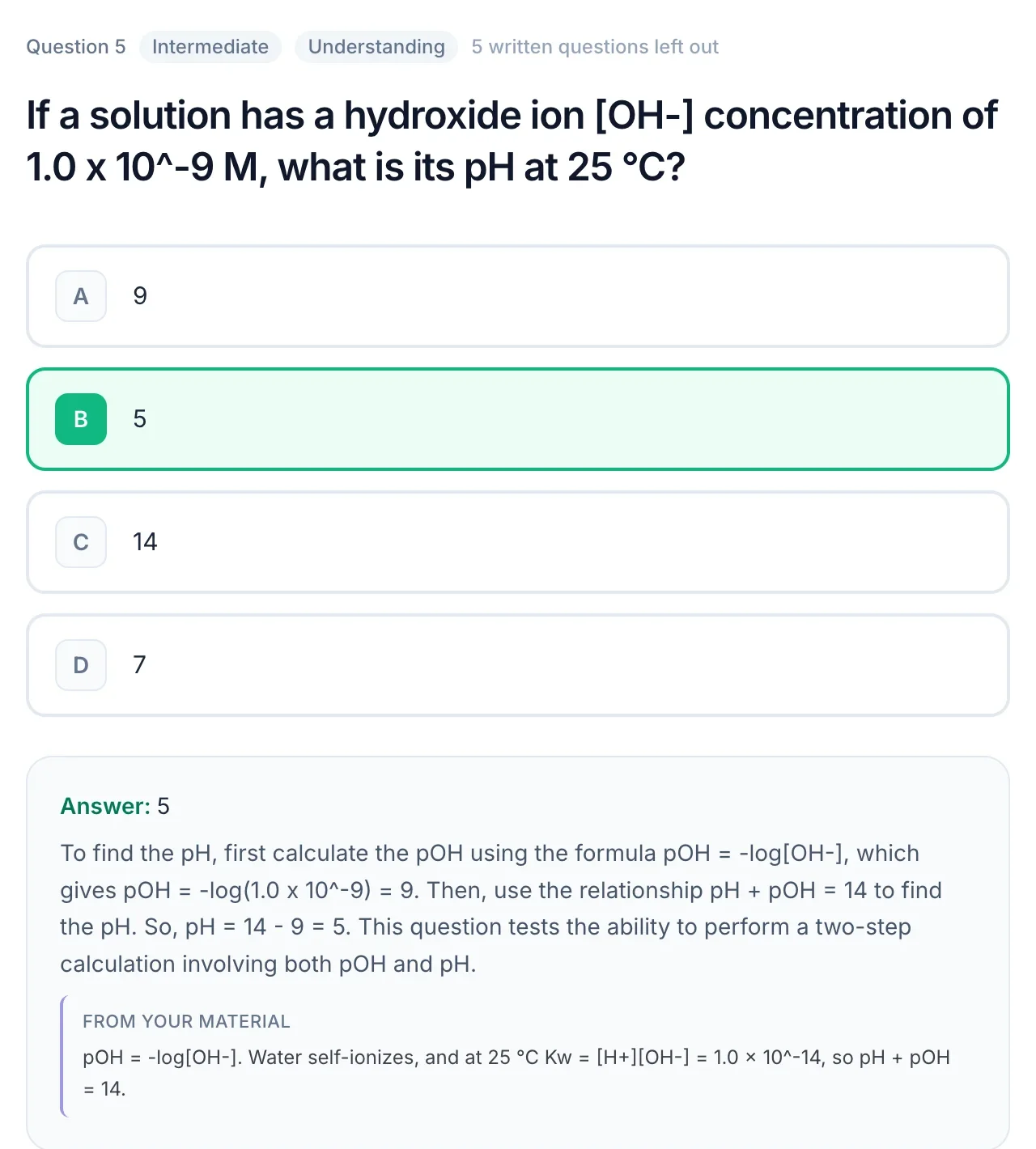
- What questions to ask (templates for any subject)
- Common mistakes to avoid
- Advanced techniques for mastery
By the end, you'll have a complete system for studying smarter, not harder.
Let's start with why this works so well.
Part 1: The Science - Why Questions Work Better Than Everything Else
The Research is Overwhelming
In 2011, researchers Karpicke and Blunt published a landmark study in Science that changed how we understand learning.
They compared four study methods:
- Re-reading the material
- Concept mapping (drawing connections)
- Elaborative studying (detailed note-taking)
- Retrieval practice (answering questions)
The results shocked the education world:
Students who used retrieval practice scored 50% higher on the final test than students who re-read the material. They even outperformed students who spent the same amount of time creating elaborate concept maps.
This wasn't a fluke. The testing effect, the finding that practicing retrieval improves long-term retention, has been replicated in over 100 studies across 80+ years.
Translation: Answering questions is approximately twice as effective as traditional studying.
What Happens in Your Brain When You Answer Questions
Here's the neurological magic:
When you read passively:
- Information enters working memory
- Your brain says "okay, I recognize this"
- It might make it to short-term memory
- But rarely encodes to long-term memory
- Result: You forget within 24 hours
When you answer a question:
- Your brain has to actively retrieve information
- This retrieval process strengthens neural pathways
- Your brain creates multiple access routes to the memory
- The effort of retrieval triggers deeper encoding
- Result: Information transfers to long-term memory
Think of it like this: Reading is like watching someone work out. Answering questions is like doing the workout yourself.
Only one builds strength.
The Four Mechanisms That Make Questions So Powerful
1. Retrieval Strengthening
Every time you successfully recall information, you strengthen the memory. It's like a muscle, use it or lose it. Questions force you to use the memory, making it stronger each time.
2. Elaborative Processing
When you generate questions or answer them, your brain has to reorganize information. This forces deeper processing than simple recognition. You're not just consuming, you're creating.
3. Metacognitive Awareness
Questions reveal what you actually know versus what just feels familiar. When you can't answer a question, you've identified a knowledge gap. This metacognitive feedback is invaluable for efficient studying.
4. Error Generation (Yes, Mistakes Help!)
When you answer incorrectly, your brain pays special attention to the correction. This "hypercorrection effect" means you're more likely to remember the right answer after getting it wrong than if you'd just read it passively.
Bottom line: Your brain evolved to learn through questioning and retrieval, not through passive absorption.
Part 2: The Framework - How to Actually Implement Question-Based Learning
Now that you understand why questions work, let's talk about how to use them effectively.
The 3-Phase Question-Based Learning System
Phase 1: Question Generation (During or After Reading) Phase 2: Active Recall Practice (Test Yourself) Phase 3: Spaced Review (Strategic Repetition)
Let's break down each phase.
Phase 1: Question Generation
When: During or immediately after learning new material
How Long: 15-20 minutes per chapter/lecture
The Process:
Step 1: Read/Learn Actively (Not Passively)
As you read, think: "What would I be tested on here?"
Look for:
- Definitions - Key terms and concepts
- Processes - How things work
- Relationships - Connections between ideas
- Applications - When/why you'd use this
- Comparisons - Similarities and differences
- Causes/Effects - Why things happen
Step 2: Create Questions Immediately
After each section (2-3 pages or 10-15 minutes of lecture), stop and create questions.
Aim for:
- 3-5 questions per major section
- 20-30 questions per chapter
- 10-15 questions per lecture
Step 3: Use the Question Pyramid
Create questions at multiple difficulty levels:
Level 1: Remember (30% of questions)
- What is X?
- Who discovered Y?
- When did Z occur?
- List the components of...
Level 2: Understand (40% of questions)
- How does X work?
- Why is Y important?
- Explain Z in your own words
- What's the difference between X and Y?
Level 3: Apply & Analyze (30% of questions)
- When would you use X?
- What would happen if Y changed?
- How is X similar to/different from Y?
- What are the implications of Z?
This distribution mirrors most exams and ensures comprehensive understanding.
Phase 2: Active Recall Practice
When: Same day as question generation + scheduled review sessions
How Long: 30-45 minutes per study session
The Process:
Step 1: Close Your Notes/Book
This is critical. If you can see the answers, you're doing recognition, not recall. Close everything.
Step 2: Answer Questions From Memory
Write your answers down. Don't just think them, writing forces precision and reveals gaps in understanding.
Step 3: Check Your Answers
Open your notes. Compare your answer to the correct one.
Grade yourself honestly:
- ✅ Correct: You knew it well
- ⚠️ Partial: You got the idea but missed details
- ❌ Wrong: You didn't know or got it significantly wrong
Step 4: Separate Questions Into Three Piles
Pile 1: Mastered (✅ questions)
- Review less frequently
- Boost confidence
Pile 2: Working On (⚠️ questions)
- Practice more
- Medium priority
Pile 3: Don't Know (❌ questions)
- Top priority
- Need immediate review
Phase 3: Spaced Review
When: Follow the spacing schedule below
How Long: 15-30 minutes per session
The Spacing Schedule:
First Review: 1 day after learning Second Review: 3 days after first review Third Review: 1 week after second review Fourth Review: 2 weeks after third review Fifth Review: 1 month after fourth review
This spacing schedule is based on the forgetting curve. You review just before you'd forget, which maximizes retention with minimum time investment.
During Reviews:
- Focus on Pile 3 (❌) questions first
- Then Pile 2 (⚠️) questions
- Quick check of Pile 1 (✅) to maintain
- Move questions between piles based on performance
- Add new questions as you learn new material
Part 3: The Question Types - What to Ask For Every Subject
Different subjects require different question approaches. Here's your comprehensive guide.
For Sciences (Biology, Chemistry, Physics)
Definition Questions:
What is cellular respiration? Define molarity. What is Newton's Second Law?
Process Questions:
How does photosynthesis convert light energy to chemical energy? What are the steps in glycolysis? Explain how a capacitor stores charge.
Mechanism Questions:
Why does increasing temperature speed up reaction rates? How do enzymes lower activation energy? What causes interference patterns in light waves?
Application Questions:
If you block the electron transport chain, what happens to ATP production? How would you prepare a 0.5M NaCl solution? Calculate the force needed to accelerate a 10kg object at 2m/s².
Comparison Questions:
Compare aerobic and anaerobic respiration. What's the difference between ionic and covalent bonds? How do series and parallel circuits differ?
For Mathematics
Concept Questions:
What does the derivative represent? When is a function continuous? What is the purpose of completing the square?
Procedure Questions:
How do you find the inverse of a matrix? What are the steps to factor a quadratic? How do you apply the chain rule?
Application Questions:
When would you use integration by parts? What real-world problems require systems of equations? How do you determine if an optimization problem has a maximum or minimum?
Problem-Solving Questions:
Solve: 3x² + 5x - 2 = 0 Find the derivative of f(x) = x³ sin(x) Calculate the area under y = x² from x=0 to x=2
For Humanities (History, Literature, Philosophy)
Factual Questions:
When did the French Revolution begin? Who wrote "Pride and Prejudice"? What is utilitarianism?
Analysis Questions:
What were the main causes of World War I? How does Fitzgerald use symbolism in "The Great Gatsby"? What are the strengths and weaknesses of Kant's categorical imperative?
Interpretation Questions:
What does the green light symbolize in "The Great Gatsby"? Why did the Renaissance begin in Italy? How would Mill respond to this ethical dilemma?
Synthesis Questions:
How did Enlightenment ideas influence the American Revolution? Compare Hemingway's and Faulkner's narrative styles. How do consequentialism and deontology differ in their approach to lying?
Evaluation Questions:
Was Reconstruction a success or failure? Defend your answer. Is Hamlet truly mad or feigning madness? Use textual evidence. Which ethical framework is most defensible? Why?
For Social Sciences (Psychology, Sociology, Economics)
Theory Questions:
What is cognitive dissonance? Describe Durkheim's theory of social solidarity. What is the law of supply and demand?
Research Questions:
How did Milgram study obedience? What methods do sociologists use to study culture? What data do economists use to measure inflation?
Application Questions:
How would social learning theory explain aggressive behavior? Apply conflict theory to analyze income inequality. Use supply and demand to predict the effect of a minimum wage increase.
Critical Thinking Questions:
What are the limitations of Freud's psychoanalytic theory? How might functionalist and conflict perspectives differ on education? What assumptions underlie classical economic models?
For Professional/Technical Subjects
Technical Knowledge:
What is the OSI model? Define GAAP principles in accounting. What is res ipsa loquitur in law?
Procedure Questions:
How do you debug a null pointer exception? What are the steps in closing the books? What is the process for filing a motion to dismiss?
Scenario Questions:
Given these symptoms, what's your differential diagnosis? How would you approach this code review? How would you structure this business transaction for tax efficiency?
Part 4: Advanced Techniques - Taking Question-Based Learning Further
Once you've mastered the basics, these advanced techniques will maximize your results.
Technique 1: The Interleaving Method
Don't study in blocks. Mix it up.
Bad:
- Monday: Chapter 1 questions
- Tuesday: Chapter 2 questions
- Wednesday: Chapter 3 questions
Better:
- Monday: Questions from Chapters 1, 2, and 3 mixed together
- Tuesday: More mixed questions from all three
- Wednesday: Continue mixing
Why it works: Interleaving forces your brain to actively discriminate between concepts, strengthening understanding and preventing the "familiarity trap."
Technique 2: Elaborative Interrogation
Don't just answer questions. Ask "why" and "how."
After answering a question, ask yourself:
- Why is this answer true?
- How does this connect to what I already know?
- What would happen if this weren't true?
- How could I explain this to someone else?
Example:
Question: What is photosynthesis?
Basic Answer: The process plants use to convert light into energy.
Elaborative Answer: Photosynthesis is how plants convert light energy into chemical energy stored in glucose. This happens because chlorophyll absorbs light, exciting electrons that drive ATP synthesis and the Calvin cycle. This is essential because it's the foundation of most food chains and produces the oxygen we breathe. Without it, life as we know it wouldn't exist.
The elaboration creates multiple retrieval pathways and deeper understanding.
Technique 3: The Feynman Technique Integration
Combine questions with explanations.
- Answer your question
- Explain the answer as if teaching a 10-year-old
- Identify gaps in your explanation
- Review those gaps
- Simplify and use analogies
This forces you to truly understand, not just memorize.
Technique 4: Pre-Testing
Create questions BEFORE you learn the material.
Look at chapter headings, learning objectives, and key terms. Generate questions about what you expect to learn.
Benefits:
- Activates prior knowledge
- Creates a mental framework
- Improves attention during learning
- Strengthens encoding
Example: Before reading about mitosis, ask:
- What is mitosis?
- Why do cells divide?
- What are the stages?
- How does it differ from meiosis?
Then learn the material. You'll retain dramatically more.
Technique 5: Multi-Modal Questions
Engage different cognitive systems.
Visual Questions:
Draw and label the cell cycle. Sketch how supply and demand curves shift. Diagram the nitrogen cycle.
Verbal Questions:
Explain photosynthesis aloud without notes. Teach this concept to a study partner. Record yourself explaining it.
Written Questions:
Write a paragraph comparing X and Y. Create a summary flowchart. Make a comparison table.
Motor Questions:
Act out how neurons fire. Use hand gestures to remember formulas. Build a physical model.
Different modalities create different memory traces, improving retention.
Part 5: Common Mistakes (And How to Avoid Them)
Even with the right method, these mistakes can sabotage your results.
Mistake 1: Creating Too Many Easy Questions
The Problem: Questions like "What is mitochondria?" are too simple. You can answer them without really understanding.
The Fix: Aim for 30% easy, 50% medium, 20% hard questions. Challenge yourself.
Mistake 2: Answering Questions With Notes Open
The Problem: Looking up answers defeats the purpose. You're doing recognition, not recall.
The Fix: Close everything. Struggle to remember. Check afterward. The struggle is where learning happens.
Mistake 3: Only Creating Factual Questions
The Problem: "What," "who," and "when" questions test surface knowledge. Exams test deeper understanding.
The Fix: Focus on "how," "why," "what if," and "compare" questions. These require understanding, not memorization.
Mistake 4: Not Scheduling Reviews
The Problem: Creating questions once and never reviewing them wastes the spaced repetition benefit.
The Fix: Set calendar reminders. Treat review sessions like any other class, non-negotiable.
Mistake 5: Giving Up Too Quickly
The Problem: Question-based learning feels harder at first than passive reading. Students quit before seeing results.
The Fix: Commit to trying it for 2 weeks. The initial difficulty is desirable difficulty. It's what makes it effective.
Mistake 6: Not Tracking Performance
The Problem: Without tracking, you don't know what you actually need to review.
The Fix: Mark questions as ✅, ⚠️, or ❌. Focus review time on your weaknesses, not your strengths.
Part 6: Tools and Systems for Question-Based Learning
You don't need fancy tools, but the right ones can save massive time.
The Manual System (Free)
What you need:
- Notebook or document for questions
- Separate paper for answers
- Calendar for scheduling reviews
Pros:
- Zero cost
- Complete control
- Builds question-writing skills
- Works anywhere
Cons:
- Time-consuming
- Manual tracking
- No automation
Best for: People who enjoy hands-on systems, minimal budgets, or short-term studying.
The Flashcard System (Free - $5/month)
Tools: Anki, Quizlet
What you do:
- Convert questions into flashcards
- Use spaced repetition algorithms
- Study on phone or computer
Pros:
- Automatic spacing
- Cross-device sync
- Pre-made decks available
- Good for memorization
Cons:
- Works best for simple Q&A
- Less good for complex questions
- Setup time required
Best for: Medical students, language learners, anyone memorizing large amounts of information.
The AI-Assisted System ($5-10/month)
Tools: QuerySpark, ChatGPT Plus
What you do:
- Upload PDFs/notes
- AI generates questions automatically
- You review, edit, and practice
- Export to your preferred format
Pros:
- Massive time savings (5 min vs 2 hours)
- Consistent quality
- Comprehensive coverage
- Multiple question types
Cons:
- Requires subscription
- Need to verify questions
- Internet connection required
Best for: Students with multiple courses, anyone studying from PDFs, people who value time savings.
My Recommended Hybrid System
What I actually use:
- QuerySpark to generate initial questions from PDFs (5 min/chapter)
- Manual additions for 3-5 tricky concepts I want extra practice (5 min)
- Anki for spaced repetition of medical terminology (optional)
- Google Docs for tracking progress and notes (free)
Total time per chapter: ~15 minutes question creation + 30 minutes practice
vs. my old system: 2 hours question creation + 30 minutes practice
Time saved: ~1.75 hours per chapter = 70+ hours per semester
Part 7: Subject-Specific Strategies
For STEM Courses
Priority: Process and application questions
Focus on:
- "How does X work?"
- "Why does Y happen?"
- "Calculate/solve for Z"
- "What happens if we change X?"
Special technique: Work backwards
Start with practice problems, identify what you need to know, then create questions about those concepts.
For Medical School
Priority: Clinical reasoning and mechanisms
Focus on:
- Case-based scenarios
- "Patient presents with X, what's your differential?"
- Mechanism questions ("How does this drug work?")
- High-yield facts organized by system
Use QuerySpark or similar for: Generating questions from lecture slides and textbooks.
Supplement with: Anki for memorization of anatomy, pharmacology, etc.
For Humanities/Social Sciences
Priority: Analysis, synthesis, and argumentation
Focus on:
- "What does X mean/symbolize?"
- "Compare X and Y"
- "What evidence supports Z?"
- "How would X respond to Y?"
Special technique: Debate questions
Create questions that have multiple valid answers. Practice arguing both sides.
For Languages
Priority: Production, not just recognition
Focus on:
- "How do you say X in [language]?"
- "Conjugate Y in [tense]"
- "What's wrong with this sentence?"
- "Translate this paragraph"
Special technique: Delayed translation
Create questions in the target language. Answer in target language. Forces production.
For Professional Exams (Bar, CPA, etc.)
Priority: Application and scenario-based
Focus on:
- "Client scenario X, what do you advise?"
- "Fact pattern Y, what's the issue?"
- "Calculate Z given these conditions"
Use real exam questions as models for your own question creation.
Part 8: Making It Stick - Building the Habit
Knowing the method is useless if you don't actually do it.
Week 1: Just Try It
Goal: Experience the method once
Action:
- Pick one chapter or lecture
- Create 10-15 questions
- Answer them the next day
- Notice the difference
Don't: Try to overhaul your entire study system
Week 2: Add Consistency
Goal: Use it for all new material
Action:
- Create questions for every new lecture/chapter
- Follow the spacing schedule
- Track which questions you miss
Don't: Worry about perfection
Week 3: Optimize Your System
Goal: Find your personal workflow
Action:
- Experiment with tools (manual vs. AI)
- Adjust question ratios
- Find ideal study session length
Don't: Change systems every day
Week 4: Full Integration
Goal: Make it automatic
Action:
- Question-based learning is now your default
- You don't think about it, you just do it
- Refine based on what works
Don't: Stop because it's working (keep the habit)
Habit Stacking
Attach question creation to existing habits:
"After I finish reading a chapter, I immediately create questions."
"After every lecture, before I close my laptop, I generate 10 questions."
"During my morning coffee, I review yesterday's questions."
Accountability
Find a study partner:
- Share questions
- Quiz each other
- Compare approaches
- Keep each other honest
Or use social accountability:
- Post your system on r/GetStudying
- Share progress on social media
- Join study Discord servers
Part 9: What the Evidence Actually Shows
It is tempting to put a few student success stories here. We would rather point you at the research, because it is stronger than any anecdote and you can go read it yourself.
Roediger and Karpicke, 2006
The foundational study. Students read a passage, then either reread it or took a recall test. On a test five minutes later, the rereaders did slightly better. On a test one week later, the students who had tested themselves recalled about 61 percent against about 40 percent for the rereaders. The advantage grows with delay, which is exactly the direction that matters for exams.
Dunlosky and colleagues, 2013
A review in Psychological Science in the Public Interest rated ten study techniques on the strength of the evidence behind them. Practice testing and distributed practice were the only two rated high utility. Highlighting, rereading and summarising were all rated low.
Karpicke and Blunt, 2011
Published in Science. Retrieval practice beat elaborative concept mapping, and it beat it on questions measuring meaningful learning and inference, not just verbatim recall. This matters because the usual objection to testing yourself is that it only builds shallow memorisation.
What this does not tell you
The effect sizes in these studies come from controlled conditions with assigned materials. Your results depend on the quality of your questions, whether you actually attempt retrieval before checking, and whether you keep it up across a semester. The technique is well supported. The discipline is still on you.
Part 10: Your Action Plan - Start Today
Don't wait. Start implementing question-based learning right now.
Today (15 minutes):
- Choose one upcoming test/assignment
- Pick one chapter or lecture from it
- Create 10 questions (use templates from this guide)
- Set a reminder to answer them tomorrow
This Week:
- Create questions for all new material
- Practice active recall daily (15-30 min)
- Note the difference in retention
- Adjust approach based on results
This Month:
- Full implementation of the 3-phase system
- Experiment with tools (manual, AI, flashcards)
- Build the habit through repetition
- Track your grade improvements
This Semester:
- Question-based learning is your default
- Refine based on each subject's needs
- Help others discover the method
- Enjoy better grades with less stress
Conclusion: The Study Revolution Starts With Questions
Everything I've shared in this guide comes down to one shift:
Stop being a passive consumer of information. Become an active retriever.
Questions are the tool that makes this shift possible.
They force your brain to work. They reveal gaps in understanding. They build retrieval strength. They create the "desirable difficulty" that leads to real learning.
The research is clear: Question-based learning is approximately twice as effective as passive review methods.
The student results are consistent: Better grades, less time, lower stress.
The implementation is straightforward: Create questions, practice retrieval, review with spacing.
You already know how to ask questions. You've been doing it your entire life.
Now you just need to use questions deliberately as your primary study tool.
Start today. Start small. Start with just 10 questions.
I promise you'll never go back to highlighting and re-reading.
Quick Start Toolkit
Question Templates (Copy These):
- What is [concept]?
- How does [process] work?
- Why is [idea] important?
- What's the difference between [X] and [Y]?
- When would you use [method]?
- What happens if [condition] changes?
- How is [concept] similar to/different from [related concept]?
- What evidence supports [claim]?
- What are the limitations of [theory]?
- How would you explain [concept] to someone unfamiliar with it?
Spacing Schedule (Set Reminders):
- Review 1: 1 day after learning
- Review 2: 3 days later
- Review 3: 1 week later
- Review 4: 2 weeks later
- Review 5: 1 month later
Time-Saving Tool:
If you're studying from PDFs and want to save hours of question creation:
👉 Try QuerySpark free - Upload a PDF, get practice questions in minutes
Generate your first set of questions automatically, then refine them to your needs. Perfect for students with multiple courses and limited time.
What's your biggest challenge with studying? Drop a comment, I read and respond to everyone.
Additional Resources
Related Guides:
- How to Generate Practice Questions from PDFs - 4 methods compared
- The 2AM Study Crisis: Why Highlighting Doesn't Work - Breaking bad study habits
- I Read 47 Research Papers This Month. Here's What Stuck - The science of retention
Free Downloads:
- 100 Question Templates for Every Subject - Ready-to-use templates
- Spaced Repetition Study Calendar - Pre-filled review schedule
- Question-Based Learning Checklist - Implementation guide
Scientific Papers:
- Karpicke & Blunt (2011): "Retrieval Practice Produces More Learning"
- Roediger & Karpicke (2006): "Test-Enhanced Learning"
- Dunlosky et al. (2013): "Improving Students' Learning with Effective Learning Techniques"
Published: [DATE]
Updated: [DATE]
Reading Time: 25 minutes
Category: Study Methods & Techniques
Tags: question-based learning, study methods, active recall, retrieval practice, study smarter, exam preparation, learning science
Share this guide:
Twitter | Reddit | Facebook | Email | Pinterest