Overview
It's 2AM, your exam is in 6 hours, and your highlighted notes are useless. Here's why highlighting fails and the active study method that actually improves retention by 50%.
2:47 AM. Six Hours Until Your Exam.
Your desk looks like a war zone.
Empty Red Bull cans. Crumpled notes. That textbook you swore you'd start reading three weeks ago, now opened for the first time tonight.
And there, spread across your screen, are 47 pages of highlighted PDF notes. Yellow. Pink. Blue. Green. It looks like a rainbow exploded on every page.
You thought you were prepared. You highlighted everything that seemed important. Your notes are a masterpiece of color-coded organization. You spent hours on this.
But now, with your exam looming in 6 hours, you're re-reading the same paragraph for the fifth time and retaining nothing.
Your brain is mush. The words blur together. You can't tell what's important anymore—everything is highlighted. And worse, you don't actually understand any of it.
You're in what I call the 2AM Study Crisis.
I've been there. Sitting in that exact spot, feeling that exact panic, wondering why the study method everyone uses—the method that feels so productive—has completely failed you when it matters most.
The truth? Highlighting doesn't work. Not for real learning. Not for retention. Not for exams.
But here's the good news: There's a better way. And it doesn't require superhuman discipline or exotic study techniques. It's actually simpler than what you're doing now.
Let me show you why your current method is broken, and what to do instead.
The Highlighting Illusion: Why It Feels Productive But Isn't
Let's start with the hard truth: Highlighting is one of the least effective study techniques.
I know. I know. Everyone highlights. Your professors highlight. Your straight-A roommate highlights. The study guides all say to "identify key information."
But research from cognitive psychology is brutally clear about this.
What the Science Actually Says
In 2013, researchers John Dunlosky and colleagues published a massive review in Psychological Science in the Public Interest analyzing the effectiveness of 10 common study techniques.
Highlighting's rating? "Low utility."
The study found that highlighting produced minimal learning benefits compared to active study strategies. In some cases, students who highlighted actually performed worse on tests than students who did nothing at all.
Wait, what? How is that even possible?
The Three Lies Your Brain Tells You About Highlighting
Lie #1: "If I highlight it, I'll remember it."
Wrong. Highlighting is a recognition task, not a recall task.
When you highlight, your brain is just recognizing that "yes, this seems important." You're not processing the information deeply. You're not connecting it to other knowledge. You're not transforming it in any meaningful way.
Think about it: Can you remember what you highlighted three pages ago without looking back? Probably not.
Lie #2: "Highlighting helps me focus on what's important."
If you're like most students, you highlight 30-60% of your textbook or notes.
At that point, what are you even highlighting? If more than half the page is yellow, nothing is actually emphasized. You've just created a different color scheme for reading.
Lie #3: "The colorful pages mean I'm learning."
This is the cruelest lie. Your brain gives you a dopamine hit when you create those colorful pages. It feels productive. It looks like learning.
Psychologists call this a "fluency illusion"—when something feels easy and familiar, you mistake that feeling for actual learning.
But come test day, fluency evaporates. And you're left with nothing.
Why We Keep Highlighting (Even Though It Doesn't Work)
If highlighting is so ineffective, why does everyone do it?
Reason 1: It's Easy
Highlighting requires minimal cognitive effort. Read. See something that seems important. Swipe yellow marker. Done.
Compare that to actually thinking about the material, generating questions, or explaining concepts in your own words. That stuff is hard.
Our brains naturally gravitate toward the easy option, especially when we're tired or stressed.
Reason 2: It Looks Like Productivity
When you finish highlighting a chapter, you have visual proof of your work. Look at all those colors! You did something!
But "doing something" and "learning something" are not the same.
Reason 3: Everyone Else Does It
Social proof is powerful. If your friends highlight, if study guides recommend it, if it's what you've always done... why would you stop?
Breaking this habit requires seeing the evidence and being willing to try something different.
Reason 4: We Confuse Familiarity with Understanding
When you re-read highlighted text, it looks familiar. Your brain says, "Oh yes, I've seen this before."
You mistake this recognition for understanding. But on the test, when you need to recall or apply the information? It's not there.
The Real Reason You Can't Remember What You Studied
Here's what's actually happening in your brain when you highlight:
The Highlighting Process (Passive Learning)
- You read: Information enters working memory
- You highlight: You flag it as "important" (recognition)
- You move on: Information never makes it to long-term memory
- Later, you re-read: You recognize it again (still not learning)
- Test day: You need to recall... and there's nothing there
Result: Recognition without retention.
What Your Brain Actually Needs (Active Learning)
For information to stick, your brain needs:
- Elaboration: Connecting new info to existing knowledge
- Retrieval practice: Actively pulling information from memory
- Reorganization: Transforming information into your own structure
- Application: Using knowledge in different contexts
- Spacing: Reviewing over time, not in one marathon session
Highlighting does exactly none of these things.
The Methods That Actually Work: Ranked by Effectiveness
Based on that same 2013 study and subsequent research, here are study techniques ranked from most to least effective:
Tier 1: High-Effectiveness Techniques
1. Practice Testing (THE WINNER)
Creating and answering practice questions about the material.
- Effectiveness: High
- Research support: Overwhelming
- Retention improvement: 50-80% vs. re-reading
- Why it works: Forced retrieval strengthens memory pathways
2. Distributed Practice (Spacing)
Spreading study sessions over time instead of cramming.
- Effectiveness: High
- Research support: Decades of evidence
- Retention improvement: 100%+ vs. massed practice
- Why it works: Takes advantage of how memory consolidation works
Tier 2: Moderate-Effectiveness Techniques
3. Self-Explanation
Explaining concepts to yourself in your own words.
- Effectiveness: Moderate
- Research support: Strong
- Why it works: Forces deeper processing and connection-making
4. Interleaved Practice
Mixing different types of problems or topics in one session.
- Effectiveness: Moderate
- Research support: Growing
- Why it works: Develops discrimination and transfer skills
Tier 3: Low-Effectiveness Techniques (Don't Waste Your Time)
5. Highlighting/Underlining
- Effectiveness: Low
- Why it fails: Passive, no deep processing
6. Re-reading
- Effectiveness: Low
- Why it fails: Creates fluency illusion without retention
7. Summarization (when done poorly)
- Effectiveness: Low
- Why it fails: Often just copying without understanding
The pattern? Active techniques beat passive techniques every single time.
The Question Method: Your 2AM Crisis Solution
Let me introduce you to the study method that saved my academic career (and my sleep schedule):
Question-based learning.
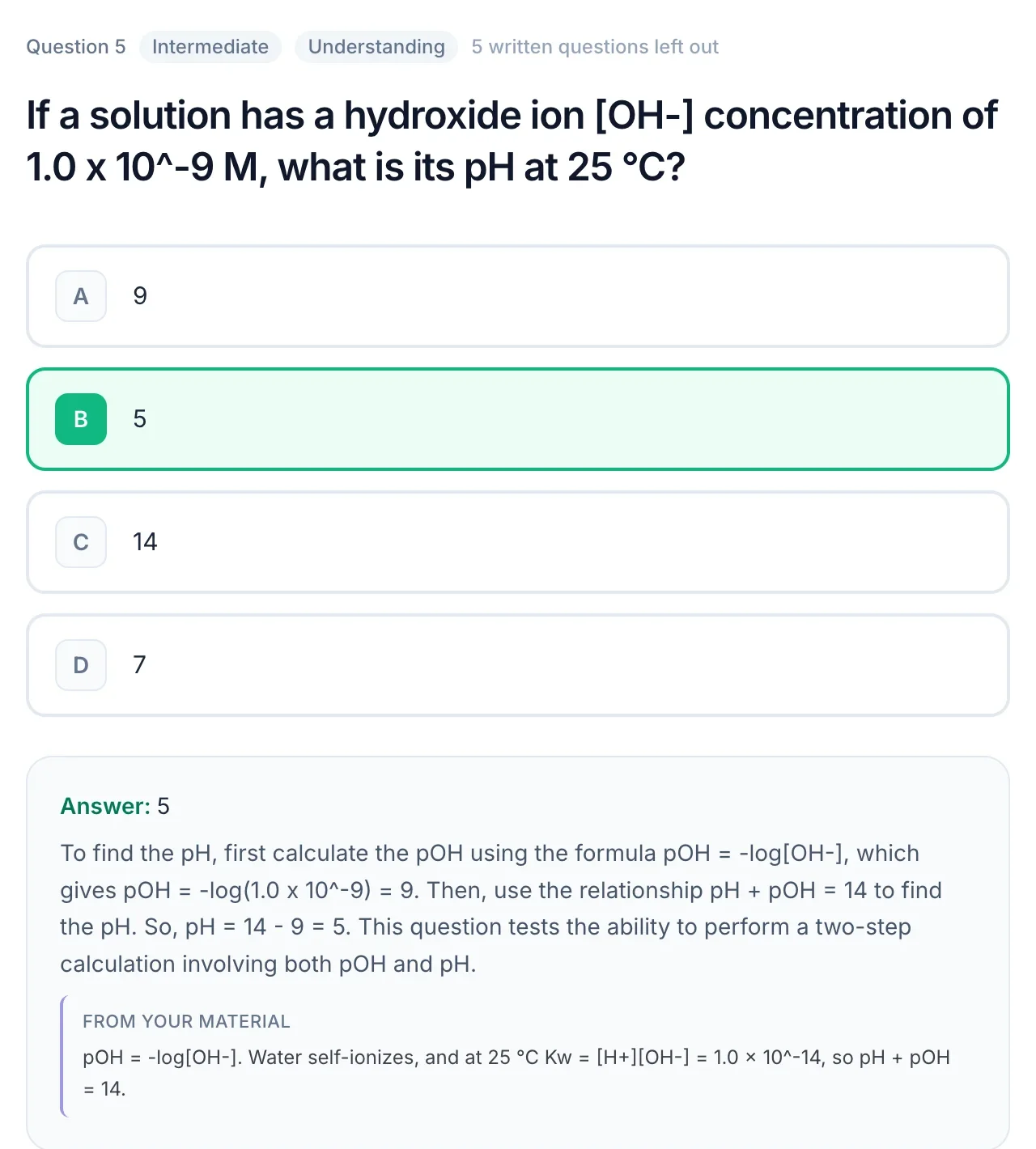
Instead of highlighting, you transform your notes into questions. Then you practice answering them without looking. That's it.
Simple? Yes. Easy? At first, no. Effective? Absolutely.
Why Questions Work So Well
When you create questions from material, your brain does four things:
1. Deep Processing: You have to understand the material well enough to formulate a question about it. This alone is more cognitive work than highlighting.
2. Retrieval Practice: Answering questions (especially without looking) is exactly what you'll need to do on the test.
3. Metacognition: Questions reveal what you actually understand vs. what just feels familiar.
4. Active Engagement: Your brain stays focused because question generation requires attention.
The 2AM Emergency Protocol (When You're Already Screwed)
Okay, real talk. It's 2AM, your exam is in 6 hours, and you need a protocol RIGHT NOW.
Here's what to do:
2:00-2:30 AM: Emergency Question Generation (30 min)
- Open your highlighted notes/textbook
- Scan your highlights (don't re-read everything)
- For each major highlighted section, write ONE question
- Aim for 20-30 questions total
- Don't overthink—fast is better than perfect right now
Use these quick question templates:
- What is [concept]?
- How does [process] work?
- What's the difference between [X] and [Y]?
- Why is [topic] important?
- What happens if [condition]?
2:30-3:30 AM: Active Recall Practice (60 min)
- Close your notes
- Answer each question from memory
- Write brief answers (2-3 sentences)
- Check your answers
- Mark the ones you got wrong
3:30-4:00 AM: Target Weak Areas (30 min)
- Focus ONLY on questions you missed
- Re-read those specific sections
- Try answering those questions again
- Repeat until you get them right
4:00-6:00 AM: Sleep (SERIOUSLY)
Two hours of sleep > two more hours of cramming. Your brain needs rest to consolidate what you just practiced.
6:00-7:30 AM: Final Review
Quick run through all questions one more time. Focus on the ones you struggled with at 3:30 AM.
Is this ideal? No. Should you plan better next time? Absolutely. Will this work better than re-reading highlights for 4 hours? 100% yes.
The Better Way: How to Study BEFORE the Crisis
Now let's talk about how to avoid the 2AM crisis altogether.
Week 1: After Each Lecture/Reading
During or immediately after class/reading (20 min):
- Take notes normally (don't worry about perfection)
- Before closing your notebook, spend 5 minutes creating questions
- Aim for 5-10 questions per lecture or chapter section
- Focus on main concepts, not every detail
Use the 5 question types:
- Definition: What is [term]?
- Explanation: How/why does [concept] work?
- Application: When would you use [principle]?
- Comparison: How is [X] different from [Y]?
- Analysis: What are the implications of [idea]?
That evening (10 min):
- Try answering your questions without looking
- Check your answers
- Note which ones you struggled with
Week 2-3: Regular Review
Every 3 days (15 min):
- Review all questions from the past week
- Answer them without looking
- Identify patterns in what you're forgetting
- Adjust your questions if they're too easy/hard
Weekly review (30 min):
- Go through ALL questions from the past 2-3 weeks
- Create new questions connecting different topics
- Remove questions you can answer instantly
Week 4: Pre-Exam Intensive
5 days before exam:
- Compile all questions into one master list
- Organize by topic/difficulty
- Identify your 3 weakest areas
3 days before:
- Practice all questions in random order
- Focus extra time on weak areas
- Create a few new "connecting" questions
1 day before:
- Final run-through of all questions
- Quick review of only the questions you miss
- Early bedtime (seriously)
Exam day:
- Light review of trickiest questions over breakfast
- Trust your preparation
- Breathe
How to Make the Transition From Highlighting to Questions
"Okay, I'm convinced. But I've been highlighting for years. How do I actually change?"
Start small. Don't try to overhaul everything at once.
Week 1: Hybrid Approach
- Keep highlighting if it makes you comfortable
- BUT: After each section, add 3 questions
- You're just adding questions on top of your current method
Week 2: Shift the Balance
- Highlight less (only genuinely key terms/concepts)
- Create more questions (5-8 per section)
- Start answering questions the same day you create them
Week 3: Question-First
- Read with question-generation intent
- Highlight only to mark content for questions
- Most of your active time is on questions now
Week 4: Full Transition
- Questions are your primary study tool
- Highlighting becomes minimal or disappears
- You trust the method because you've seen results
Tools That Help
For manual question creation:
- Notebook + pen (classic, effective)
- Google Doc with two columns (questions | answers)
- Notion (if you're already using it)
For AI-assisted question creation:
- QuerySpark (upload PDFs, get questions automatically)
- Anki (spaced repetition flashcards)
- Quizlet (if you prefer their interface)
My personal system: I use QuerySpark to generate initial questions from my PDFs (saves hours), then add 5-10 custom questions on concepts I find tricky. Takes about 15 minutes per chapter instead of 2+ hours creating everything manually.
Real Students, Real Results
Let me share some transformations I've seen (names changed for privacy):
Sarah: From 2.8 to 3.7 GPA in One Semester
Before:
- Highlighted entire textbooks (seriously, 60%+ of every page)
- Re-read notes multiple times
- Pulled all-nighters before exams
- GPA: 2.8
After switching to questions:
- Created 30-40 questions per chapter
- Practiced active recall daily
- Slept 7+ hours before exams
- GPA: 3.7 (one semester later)
Her quote: "I actually understand the material now instead of just recognizing it during the test."
Marcus: From Retaking Organic Chemistry to Acing It
First attempt (with highlighting):
- Spent 4 hours per day studying
- Highlighted notes and textbook
- Failed with a D+
Second attempt (with questions):
- Spent 2 hours per day studying
- Created and practiced questions
- Passed with an A-
His quote: "Questions forced me to actually understand mechanisms instead of memorizing structures. Game-changer."
Jessica: Cut Study Time in Half, Improved Grades
Before:
- 6 hours per day studying
- Lots of re-reading and highlighting
- B average
After:
- 3 hours per day studying
- Question-based learning
- A- average
Her quote: "I thought reducing study time would hurt my grades. Turns out quality matters way more than quantity."
The Most Common Objections (And My Answers)
"But highlighting is fast and easy!"
Yes, and it's also ineffective. Fast and easy means nothing if you don't retain the information.
Creating questions takes more initial time, but saves massive time because you don't have to re-read everything 5 times.
Math:
- Highlighting: 30 min + re-reading 4x (20 min each) = 110 minutes total
- Questions: 45 min creating + 30 min practicing = 75 minutes total
Questions are actually faster overall AND more effective.
"I don't know how to create good questions"
Nobody does at first. You get better with practice.
Start with simple "What is..." questions. Gradually add "How..." and "Why..." questions. Use AI tools like QuerySpark to see examples of good questions, then model yours after them.
"What if I highlight AND create questions?"
That's fine as a transition, but you'll eventually realize highlighting adds no value. Save yourself the time.
"My professor highlights in lecture. Should I copy those highlights?"
Your professor highlighting while teaching is different from you highlighting while learning. They already know the material—they're just emphasizing for your benefit.
Better approach: Turn the professor's highlights into questions during or right after class.
"This seems like more work"
Initially, yes. The first few times creating questions feels slow and awkward.
But like any skill, you get faster. By week 3, question creation becomes second nature. And the payoff—actually remembering what you study—is worth every minute.
"What about for memorization-heavy classes?"
Question-based learning works especially well for memorization!
Instead of trying to memorize by re-reading, you're practicing retrieval—which is exactly what you need to do on the test. Questions are perfect for terminology, dates, formulas, etc.
The Questions You Should Be Asking Right Now
Let me predict your questions and answer them:
Q: How many questions should I create per chapter?
A: For a typical 20-30 page textbook chapter, aim for 30-50 questions. That's about 1-2 questions per page of content. More is fine, but quality > quantity.
Q: Should I create questions while reading or after?
A: Both work, but I prefer after reading a section. Read → understand → then create questions. This way you can focus on actually understanding first, then synthesizing into questions.
Q: What if I can't answer my own questions?
A: Perfect! That tells you exactly what you need to study more. Questions are diagnostic tools—they reveal your knowledge gaps.
Q: How do I remember to review questions regularly?
A: Set calendar reminders. Treat review sessions like any other class—they're scheduled, non-negotiable time. 15 minutes 3x per week is infinitely better than 3 hours the night before the exam.
Q: Can I use this method for math and science?
A: Absolutely! For math: Create questions about when to use formulas, how to approach problem types, and why certain methods work. For science: Process questions, mechanism questions, and application questions work great.
Q: What about essays and humanities?
A: Especially effective! Create questions about themes, arguments, evidence, connections between texts, and critical analysis. Perfect for humanities.
Q: Should I study alone or in groups with this method?
A: Both! Create questions individually, then quiz each other in study groups. Teaching others and hearing their explanations is incredibly valuable.
Your Action Plan: Starting Tomorrow
Don't wait until your next 2AM crisis. Start building better habits now.
This Week:
Day 1 (Today):
- Finish reading this article
- Pick ONE upcoming assignment or chapter
- Commit to trying the question method with just that one thing
Day 2-3:
- Read/attend that class
- Create 10-15 questions from the material
- Try answering them before you sleep
Day 4:
- Review those questions (answer without looking)
- Note which ones were hard
- Quick 5-minute review of just the hard ones
Day 5-7:
- Repeat the process with new material
- Build the question-creation muscle
- Notice how much more you remember
Next Week:
- Continue with all new material
- Start spacing reviews (questions from Week 1 + Week 2)
- Refine your question templates
- Notice your confidence growing
By Week 4:
- This will feel natural
- Your study sessions will be shorter
- Your retention will be noticeably better
- You'll wonder why you ever highlighted
The Bottom Line: Choose Active Over Passive
Here's what it comes down to:
Highlighting is passive. Questions are active.
Passive learning feels easier in the moment but fails when it matters.
Active learning feels harder initially but delivers when you need it.
You can keep doing what's comfortable and keep having 2AM panic sessions where nothing sticks.
Or you can invest 30 minutes learning a better method that will save you hundreds of hours and dramatically improve your grades.
The choice is yours.
But if you're tired of colorful notes that don't help, if you're sick of studying for hours and forgetting everything, if you want to actually understand material instead of just recognizing it...
Try questions for one week. Just one week.
I'm betting you'll never go back to highlighting.
P.S. - How to Avoid Your Next 2AM Crisis
If you want to start immediately with zero effort:
- Take your next PDF (textbook chapter, lecture notes, study guide)
- Upload it to QuerySpark
- Get 20-50 practice questions generated automatically in 2 minutes
- Start practicing
No manual question writing. No figuring out "good question" templates. Just instant, quality practice questions from your material.
👉 Try QuerySpark free - First document is free, no signup required. See how much faster studying can be when you skip the highlighting phase entirely.
Because the best way to avoid a 2AM study crisis is to never need one in the first place.
What's your biggest struggle with studying? Have you been stuck in the highlighting trap? Share in the comments—I read and respond to everyone.
Additional Resources
Related Posts:
- I Read 47 Research Papers This Month. Here's What Actually Stuck - Deep dive on question-based learning
- How to Generate Practice Questions from PDFs (4 Methods Compared) - Comprehensive guide to creating questions efficiently
- Study Smarter: The Complete Guide to Question-Based Learning - The ultimate resource on this method
Free Downloads:
- The 2AM Crisis Prevention Checklist - Weekly study schedule template
- 50 Question Starters for Any Subject - Templates to jumpstart question creation
- Study Method Comparison Chart - Visual guide to effective vs. ineffective techniques
Scientific Papers (if you want to dig deeper):
- Dunlosky et al. (2013): "Improving Students' Learning With Effective Learning Techniques"
- Karpicke & Blunt (2011): "Retrieval Practice Produces More Learning than Elaborative Studying with Concept Mapping"
- Roediger & Karpicke (2006): "Test-Enhanced Learning"