
AI Quiz Generator for the CPA Exam: CPA Practice Questions from Your Notes
Finish a FAR, AUD or REG lesson, upload your notes, and check that the rules stuck before you move on. QuerySpark writes multiple choice questions with an explanation for every answer in about a minute.
- No credit card
- Free plan after the trial
- Cancel anytime
Drop a PDF, slides or notes
or paste a YouTube link
Quick answer
Can you make CPA practice questions from your own notes?
Yes. Upload your review notes, lecture slides or textbook chapters and QuerySpark writes multiple choice questions for FAR, AUD, REG or your Discipline section, with an explanation for every answer, usually 10 to 20 per set in about a minute. Use it to drill the topic you just studied. It does not replace your review course's question bank: it does not write task-based simulations and is not calibrated to the exam.
- Multiple choice for FAR, AUD, REG, BAR, ISC and TCP topics
- An explanation for every answer; most show the source passage
- 3-day Pro trial with no card
- Export to PDF, Word or CSV
Made for the exams and classes you are studying for
- NCLEX
- MCAT
- AP Biology
- USMLE Step 1
- CPA
- AP US History
- Pharmacology
- Anatomy and Physiology
- LSAT
- CompTIA Security+
- Organic Chemistry
- Microeconomics
- GCSE Science
- AP Psychology
- Bar exam
- Pathophysiology
- Calculus
- IB Biology
- World History
- Physics
- Biochemistry
- Statistics
- PMP
- Intro to Psychology
One upload
Every way to study, made from your notes
Each upload gives you practice questions, flashcards, a study guide and practice tests. Pick whichever suits the day.
Core and Discipline
CPA practice questions for each exam section
The exam uses a Core plus Discipline model: every candidate takes AUD, FAR and REG, plus one Discipline section (BAR, ISC or TCP). Each section mixes multiple choice with task-based simulations. Here is where generated questions help most.
| Section | Typical topics in your notes | Fit for generated questions |
|---|---|---|
| FAR (Core) | Revenue recognition, leases, bonds, inventory, governmental and not-for-profit accounting | Strong: rules plus short calculation questions |
| AUD (Core) | Engagement planning, internal control, evidence, audit reports, ethics | Strong: concept and judgment questions |
| REG (Core) | Individual and entity taxation, business law, ethics and responsibilities in tax | Strong, if your notes match the tax law your exam window tests |
| BAR (Discipline) | Financial statement analysis, data analytics, technical accounting topics | Good for concepts; long calculations belong in your review course |
| ISC (Discipline) | IT general controls, data management, security and privacy, SOC engagements | Strong for control concepts and terms |
| TCP (Discipline) | Tax compliance and planning for individuals and entities, property transactions | Good, with the same tax-year check as REG |
Topic lists are summaries. The AICPA Blueprint for each section is the official list of what is tested.
Daily volume
How many CPA practice questions should you do a day?
Enough to cover what you learned that day, then more as the exam gets closer. Early in a section, 20 to 40 multiple choice questions on the topic you just studied is plenty. During review, many candidates work 40 to 80 mixed questions a day and a few simulations a week.
Watch your score on questions you have not seen before. Repeating the same review-course questions inflates scores because you start remembering answers. Fresh questions generated from your notes on a weak topic are a quick check of whether you understand the rule or just recognize the question.
| Phase | Daily practice | Where the questions come from |
|---|---|---|
| Learning a new topic | 20 to 40 multiple choice on that topic | Your review course's questions; a QuerySpark set from your notes right after each lesson |
| Mid-section review | 40 to 80 mixed multiple choice, plus a few simulations | Your review course's question bank and simulations; QuerySpark for topics you keep missing |
| Final 1 to 2 weeks | Mixed questions, simulations and a full mock exam | Review course mock exams and the free AICPA sample test; QuerySpark flashcards for formulas and thresholds |
Common ranges candidates use, not official guidance. Adjust them to your schedule.
Study plan
How to study for the CPA exam
Studying for free? The AICPA Blueprints and sample tests cost nothing, and QuerySpark's free plan covers 20 questions a month after the trial. Most candidates still use a paid review course for its simulations.
- 01
Choose a section order
Many candidates start with FAR, the broadest section, or with the section closest to their day job. Check how long your jurisdiction gives you to pass the rest once you pass your first.
- 02
Learn, then question, the same day
After each review-course lesson, generate a quick set from your notes and check that the rules stuck before moving on.
- 03
Do simulations every week
Task-based simulations carry a large share of each section's score and need practice in exam-like software, so schedule them from the first week, not the last.
- 04
Final review from your miss log
In the last one to two weeks, work mixed questions, take the AICPA sample test to learn the interface, and review your miss log every day.
Miss log
How to review missed CPA questions
Calculation misses: redo the problem on paper from scratch before reading the solution. If you get it right the second time, the issue was speed or a careless step; if not, it is the method.
Rule misses:write the rule as a one-line flashcard, such as "tracing tests completeness, vouching tests occurrence." Thresholds and criteria are exactly what spaced repetition is good at.
Reading misses: questions that ask which is not, least likely or most appropriate are easy to flip. Underline the qualifier on your scratch sheet before you look at the options.

Question types
What QuerySpark writes for CPA candidates
Want a timed run through several topics? The practice test maker turns your notes into a scored test.
Short calculations
Inventory costing, depreciation, bond amortization, basis and gain: short problems with an explanation of the numbers.
Rules and standards
Recognition criteria, report types and thresholds, asked the way multiple choice questions test them.
Audit and controls concepts
Assertions, evidence, internal control and IT general controls for AUD and ISC.
Flashcards with spaced repetition
Formulas, thresholds and journal entries, brought back on a schedule so FAR survives until you sit REG.
Scored practice tests
Combine several topics into one practice test and get a score at the end.
PDF, Word and CSV export
Print a set for the train, or import the CSV into Anki or Quizlet.
Honest limits
What it is not: a CPA review course
QuerySpark is not affiliated with the AICPA or NASBA. Questions are not calibrated to exam difficulty and there is no score prediction.
It does not write task-based simulations: no research tasks, document review, journal-entry grids or spreadsheet exhibits. Practice those in your review course.
Tax law and standards change. Questions come from your material, so outdated notes produce outdated questions; check that your REG and TCP notes match the tax year your exam window tests.
Each question has one correct answer. Only upload material you are entitled to use for your own study.
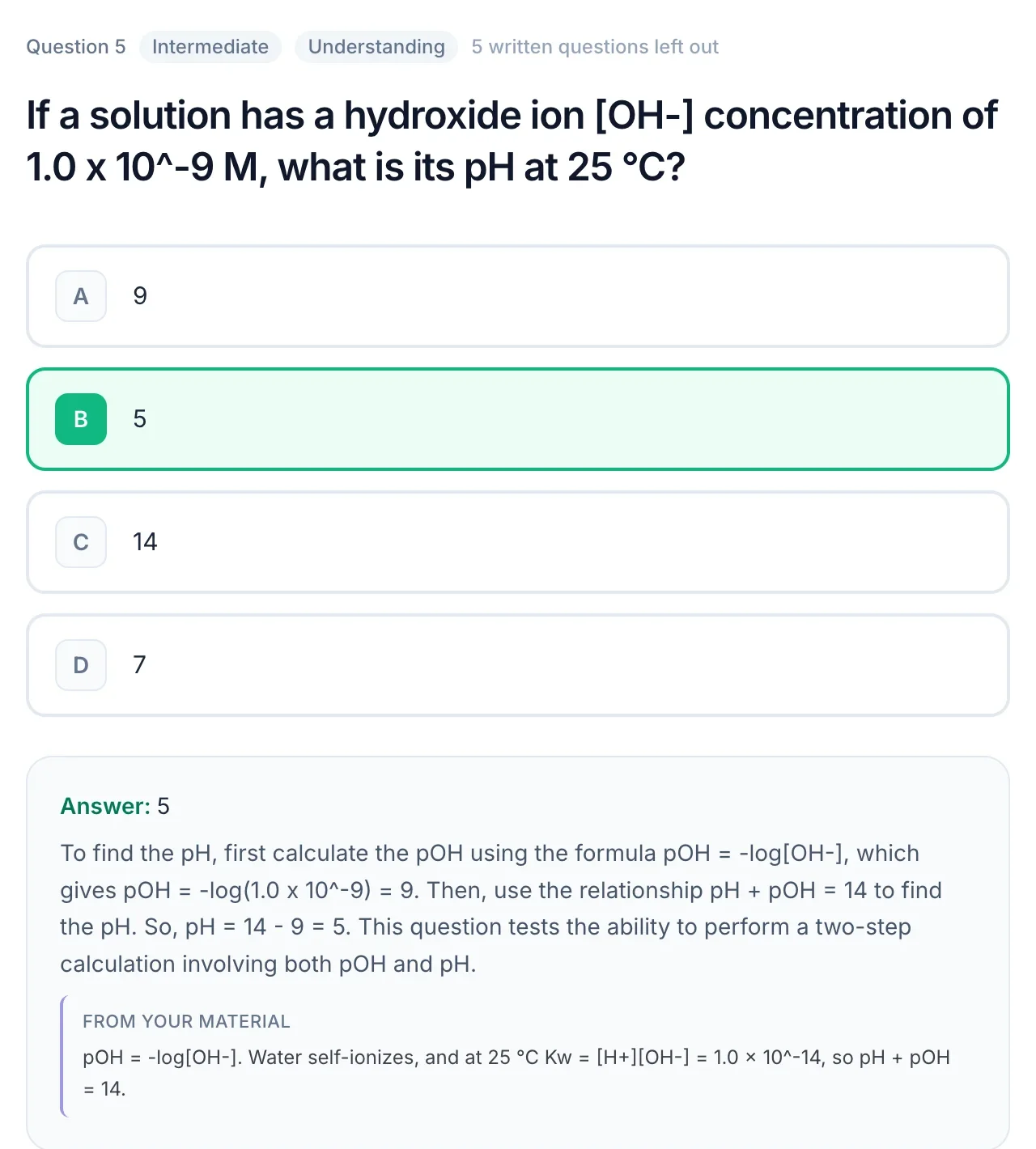
Examples
Example CPA practice questions and answers
Examples of what QuerySpark can generate from typical CPA review notes. They are illustrations, not AICPA exam items.
FAR, from an inventory lesson
A company starts the year with 100 units costing $10 each and buys 200 units at $12 each. It sells 150 units. Using FIFO in a periodic system, what is cost of goods sold?
- A.$1,500
- B.$1,600
- C.$1,700
- D.$1,800
Answer: B. FIFO sells the oldest units first: 100 × $10 + 50 × $12 = $1,600. $1,800 is the LIFO answer (150 × $12) and $1,700 is weighted average ($3,400 ÷ 300 units × 150).
AUD, from an audit evidence lesson
An auditor selects a sample of shipping documents and traces each one to a recorded sale in the sales journal. Which assertion does this test most directly?
- A.Occurrence
- B.Completeness
- C.Valuation
- D.Rights and obligations
Answer: B. Tracing from source documents forward into the records tests whether every shipment was recorded, which is completeness. Vouching from recorded sales back to shipping documents would test occurrence.
REG, from a business law lesson
Under the UCC statute of frauds, a contract for the sale of goods generally must be evidenced by a writing to be enforceable when the price is:
- A.$500 or more
- B.$1,000 or more
- C.$5,000 or more
- D.Any amount
Answer: A. UCC Article 2 requires a writing signed by the party to be charged for sales of goods priced at $500 or more, subject to exceptions such as specially manufactured goods and goods already paid for or accepted.
ISC, from a SOC engagements lesson
A user entity's auditor needs evidence that a service organization's controls relevant to financial reporting operated effectively over a period. Which report is most appropriate?
- A.SOC 1 Type 2
- B.SOC 2 Type 1
- C.SOC 3
- D.An agreed-upon procedures report
Answer: A. SOC 1 reports cover controls relevant to user entities' financial reporting, and a Type 2 report includes tests of operating effectiveness over a period. SOC 2 and SOC 3 address trust services criteria such as security and availability.
Popular study sets
Made with QuerySpark from real course material. Open one and start studying, no account needed.
Frequently asked questions
There is no set number. Many candidates aim to work every multiple choice question in their review course at least once and redo the ones they missed, often 40 to 80 a day during review plus a few simulations each week. Accuracy on questions you have not seen before is a better signal than the total.
Pick a section order, follow a review course lesson by lesson, test yourself on each lesson the same day, practice simulations weekly and finish with mixed questions and a mock exam. Keep a miss log and review it daily in the final two weeks. QuerySpark helps with the same-day testing and the miss log.
Partly. The AICPA Blueprints listing every tested topic and the AICPA sample tests are free, and your university textbooks cover much of the content. QuerySpark's free plan includes 20 generated questions a month after the trial. Most candidates still find a paid review course worthwhile for its simulation bank.
The AICPA publishes free sample tests for each section, including FAR, with multiple choice questions and simulations, and many review courses offer free trials. QuerySpark also lets you paste up to 6,000 characters of FAR notes and get questions with explanations 3 times a day without an account.
No. It writes multiple choice and short-answer questions with one correct answer each. Task-based simulations, with exhibits, research and document review, should be practiced in your review course or the AICPA sample tests.
It depends on your background. Many candidates find FAR the most demanding because of its breadth, while others struggle more with AUD's judgment questions or REG's detail. The AICPA publishes pass rates by section each quarter if you want to compare.
Yes, that is the intended use. Generate extra questions from the notes and outlines you make while studying, focused on topics you keep missing. Only upload material you are entitled to use for your own study.
Yes, through CSV. Export the set or flashcards as CSV and import the file into Quizlet or Anki. There is no direct sync. PDF and Word exports are also available for printing.
Still stuck? Email us.
Start Generating CPA Practice Questions Today
Get started with a free 3-day Pro trial: upload your first review outline and see the difference. No credit card required.

Explore More Study Tools
More ways to turn CPA review notes into practice.