AI Quiz Generator for Law Students: Law School Practice Questions from Your Outlines
Upload your outline, case briefs or a class recording and test yourself on the rules, elements and holdings before you sit down to write practice essays. Every answer comes with an explanation.
- No credit card
- Free plan after the trial
- Cancel anytime
Drop a PDF, slides or notes
or paste a YouTube link
Quick answer
Can AI make law school practice questions from your outline?
Yes. Upload your outline, case briefs or casebook notes and QuerySpark writes multiple choice questions on the rules, elements and holdings in them, each with an explanation, usually 10 to 20 per set in about a minute. That is a fast way to check black-letter law before you write practice essays. It does not grade essays and it is not an MBE question bank, so keep your professor's past exams and released bar questions for the real format.
- Rule, element and short hypothetical questions
- Works from outlines, case briefs, casebook PDFs and lecture recordings
- Flashcards for elements and exceptions
- 3-day Pro trial, no card needed
Made for the exams and classes you are studying for
- NCLEX
- MCAT
- AP Biology
- USMLE Step 1
- CPA
- AP US History
- Pharmacology
- Anatomy and Physiology
- LSAT
- CompTIA Security+
- Organic Chemistry
- Microeconomics
- GCSE Science
- AP Psychology
- Bar exam
- Pathophysiology
- Calculus
- IB Biology
- World History
- Physics
- Biochemistry
- Statistics
- PMP
- Intro to Psychology
One upload
Every way to study, made from your notes
Each upload gives you practice questions, flashcards, a study guide and practice tests. Pick whichever suits the day.
Study plan
How to study for law school exams
Law school grades usually rest on one final exam per course, so the semester is preparation for a single timed performance. Four steps that work for 1L and upper-level courses alike.
- 01
Write your own outline as you go
Condense each week's cases into rules, elements and exceptions. Outlining is studying; a borrowed outline is a reference, not a substitute.
- 02
Test the rules with multiple choice
Upload the outline section for a topic and answer a set. If you cannot pick the right rule from four options, you will struggle to apply it in a hypothetical.
- 03
Write timed answers to old exams
Many professors make past exams available, sometimes with model answers. Write under time, compare, and take questions to office hours.
- 04
Build an attack outline
In the final weeks, cut your outline down to a checklist of issues in the order you would spot them, then run practice fact patterns through it.
Exam format
Are law school exams multiple choice?
Mostly not. Most law school finals are built around essay hypotheticals: a long fact pattern in which you spot the issues and analyze each one, often in IRAC order. Some professors add a multiple choice section, especially in courses heavy on precise rules such as Evidence, Civil Procedure and Property.
That makes multiple choice practice a means, not the end. If you know a rule precisely enough to pick it out of four close options, your essay time goes to analysis instead of trying to remember the elements. It is also direct practice for the bar exam, where the MBE is entirely multiple choice.
Studying for a closed-book exam? Turn your attack outline into flashcards and review elements and exceptions daily in the weeks before finals.
Bar prep
Bar exam practice questions: where generated questions fit
The best MBE practice is released NCBE questions, available from NCBE and through many commercial bar courses, because the exam's wording is distinctive. Generated questions earn their place earlier: drilling the rules in your bar outline so you recognize them when NCBE phrases them its own way.
NCBE's NextGen bar exam is being introduced jurisdiction by jurisdiction, so check which exam your jurisdiction administers and when before you plan.
| MBE subject | Rules worth drilling from your outline |
|---|---|
| Civil Procedure | Personal and subject matter jurisdiction, Erie, joinder, preclusion |
| Constitutional Law | Standing, levels of scrutiny, the Commerce Clause, First Amendment |
| Contracts | Formation, consideration, statute of frauds, UCC Article 2, remedies |
| Criminal Law and Procedure | Homicide, mens rea, inchoate crimes, Fourth and Fifth Amendment |
| Evidence | Relevance, hearsay and its exceptions, character evidence, impeachment |
| Real Property | Estates and future interests, recording acts, easements, landlord and tenant |
| Torts | Negligence, intentional torts, strict and products liability, defamation |
After each set
How to review missed law school questions
Name the element. Most misses come down to one element or one exception you forgot. Write the full rule statement out again with that element underlined.
Check which body of law applies.Common law or UCC, majority or minority rule, federal rules or your state's: many wrong answers are correct under a different regime.
Feed it back into your outline. If a question exposed a gap, the fix belongs in your outline, not just in your head. Then regenerate a set from the corrected section.

Question types
What QuerySpark writes for law students
Contracts, Torts, Civil Procedure, Property, Criminal Law, Constitutional Law, Evidence and Professional Responsibility: questions follow whichever outline you upload.
Rule and element questions
Which element is missing, which test applies, which exception fits: written from the rules in your outline.
Short hypotheticals
A few sentences of facts followed by a question on the likely outcome, to practice recognizing a rule in context.
Case holdings
Questions on the holding and reasoning of the cases in your briefs, useful before class and before the exam.
Essay prompts
Prompts for writing out an analysis, with an explanation of the relevant rule. QuerySpark does not grade your essay.
Flashcards for elements
Elements, exceptions and multi-part tests as flashcards with spaced repetition, ideal for closed-book exams.
From lecture recordings
Upload a class recording up to 25 MB and get questions from the transcript, so the points your professor stressed get tested.
Honest limits
What it is not: an essay grader or MBE bank
It does not grade essay answers or predict how your professor would score them. Timed practice on past exams, compared against model answers, is still the core of law school exam prep.
It is not an MBE question bank and is not affiliated with NCBE. Generated questions do not match the bar exam's distinctive wording, so use released NCBE questions for format practice.
Questions follow your material. If your outline mixes common law, UCC and Restatement rules without labels, questions can blur them too, so label which rule you are using.
Questions are short and self-contained with one correct answer. Long, multi-issue fact patterns are outside what it writes.
Examples
Example law school practice questions with answers
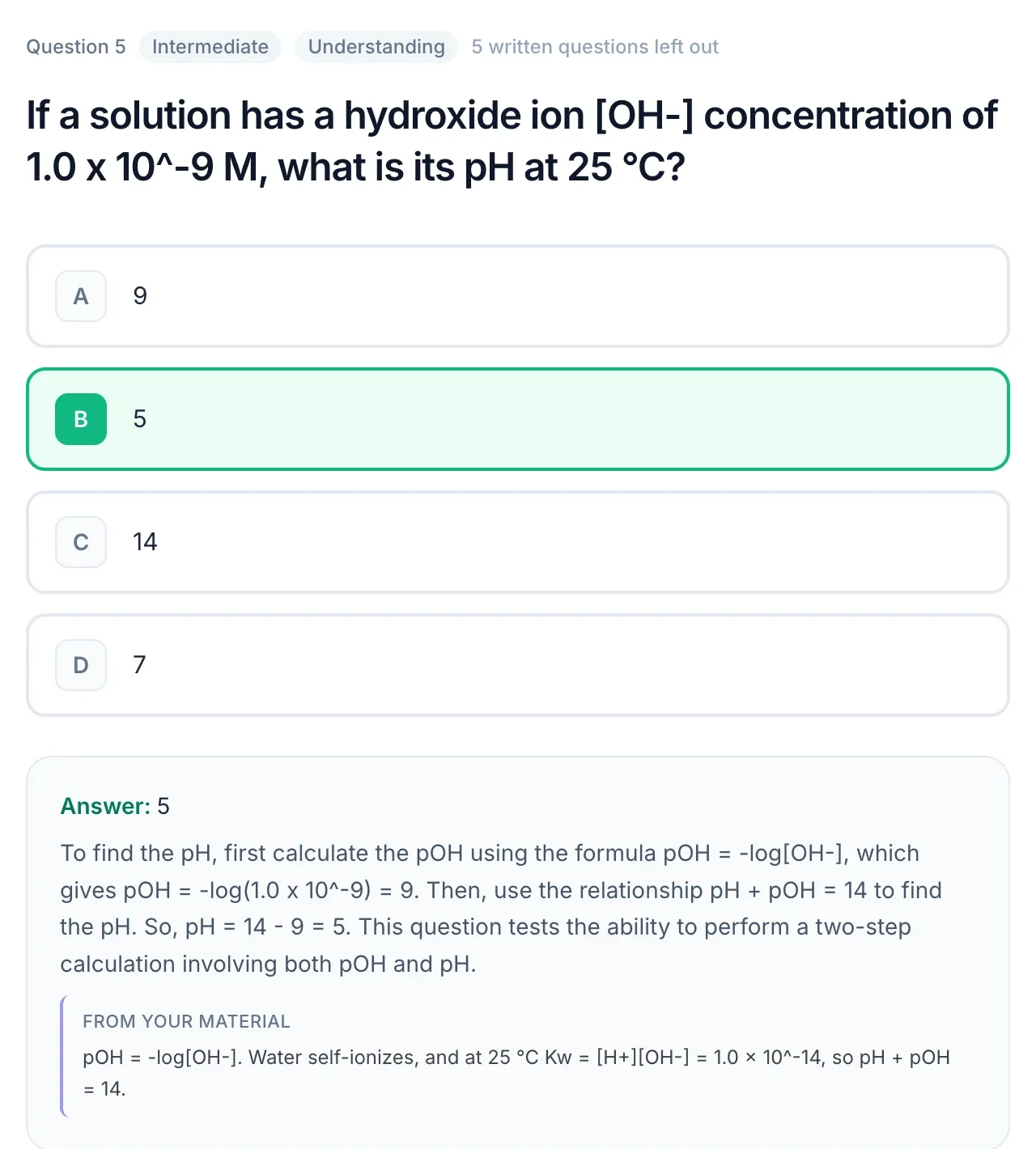
Examples of what QuerySpark can generate from typical 1L and bar outlines. They are illustrations, not NCBE items, and they state general rules; your jurisdiction or professor may differ.
Contracts, from an offer and acceptance outline
A offers in writing to sell B her house for $300,000. B replies, "I accept, provided you include the furniture." Under the common law, B's reply is best described as:
- A.An acceptance, with the furniture term treated as a mere proposal
- B.A counteroffer that rejects A's offer
- C.An acceptance that binds A to include the furniture
- D.An option contract
Answer: B. Under the common law mirror image rule, which governs sales of land, an acceptance must match the offer. A conditional acceptance is a counteroffer, which terminates the original offer. The UCC's more flexible rules on additional terms apply only to sales of goods.
Torts, from a negligence outline
D negligently bumps P's car at low speed. Because P has a rare bone condition, P suffers severe fractures that an average person would not have suffered. D is most likely liable for:
- A.Only the injuries an average person would have suffered
- B.All of P's injuries
- C.Nothing, because the severity of harm was unforeseeable
- D.P's injuries only if D knew of P's condition
Answer: B. Under the eggshell plaintiff rule, a defendant takes the plaintiff as found. Once some injury is foreseeable, the defendant is liable for its full extent, even when it is far worse than expected.
Evidence, from a hearsay outline
In a trial over a car accident, a witness testifies that a bystander said, while watching the collision, "The blue car just ran the red light." The bystander is unavailable. Which hearsay exception best fits?
- A.Present sense impression
- B.Dying declaration
- C.Statement against interest
- D.Former testimony
Answer: A. A statement describing an event made while or immediately after the declarant perceived it is a present sense impression under FRE 803(1), which applies whether or not the declarant is available. The other three are FRE 804 exceptions that need circumstances not present here.
Civil Procedure, from a jurisdiction outline
A citizen of Texas sues a citizen of Texas and a citizen of Ohio in federal court on a state-law claim for $100,000. Does the court have diversity jurisdiction?
- A.Yes, because the amount in controversy exceeds $75,000
- B.Yes, because at least one defendant is diverse from the plaintiff
- C.No, because complete diversity is lacking
- D.No, because state-law claims must be filed in state court
Answer: C. Diversity jurisdiction under 28 U.S.C. § 1332 requires complete diversity, meaning no plaintiff shares citizenship with any defendant, plus more than $75,000 in controversy. The Texas defendant destroys complete diversity.
Popular study sets
Made with QuerySpark from real course material. Open one and start studying, no account needed.
Frequently asked questions
Write your own outline during the semester, test yourself on the rules in it, and spend the final weeks writing timed answers to your professor's past exams and comparing them with model answers. Condense the outline into an attack outline you can run fact patterns through. QuerySpark helps with the rule-testing step.
Mostly not. Most law school finals center on essay hypotheticals, where you spot issues in a long fact pattern and analyze them. Some professors add a multiple choice section, and the MBE portion of the bar exam is entirely multiple choice.
Start with your own professor, since many make past exams available, sometimes with model answers, and they show what that professor rewards. Study aids such as the Examples & Explanations series offer worked hypotheticals by subject. QuerySpark adds multiple choice drills written from your own outline.
Yes, for specific jobs: testing yourself on rules, turning outlines into flashcards and checking your understanding of a case. It does not replace writing your own outline or practicing timed essays. Check your school's and professor's policy on AI use, especially for graded work.
For drilling rules, yes: upload your bar outlines and test yourself subject by subject. For MBE format practice, use released NCBE questions, available from NCBE and through many commercial bar courses, because generated questions do not match the exam's wording.
It writes short fact patterns that ask which issue or rule applies, which trains recognition. It does not write full multi-issue exam hypotheticals or grade your written analysis, so practice those with past exams.
Memorize an attack outline: the issues in the order you would spot them, with the elements of each rule. Flashcards with spaced repetition work well for elements and exceptions, and timed practice with old exams shows whether you can recall them under pressure.
Yes. PDFs, Word documents, PowerPoint, photos of neat handwritten notes, lecture recordings up to 25 MB and pasted text all work. Well-structured outlines produce better questions than raw opinion text.
Yes. Uploads are private by default, never used to train AI models, and you can delete them at any time.
Still stuck? Email us.
Start Generating Law Practice Questions Today
Upload your first case brief or outline and see the difference. Free to start, no credit card required.