
AI Question Generator for Medical Students: USMLE-Style Practice Questions from Your Lectures
Turn lecture slides, recordings and textbook chapters into clinical-vignette questions with an explanation for every answer. Learn each block as it happens, then bring that habit into board prep.
- No credit card
- Free plan after the trial
- Cancel anytime
Drop a PDF, slides or notes
or paste a YouTube link
Quick answer
Can AI write USMLE-style practice questions from your lectures?
Yes. QuerySpark turns the slides, recordings and chapters you upload into clinical-vignette multiple choice questions with an explanation for each answer, usually 10 to 20 per set in about a minute. It is built for learning your own course content in the preclinical years and on rotations. It is not an official USMLE or NBME question bank, so keep a board question bank and NBME self-assessments for exam prep.
- Vignette questions for Step 1, Step 2 CK, COMLEX and shelf content
- An explanation for every answer; most show the source passage
- Works from slides, PDFs and lecture recordings
- CSV export that Anki can import
Made for the exams and classes you are studying for
- NCLEX
- MCAT
- AP Biology
- USMLE Step 1
- CPA
- AP US History
- Pharmacology
- Anatomy and Physiology
- LSAT
- CompTIA Security+
- Organic Chemistry
- Microeconomics
- GCSE Science
- AP Psychology
- Bar exam
- Pathophysiology
- Calculus
- IB Biology
- World History
- Physics
- Biochemistry
- Statistics
- PMP
- Intro to Psychology
One upload
Every way to study, made from your notes
Each upload gives you practice questions, flashcards, a study guide and practice tests. Pick whichever suits the day.
Daily volume
How many practice questions a day in medical school?
It depends on the phase. During preclinical blocks, 20 to 40 questions a day on current lectures is sustainable alongside class. In dedicated board study, many students do two or three timed blocks of 40 from a question bank, then spend as long again reviewing the explanations. On clerkships, 20 to 40 a day around clinical hours keeps shelf prep moving.
The trap in the preclinical years is waiting until dedicated to start questions at all. Testing yourself on each lecture soon after you hear it is where a generator like QuerySpark earns its place: board banks are organized by system, not by your school's lecture order, and they do not cover your faculty's favorite details.
| Phase | Questions a day | Where the questions come from |
|---|---|---|
| Preclinical blocks (M1 and M2) | 20 to 40 | QuerySpark sets from this week's lectures; a board question bank by organ system once you start one |
| Dedicated Step 1 or COMLEX Level 1 | 80 to 120, in timed blocks | A board question bank and NBME self-assessments; QuerySpark on your notes for systems that keep scoring low |
| Clerkships and shelf exams | 20 to 40 | A clinical question bank for the rotation; QuerySpark from rotation notes and assigned readings |
| Dedicated Step 2 CK | 80 to 120, in timed blocks | Board question bank and self-assessments; QuerySpark to relearn weak topics from your own notes |
Common ranges students use, not official guidance. Adjust them to your schedule and your scores.
Study plan
How to study in medical school with practice questions
A loop that works from your first block through Step 2 CK. QuerySpark covers the lecture-level steps; official and commercial board resources cover the rest.
- 01
Question each lecture the same week
Generate a set from the slides or the recording within a few days of the lecture. Retrieval soon after first exposure makes block-exam review much faster.
- 02
Make cards from misses, not from everything
Converting a whole deck into flashcards creates a review pile you will never finish. Turn the questions you got wrong into cards and keep the deck small.
- 03
Start board questions by system
Many students begin a board question bank during their second year, doing questions on the system they are covering in class rather than saving them all for dedicated.
- 04
Let self-assessments steer dedicated
Official NBME self-assessments show where you stand. Use your weakest systems to decide what to relearn, then go back to the lectures where you learned them.
After each block
How to review missed USMLE-style questions
Vignettes usually test two steps: recognize the condition, then answer something about it (mechanism, next step, complication). For every miss, name the step that failed. Missing the diagnosis means you need pattern recognition; knowing the diagnosis but missing the mechanism means you need content.
Read the explanation for every option, not only the correct one. Each wrong option is usually a real condition or drug that the vignette was built to rule out, so it is a free second question.
Write one learning point per miss in a sentence you could put on a flashcard. If the gap traces back to a lecture, upload that lecture and generate a focused set; most QuerySpark questions show the passage they came from, so you can see exactly what you missed.
Question types
What QuerySpark writes for medical students
Anatomy, physiology, biochemistry, pharmacology, pathology, microbiology, immunology and biostatistics: whatever the lecture covers, the questions follow it.
Clinical vignettes
A patient presentation with history, exam and labs, followed by one best-answer question, written from the disease content in your lectures.
Mechanism questions
Biochemistry, physiology and pathology asked the way boards ask them: which enzyme, which receptor, which mechanism explains this finding.
Pharmacology
Mechanism of action, adverse effects, interactions and contraindications for the drugs in your pharm lectures.
From lecture recordings
Upload a recording up to 25 MB, or link a YouTube lecture that has captions, and get questions from the transcript.
CSV for Anki
Export questions or flashcards as CSV and import them into Anki. PDF, Word and Markdown exports are also available.
Spaced repetition built in
Prefer one app? Flashcards made from the same lecture are scheduled with spaced repetition inside QuerySpark.
Honest limits
What it is not: a USMLE question bank
It is not an official USMLE, COMLEX or NBME question bank and is not affiliated with NBME, FSMB or NBOME. Questions are not calibrated to board difficulty and cannot predict a score.
Questions are text only. It does not produce image-based items such as histology slides, radiographs or ECG strips, which you will meet on the boards.
Each question has one correct answer, written from your material. If a slide is wrong or out of date, the question can be too, so check surprising answers against a standard reference.
Remove patient identifiers from anything you upload from clinical work.
Examples
Example USMLE-style practice questions with explanations
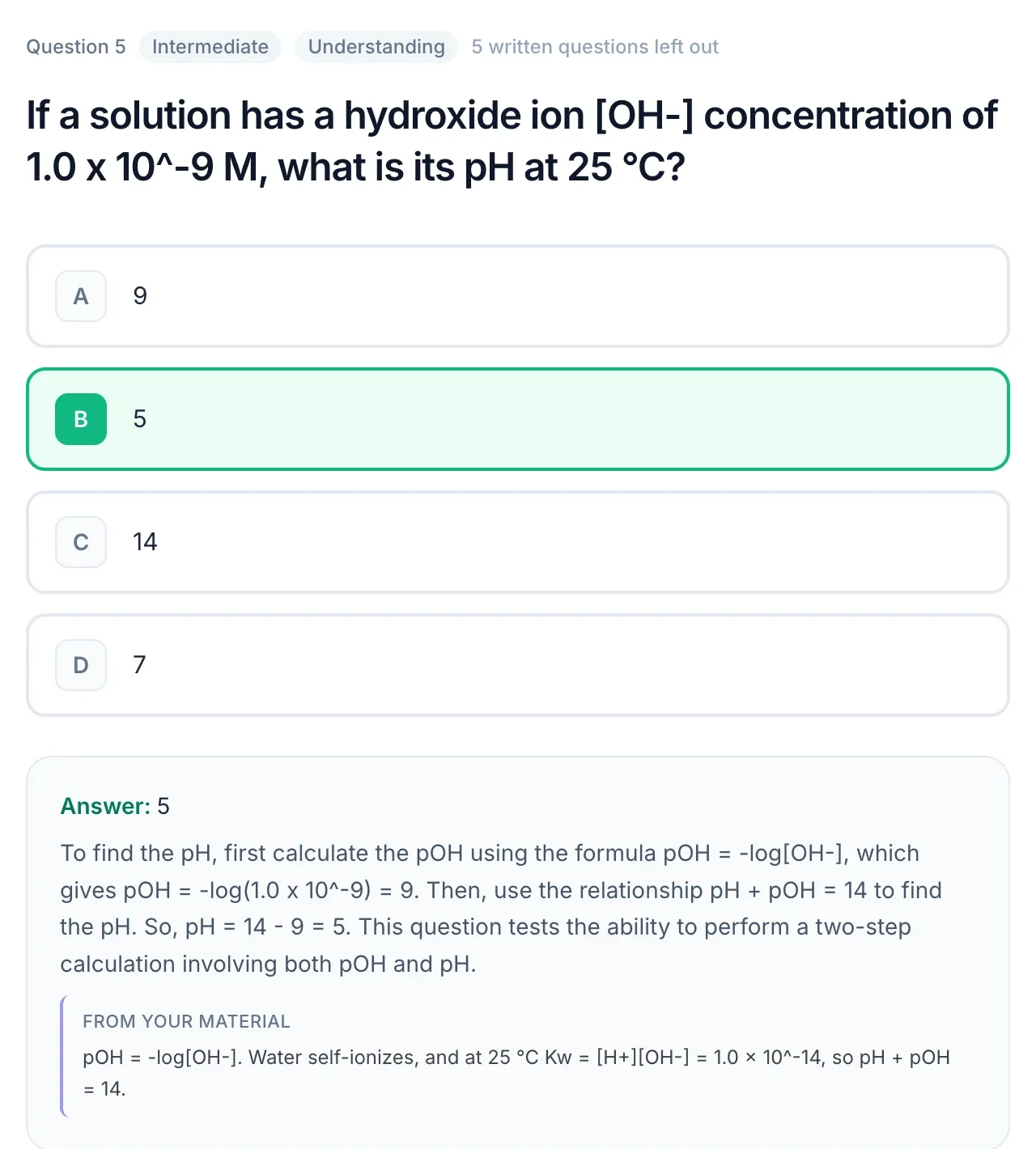
Examples of what QuerySpark can generate from typical preclinical lecture material. They are illustrations, not official USMLE or NBME items.
Renal pathology, from a nephritic syndrome lecture
A 7-year-old boy is brought in with cola-colored urine and puffy eyelids. Three weeks ago he had a sore throat. His blood pressure is elevated. Which finding is most likely on renal biopsy?
- A.Linear IgG deposits along the glomerular basement membrane
- B.Subepithelial immune complex humps on electron microscopy
- C.Apple-green birefringence with Congo red stain
- D.Effacement of podocyte foot processes with no deposits
Answer: B. Hematuria, edema and hypertension a few weeks after strep pharyngitis point to poststreptococcal glomerulonephritis, which shows subepithelial humps on electron microscopy. Linear IgG suggests anti-GBM disease, Congo red birefringence suggests amyloidosis, and isolated foot process effacement suggests minimal change disease.
Pharmacology, from an antihypertensives lecture
A 58-year-old man started on lisinopril for hypertension develops a persistent dry cough. Which mechanism best explains the cough?
- A.Accumulation of bradykinin from reduced breakdown
- B.Increased angiotensin II activity in the airways
- C.Blockade of beta-2 receptors in bronchial smooth muscle
- D.Increased aldosterone secretion
Answer: A. ACE also breaks down bradykinin, so inhibiting it lets bradykinin build up, causing cough and, rarely, angioedema. Angiotensin II receptor blockers do not have this effect, which is why patients are often switched to one.
Biochemistry, from a glycogen storage disease lecture
A 4-month-old has hypoglycemia between feeds, hepatomegaly, lactic acidosis and an elevated uric acid level. Which enzyme is most likely deficient?
- A.Glucose-6-phosphatase
- B.Lysosomal acid alpha-glucosidase
- C.Muscle glycogen phosphorylase
- D.Glycogen debranching enzyme
Answer: A. Von Gierke disease (type I) blocks the last step of both glycogenolysis and gluconeogenesis, causing severe fasting hypoglycemia with lactic acidosis, hyperuricemia and hepatomegaly. Pompe disease mainly affects the heart, McArdle disease affects skeletal muscle, and Cori disease causes milder hypoglycemia with normal lactate.
Microbiology, from a GI infections lecture
A patient treated with clindamycin for a skin infection develops profuse watery diarrhea a week later. Which organism is the most likely cause?
- A.Clostridioides difficile
- B.Vibrio cholerae
- C.Giardia lamblia
- D.Salmonella enterica
Answer: A. Antibiotics, clindamycin in particular, disrupt normal gut flora and allow C. difficile to overgrow. Its toxins damage the colonic mucosa, which can form pseudomembranes.
Your study stack
QuerySpark vs a board question bank vs Anki
They do different jobs. Most students who use QuerySpark keep a board question bank too.
| QuerySpark | Board question bank | Anki | |
|---|---|---|---|
| Questions written from your own lectures | Yes | No | Only if you write the cards |
| Items written by board-prep authors | No | Yes | Premade community decks |
| Image-based questions | No | Yes | Depends on the deck |
| Compare your score with other users | No | Yes | No |
| Best for | Block exams and relearning weak topics | Board-style practice and readiness | Long-term memorization |
Already on Anki? Export your QuerySpark set as CSV and import it. See the flashcard generator for decks made straight from a lecture.
How it works
How to turn a lecture into practice questions
Upload one lecture at a time (PDF, PowerPoint, Word or a recording), generate a set, then answer and read the explanations. The free plan includes 20 questions and 10 PDF pages a month after a 3-day Pro trial; the Student plan is $9/month for 1,000 questions.
Popular study sets
Made with QuerySpark from real course material. Open one and start studying, no account needed.
Frequently asked questions
During dedicated Step 1 or Step 2 CK study, many students do two or three timed blocks of 40, about 80 to 120 questions a day, plus time to review them. During the school year or on rotations, 20 to 40 a day is more common. Review time per question matters more than the count.
Most students combine a board question bank, a concise review resource and spaced repetition, then use NBME self-assessments during dedicated study to track readiness. Starting questions by system in the preclinical years means dedicated becomes review rather than first exposure. QuerySpark helps with the earlier part: testing yourself on your own lectures as you go.
Yes. USMLE Step 1 has been reported as pass/fail since January 2022. Step 2 CK is still scored, which is one reason students keep up strong question habits after Step 1.
The official USMLE website publishes free sample questions for each Step, and many question banks offer free trials. QuerySpark also lets you paste up to 6,000 characters of lecture notes and get questions with explanations 3 times a day without an account.
Yes. It writes vignette-style single best answer questions, a patient presentation followed by a question on diagnosis, mechanism or next step, from the material you upload. They are written from your notes rather than by board item writers, so treat them as content practice, not a readiness measure.
Yes. Export as CSV and import the file into Anki, mapping the question to the front and the explanation to the back. There is no direct Anki sync. PDF, Word, Markdown and JSON exports are also available.
No. Those are expert-written board question banks with image-based items and performance compared with other users. QuerySpark writes questions from your own lectures and notes, which those banks do not cover, so it suits block exams and relearning weak topics.
It works for the content: upload the material for a system or clerkship and you get practice questions on it. It is not built around the COMLEX or NBME subject exam blueprints, so use official and commercial resources for format practice.
Accuracy follows the source. Every answer has an explanation, and most questions show the passage they were written from so you can check it. Errors in your slides can carry into the questions, so verify anything that conflicts with a standard reference.
Yes. Uploads are private by default, never used to train AI models and can be deleted at any time. De-identify any patient information before uploading.
Still stuck? Email us.
Start Generating Medical Practice Questions Today
Upload your first lecture and get vignette-style questions in about a minute. Free to start, no credit card required.

Explore More Study Tools
More ways to study your own lectures with QuerySpark.