
AI Quiz Generator for the MCAT: MCAT Practice Questions by Topic
Finish a chapter, upload it, and check yourself on it in a minute. QuerySpark turns review books, class slides and your own notes into Bio/Biochem, Chem/Phys and Psych/Soc questions with an explanation for every answer.
- No credit card
- Free plan after the trial
- Cancel anytime
Drop a PDF, slides or notes
or paste a YouTube link
Quick answer
Can you make MCAT practice questions by topic with AI?
Yes. Upload a review-book chapter, your class slides or notes from a video lecture and QuerySpark writes multiple choice questions on that topic with an explanation for each answer, usually 10 to 20 per set in about a minute. That makes it a quick way to check content review one topic at a time. It does not write passage-based sets or full-length exams, so keep AAMC official practice for those.
- Topic questions for Bio/Biochem, Chem/Phys and Psych/Soc
- An explanation for every answer; most show the source passage
- Flashcards for amino acids, equations and Psych/Soc terms
- 3-day Pro trial, no card needed
Made for the exams and classes you are studying for
- NCLEX
- MCAT
- AP Biology
- USMLE Step 1
- CPA
- AP US History
- Pharmacology
- Anatomy and Physiology
- LSAT
- CompTIA Security+
- Organic Chemistry
- Microeconomics
- GCSE Science
- AP Psychology
- Bar exam
- Pathophysiology
- Calculus
- IB Biology
- World History
- Physics
- Biochemistry
- Statistics
- PMP
- Intro to Psychology
One upload
Every way to study, made from your notes
Each upload gives you practice questions, flashcards, a study guide and practice tests. Pick whichever suits the day.
Daily volume
How many MCAT practice questions per day?
Fewer than you might think early on, and more structured later. During content review, 20 to 50 questions on what you studied that day is enough: you are checking understanding, not building stamina. Doing hundreds of discrete questions on topics you have not reviewed yet mostly measures what you do not know.
Once content is covered, count in passages and sections instead of questions. Timed passage sets train the skill the exam actually tests, which is applying content to an unfamiliar experiment. Save the official AAMC full-lengths for the final weeks, since they are the closest match to test day, and give each one a full review day.
| Phase | Daily practice | Where the questions come from |
|---|---|---|
| Content review | 20 to 50 topic questions | QuerySpark sets from each chapter you finish, plus your review book's end-of-chapter questions |
| Practice phase | Several passages or one timed section, then review | AAMC Section Bank and Question Packs or a commercial question bank; QuerySpark to patch the content gaps they expose |
| Final weeks | About one full-length a week, review days between | AAMC full-length practice exams; QuerySpark flashcards and short sets on topics that keep coming up in your miss log |
Common patterns students follow, not official guidance. Adjust them to your timeline and diagnostic.
Study plan
How to study for the MCAT
The MCAT has four sections: Biological and Biochemical Foundations of Living Systems, Chemical and Physical Foundations of Biological Systems, Critical Analysis and Reasoning Skills, and Psychological, Social, and Biological Foundations of Behavior. Plan around all four.
- 01
Diagnose, then plan by section
Take a diagnostic so you know which of the four sections needs the most time. Use the AAMC content outline as your checklist rather than the order of your review books.
- 02
Review content with retrieval
Read a chapter, then test yourself on it the same day. Generate a set from the chapter you just finished and redo the misses the next morning.
- 03
Move to timed passages
The MCAT is mostly passage-based, and reading experiments and figures under time is its own skill. Shift to passage practice once most content has been covered once.
- 04
Full-lengths with full reviews
Take full-length exams on test-day timing in the final weeks and spend as long reviewing as taking. Log every miss by topic and by reason.
Miss log
How to review missed MCAT questions
Give every miss a reason: content you did not know, data you misread in the passage or figure, or reasoning that went wrong under time. Many MCAT science questions can be answered from the passage itself, so if the answer was on screen, the fix is how you read, not more content.
For content misses, go back to the chapter, upload it and generate a fresh set on that topic only. Most QuerySpark questions show the passage they came from, so you can see which line in your review book you skimmed past.
For CARS misses, reread the passage and write the author's main point in one sentence before looking at the answer choices again. Then explain why your choice was wrong in the passage's own terms.

By section
MCAT practice questions by topic: what QuerySpark writes
Questions follow the material you upload, so a chapter on enzyme kinetics gives you enzyme kinetics. Watching video lectures instead? Turn a captioned YouTube lecture into a quiz.
Bio/Biochem
Enzyme kinetics, metabolism, amino acids, molecular biology and organ systems, from the chapter you upload.
Chem/Phys
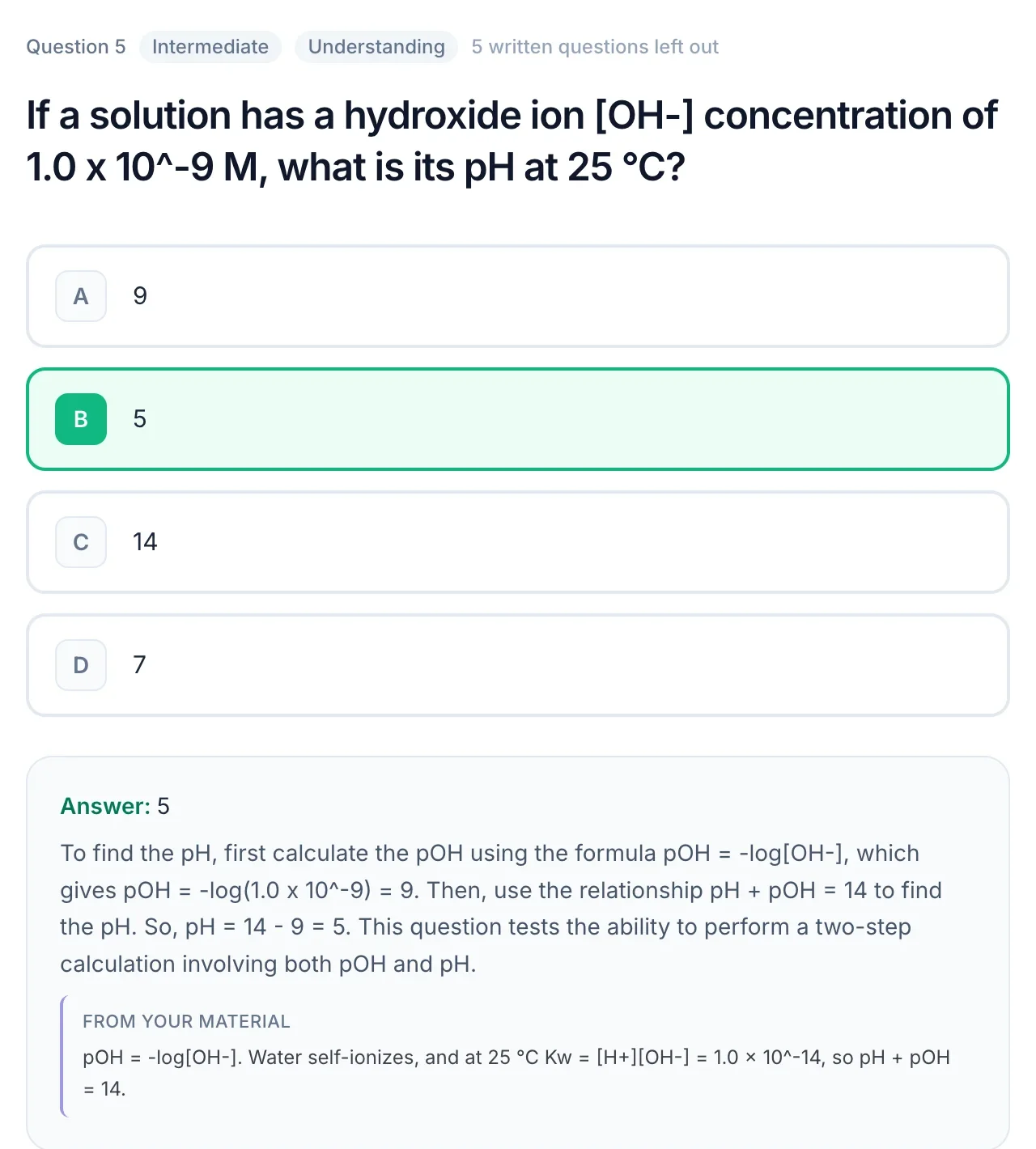
General chemistry, organic chemistry and physics, including short calculations such as pH, kinematics and circuits, each with an explanation.
Psych/Soc
Definition and application questions on the theories, studies and terms in the Psych/Soc material you review.
Reading checks for CARS
Questions on the main argument and claims of a text you paste. Good for active reading; not a substitute for timed CARS passages.
Flashcards with spaced repetition
Amino acid properties and abbreviations, equations and Psych/Soc terms, reviewed on a schedule so month-one content lasts.
CSV, PDF and Word export
Import the CSV into Anki next to the decks you already use, or print a set for a study session away from the screen.
Honest limits
What it is not: an MCAT question bank
QuerySpark is not affiliated with the AAMC. Questions are not calibrated to MCAT difficulty and cannot predict a score.
Questions are discrete and self-contained. It does not build MCAT-style passages with an experiment, figure or data table followed by a question set, which is most of the real exam.
CARS is a reasoning skill best trained on real passages under time. QuerySpark can check your comprehension of a text, but it is not a CARS question bank.
Each question has one correct answer and is written from your material, so an error in your notes can carry into a question.
Examples
Example MCAT practice questions with answers
Discrete questions of the kind QuerySpark can generate from typical MCAT review material. They are illustrations, not official AAMC items.
Biochemistry, from an amino acids chapter
Which amino acid side chain is most likely to carry a positive charge at physiological pH (7.4)?
- A.Aspartate
- B.Histidine
- C.Lysine
- D.Serine
Answer: C. Lysine's side chain has a pKa near 10.5, so it stays protonated and positive at pH 7.4. Histidine's side chain pKa is about 6, so it is mostly neutral at physiological pH; aspartate is negative and serine is uncharged.
Physics, from a kinematics chapter
A ball is dropped from rest. Ignoring air resistance and using g = 10 m/s², how fast is it moving after 2 seconds?
- A.5 m/s
- B.10 m/s
- C.20 m/s
- D.40 m/s
Answer: C. With constant acceleration from rest, v = at = 10 m/s² × 2 s = 20 m/s.
Psych/Soc, from a memory chapter
A student who studies in the same quiet library where she later takes her exam recalls more than classmates who studied elsewhere. Which concept best explains this?
- A.State-dependent memory
- B.Context-dependent memory
- C.Proactive interference
- D.Serial position effect
Answer: B. Recall improves when the environment at retrieval matches the environment at encoding. State-dependent memory refers to internal states such as mood or intoxication rather than the physical setting.
General chemistry, from an acids and bases chapter
What is the pH of a 0.001 M solution of HCl?
- A.1
- B.2
- C.3
- D.11
Answer: C. HCl is a strong acid and dissociates completely, so [H⁺] = 1 × 10⁻³ M and pH = 3.
Getting started
How to make MCAT questions from your review books
Upload one chapter at a time as a PDF, slides or notes, generate a set, and redo your misses the next day. After the 3-day Pro trial, the free plan covers 20 questions and 10 PDF pages a month; the Student plan ($9/month) covers 1,000 questions and 500 PDF pages a month.
Popular study sets
Made with QuerySpark from real course material. Open one and start studying, no account needed.
Frequently asked questions
In content review, 20 to 50 questions on the topics you studied that day is plenty, because the goal is checking understanding. In the practice phase, think in passages and timed sections instead, and near the end take about one full-length a week with a full day to review it.
Take a diagnostic, plan your time by section using the AAMC content outline, review content while testing yourself on each chapter, then move to timed passages and full-length exams. Review every miss and log it by topic and reason. QuerySpark is most useful during content review and for patching gaps found later.
Many students plan around three months of full-time study, or longer if studying part-time during school. The right length depends on your diagnostic score, your science background and your target score. Build in time for full-length exams and their reviews, not just content.
Yes. All four sections are multiple choice. Most questions are tied to passages, and the science sections also include some standalone questions.
The AAMC offers a free sample test, and Khan Academy's MCAT collection includes free practice passages. QuerySpark lets you paste up to 6,000 characters of notes and get questions with explanations 3 times a day without an account.
Not in the exam's format. QuerySpark writes self-contained questions on a topic, not a passage with a shared experiment or figure followed by several questions. Use AAMC material and a commercial question bank for passage practice, and QuerySpark for topic-by-topic content checks.
Only a little. It can quiz you on the main argument and claims of a text you paste, which supports active reading. CARS improvement mostly comes from timed practice on real passages and careful review of why each wrong answer is wrong.
Yes. Export questions or flashcards as CSV and import the file into Anki. There is no direct sync. PDF, Word and Markdown exports are also available.
No. AAMC's official practice is written by the test maker and is the closest thing to the real exam, and commercial question banks add large volumes of passage-based practice. QuerySpark writes questions from your own review books and notes to reinforce content. It is not affiliated with or endorsed by the AAMC.
Still stuck? Email us.
Start Generating MCAT Practice Questions Today
Get started with a free 3-day Pro trial: upload your first review chapter and see the difference. No credit card required.

Explore More Study Tools
More ways to turn MCAT content review into practice.